
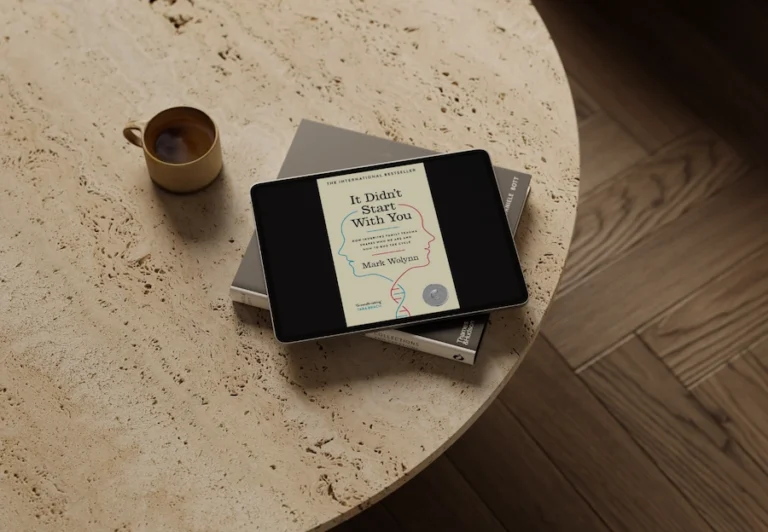
My first book review of the year, and it’s a controversial one…
It Didn’t Start With You by Mark Wolynn introduces how inherited family trauma shapes who we are and how to end the cycle.
Let me start off by saying that this book has been on my TBR pile for over a year.
Shameful I know. I bought it towards the end of 2020 after months of inner turmoil, pushing through mindset blocks and practising self-love.
So, I guess I’ve been putting off reading it because I knew it would be an uncomfortable and challenging read. As well as force me to face questions about my parents, how they parented me and how they were parented.
This would have opened up a whole new can of worms and even more questions and answers to add to my healing journey. I just didn’t think I was ready.
It can get emotionally exhausting constantly looking inwards and trying to better yourself.
Sometimes there comes a point when you just want to be.
You don’t have to spend each day being an ongoing self-improvement project.
But now that I’m finally living a life of remote work and travel, something I’ve dreamed about since March 2020, I feel happier and more fulfilled. As though I can tackle more discomfort and growth.
And so, reading It Didn’t Start With You by Mark Wolynn last month felt like the right time.
Here is my long-awaited book review, and the first one of the year.
I recommend reading through it with an open mind, as the ideas, facts, and research can seem slightly controversial.
The lowdown on It Didn’t Start With You
Essentially, this is a self-help book. It explores the psychology and science behind traumatic experiences and how it is passed down.
It Didn’t Start With You teaches us how to become aware of our inherited family trauma, but also encourages us to go on a healing journey so we can end the cycle of trauma that has been carried through generations.
Mark counterbalances the argument between nature versus nurture. He says that we can inherit trauma through the actions and behaviour of our parents, our grandparents or great-grandparents.
But on the other hand, he suggests that trauma lies deep inside the unconscious, and it can be passed on long before we are even conceived.
Hello, controversy!
Inherited trauma can look like unexplained depression, anxiety, fears, phobias, obsessive thoughts and PTSD.
Throughout the book, Mark provides us with the tools, exercises and questions we need to map out our core language and discover the obstacles that are holding us back so we can start to overcome them.
Spread over 14 chapters, It Didn’t Start With You is split up into 3 parts;
- Part 1 looks at the web of family trauma and the science of inherited behaviours
- Part 2 guides you through the four steps to constructing your core language map
- And part 3 explores the pathways and practices we can do in order to reconnect and heal
The core language map
In part 2, we are introduced to the core language map and how to construct it.
Your core language is the distinctive words and sentences used to describe our deepest fears. These fears are what provide us with clues leading to the source of unresolved trauma.
Each step in part 2 offers a new tool designed to extract new information.
The tools are:
- Core Descriptors: These are the adjectives and short descriptive phrases that reveal the unconscious feelings we hold toward our parents.
- Core Complaint: Our main issue, whether internalised or projected onto others. The core complaint is often derived from fragments of a traumatic experience.
- Core Sentence: A sentence that expresses the emotionally charged language of our deepest fear. It carries the remains of unresolved trauma from our early childhood or family history.
- Core Trauma: This is the unresolved trauma in our early childhood or family history. It can unconsciously affect our behaviours, choices, health and well-being.
Sounds pretty full-on, huh?
“… the very words alone, helpless and ruined were part of my personal language of fear. They echoed traumas that took place in my family history before I was born. Unbridled and unrestrained, these words reeled in my head and rattled my body.”
Mark Wolynn | It Didn’t Start With You
How easy is It Didn’t Start With You to read?
To be perfectly honest, I found It Didn’t Start With You pretty difficult to read, and because of this, I regularly zoned out. It’s full of scientific information, technical terms and complex language that can be hard to absorb and make sense of.
‘It Didn’t Start With You’ also consists of long chapters and bulky paragraphs, so it can be hard to digest at times.
There is a glossary included at the back with all the relevant core language terms used, which is useful to refer back to as you progress through the book.
Out of 10, I would give this book a difficulty rating of 7.5!
So if psychology and self-help books aren’t your usual type of book, then I would suggest reading an easier book in this genre, like The Gifts of Imperfection or Eliminate Negative Thinking, to help ease you in.
Trigger warning: It Didn’t Start With You contains some pretty heavy real-life case studies from Mark’s own patients that stem from the Holocaust, 9/11, slavery, the Khmer Rouge, and other tragic events.
So, a warning that this book can be triggering and heart-wrenching.
The 3 biggest key points and takeaways from It Didn’t Start With You
1 | The relationship we have with our parents
It Didn’t Start With You is filled with a few “mic-drop” quotes that really got me thinking about how I treat and view my own parents.
The book has really helped me see that I can’t change my parents, their past, their decisions or how they behave. But I can learn from their mistakes and change the way I hold them inside me.
We can’t go through life being angry, resentful or embarrassed by our parents because we need them in our lives. We cannot reject them.
Likewise, we cannot love one more than the other. They are both a part of us.
“When we pit one parent against each other, we go against the source of our own existence, and unconsciously create a rift inside ourselves. We forget that half of us comes from our mother and half comes from our father”
Mark Wolynn | It Didn’t Start With You
2 | Goes against the fundamentals of Stoicism
Mark suggests that inherited family trauma can not only affect the relationship we have with our parents, but also the intimate relationships we have and how we achieve our goals.
I’m currently learning more about Stoicism, but the ideas in this book go completely against the fundamentals of Stoicism.
This book says that our thoughts and actions are being controlled by unhealed family trauma, whereas Stoicism would say that you are the only one in control of your thoughts and only you have the power to change them.
As a result, I found it difficult to accept the ideas. I would be more inclined to agree that a Stoic approach is more useful because, regardless of our ancestors’ guilt or trauma, we can, if we put in the work, control and manage our thoughts and our perceptions about them.
“Not all behaviours expressed by us actually originate from us. They can easily belong to family members who came before us. We can merely be carrying the feelings for them or sharing them. We call these “identification feelings.”
Mark Wolynn | It Didn’t Start With You
3 | Healing sentences we can say to ourselves
Mark includes a collection of healing sentences to help support “the parts of ourselves that feel most vulnerable.” And I must admit, this was probably my favourite page in the whole book.
I’m trying to practice self-love more and more every day, and these healing sentences really help me be there for myself in tough or overwhelming situations.
I’ve made a note of them in my own Notion board so I can refer back to them whenever I need them and I encourage you to do the same.
Write them down somewhere in a notebook or on your computer or you can even bookmark this page. And when you start to repeat one or more of these healing sentences, place your hand on your chest, or other parts of the body and breath in deeply.
Healing sentences for when you need them most
- I’ve got you
- I’ll comfort you
- I’m here
- I’ll hold you
- Whenever you’re feeling scared or overwhelmed, I won’t leave you
- I’ll stay with you
- I’ll breathe with you until you’re calm

Final thoughts
Overall, I would give It Didn’t Start With You 3.5 out of 5 stars.
Although the scientific research and information that Mark proposes in his book are super interesting I found it hard to really get my teeth stuck into this book.
It’s not an enjoyable book. It’s often, at times, difficult to read, challenging and rather triggering.
And I found myself craving more fiction.
It also took me over a month to finish this book, as I just wasn’t excited to wake up in the morning to read it.
My reading suffered, and picking up this book, unfortunately, felt like a chore.
So, if you do choose to buy this book, I recommend reading it alongside a more light-hearted fiction book and saving this for when you feel in the mood.
I also felt the clients Mark chose to include in his book fit the narrative that the root cause of our issues comes from the traumas of our parents, grandparents and even great-grandparents. And unless identified and dealt with, the cycle cannot break.
But as a “wannabe” Stoic, I found it hard to accept that people aren’t in control of their thoughts and feelings. The fundamental practice in Stoicism is that the mind is the only thing you can control.
I would also say you need to have an open mind when reading this book, as it offers a new perspective on trauma and how it is inherited. Points you might not necessarily agree with.
On a more positive note, this book has given me some great guidance on how I can be more aware of the deep trauma and triggers that lie within my family.
This is super helpful for when and if I have kids. I can be more conscious of my behaviour and my attitude, and parent in a different way so I can “break the cycle.”
Until next week,
Thalia xx
Just a heads up — This post contains affiliate links. If you make a purchase using the links above, then I will be rewarded at no extra cost to you. Thank you, as always, for your support.



J.N. Kingma-Postma
I read the book in Dutch to write a review for the Dutch publishing agency. I really enjoyed reading your review. And I must admit I share your opinion. The information is interesting but I kept on wondering how it was possible that all clients healed so quickly. Thanks again for giving your opinion on the book. I review my books on Instagram and Facebook under Boekenpearls76.
Thalia
I’m so happy you enjoyed my review of this book! I have to admit, it was a difficult one to get through. I am always sceptical about this in books as the author will only include case studies of people who fit the narrative rather than who didn’t! Kind of like manifesting ? You never hear from the people it didn’t work for.
Sarah
Completely agree with your review of this book. I’ve just finished reading it, thinking it would provide me with some useful insights on dealing with the trauma within my own family, but the idea of not rejecting parents didn’t sit right with me. I’d argue that sometimes it’s necessary to distance yourself from people who have seriously harmed you (child abuse, for example, an issue which the book didn’t really deal with). This is what my mother did with her parents, and I’m grateful for that decision as it enabled her to protect me from their harmful behaviour later on.
Thalia
Hi Sarah, thank you for taking the time to read my book review and for adding to the conversation. I completely understand your perspective on the idea of not rejecting parents, and how it may not always be applicable in certain situations, especially in cases of abuse. I think it’s important to acknowledge that everyone’s experiences are unique and there is no one-size-fits-all solution when it comes to healing from trauma. Maybe Mark could have mentioned this more in his book.
Dr. E Douglas Pratt
Hello, Sarah. Your situation with your parents is similar to mine. One helpful thing I’ve learned, and keep practicing, is that I can distance from some threatening, unsafe people without rejecting them. I set clearer boundaries, which I can open up a bit or tighten up as needed… I can close a boundary knowing I can open it up again when I’m more safe. That’s a healing skil-set.
Thalia
Thanks for adding to the conversation!
Andrew Robertson
Hi Thalia, enjoyed reading your review even though you posted it over a year ago.
I both agree and disagree with some of your points. Respectfully, at the surface level, it’s not about you, whether or not it was difficult to read for you. That’s a subjective personal commentary. Your skill set is breaking down the core components into a simple understanding so any future reader can jump right in, thank you. Having just started reading the book, I really like it. I like the technical breakdown and deeper thought process using extreme client examples to drive home larger points (have you read Viktor Frankl’s book “Man’s Search for Meaning?”). Further, as a Christian Stoic, I do not see a conflict between the two, yet a natural balance in what we can achieve once we acknowledge and start the healing process. Yes, once we can identify, name, and accept, (think AA meetings) then we can mentally choose to move forward with the constructive healing tools outlined in the book. For me personally, the concept of bringing in the spiritual aspect allows one to be comforted and healed with a greater source that allows us to still be the child in the healing process while moving towards the adulting process to stand stronger as I take the mental stance of ‘never more.’ Keep up your good work,… Drew
Thalia
Hi Drew, thank you so much for taking the time to leave your comment. I have not yet read “Man’s Search for Meaning” but I hear it is an incredible read so I really need to add it to my TBR asap. It’s interesting that as a Christian Stoic, you didn’t see the conflict within the book. That is why I love to hear other people’s perspectives because we do all experience and view things differently. As I mentioned in my review, I did struggle with the language in the book so maybe I didn’t get a full grasp of what Mark was trying to get across, so thank you so much for adding to the conversation! I’ve learnt a lot from what you had to say and I hope others to do xx
Dr. E Douglas Pratt
Your review strikes me as well-organized, smart, and honest, Thalia. You seem like a genuine person with no “axe to grind”. So I can tell “It Didn’t Start With You” is right for me. Thank you and keep your helpful reviews comin’.
Thalia
Thank you so much for your kind words 😊