

I never thought I’d become a self-help girlie.
For most of my life, I was strictly a fiction reader. Beach reads, smut, literary novels, the occasional thriller, etc. You get the picture.
The self-help aisle always felt cringe to me, like it was for people who needed fixing.
Then lockdown happened.
I was stuck inside, doing work that was slowly burning me out, and someone in my life invited me to join a self-development book club they’d just started.
I said yes mostly because I had nothing else going on, and the first book we read cracked something open in me. I don’t even remember which one was first, but I remember the feeling of finishing it and realising that maybe this whole “personal growth” thing wasn’t as bad as I’d originally thought.
Maybe it was actually just a different way of asking the questions I’d been avoiding for years.
Long story short, I was hooked.
Now, 50+ self-help books later, I like to think I’m a bit of a pro when it comes to recommending the ones actually worth your time.
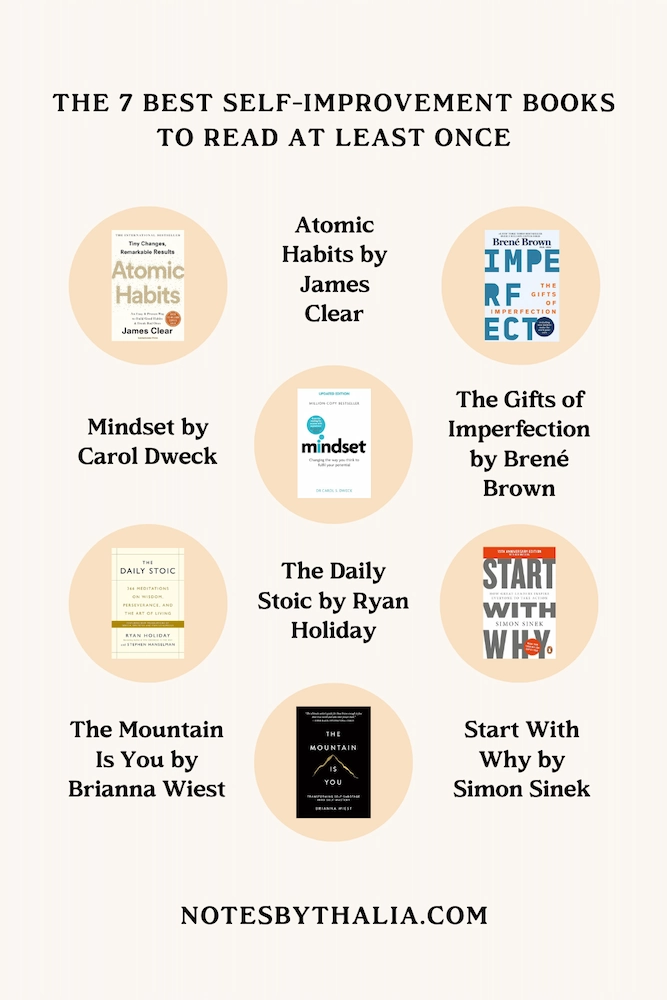
Here are the 5 best self-improvement books I’ve narrowed it down to.
P.S. If you’re new here, hey! I’m Thalia. I help burnt-out girlies like you build a life that’s aligned, magnetic, and unapologetically yours. Every week(ish), I share content on burnout recovery, self-development, finding joy, and career growth. Subscribe here so you never miss a debrief.
What are the best self-improvement books?
Not to sound dramatic, but each one of these books has probably changed my life in some way.
I read them at a time when I felt lost, anxious, and overwhelmed with the state of the world. They all allowed me to quiet the noise inside my head and focus only on what I can control — my mind, my goals, and the bigger picture.
So whenever anyone asks me, “What book should I read next?” I always point them to this list:
- The Mountain Is You by Brianna Wiest
- The Gifts of Imperfection by Brené Brown
- Start With Why by Simon Sinek
- The Daily Stoic by Ryan Holiday
- Atomic Habits by James Clear
Let’s break down why…
P.S. If you disagree or have your own recommendation to add to the list, drop a comment below.
1 | The Mountain Is You by Brianna Wiest
What it’s about:
The Mountain Is You is all about self-sabotage.
Specifically, the version of self-sabotage that nobody really talks about: the kind that’s not you deliberately ruining your life, but your mind trying (badly) to protect you from change and discomfort.
Brianna Wiest’s whole argument is that the mountain in your life, the thing you keep almost climbing and then backing away from, is actually you. And that real transformation isn’t about overriding your impulses with willpower. It’s about understanding why you keep getting in your own way in the first place.

Why it landed for me:
I picked up The Mountain Is You at a point when I was going through some big changes, both professionally and personally, and I noticed a pattern.
Every time things started moving forward, I’d quietly retreat back to my comfort zone. I’d tell myself I needed more time to think and that tomorrow would be a better day to start.
Classic procrastinator move. Honestly, I’ve been this way since uni, and when things were particularly overwhelming, I’d even use resources like write my essay to take the pressure off.
I’d always thought self-sabotage was something you did consciously to mess things up for yourself. But Brianna reframes it as a form of protection, which changed everything for me.
Procrastination wasn’t me being lazy. It was a signal that something underneath needed my attention.
Why I still recommend it:
This is the book for anyone who keeps trying to make a change but can’t quite figure out what’s stopping them.
It works whether you’re new to self-development or already elbow deep into it, because Brianna names behavioural patterns that most other books gloss over.
A quick heads up: it reads more like an essay than a handbook. Brianna doesn’t give you tidy bullet points or step-by-step actions at the end of chapters, which I found a bit frustrating by the end.
So if you’re someone who needs structure to absorb things, pair it with a journal and pull out your own takeaways as you go. The Kindle version is worth it just for the highlight feature, because you’ll be underlining constantly.
“To truly heal, you are going to have to change the way you think. You are going to have to become very conscious of negative and false beliefs and start shifting to a mindset that actually serves you.”
Brianna Wiest | The Mountain Is You
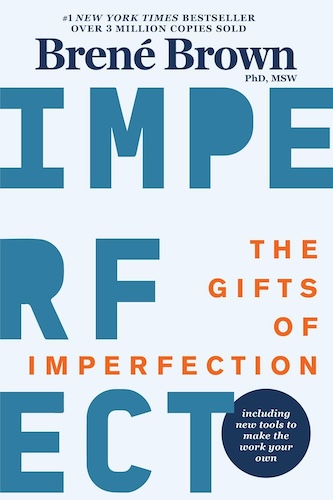
2 | The Gifts of Imperfection by Brené Brown
What it’s about:
The Gifts of Imperfection is about what Brené Brown calls “wholehearted living.”
Her whole argument is that the version of yourself you’ve been trying to perform (aka the productive one, the put-together one, the one who has it all figured out) is the thing standing between you and a life that actually feels like yours.
It’s structured around ten “guideposts” for letting go of who you think you’re supposed to be, and stepping into who you actually are.
Why it landed for me:
There’s a line in this book that completely rewired my brain. Brené writes about how we’ve ended up in a culture where “our self-worth is tied to our net worth, and we base our worthiness on our level of productivity.”
I read that sentence and just sat with it for about ten minutes.
At the time, I was deep in the early stages of building this blog, working a job I knew was wrong for me, and quietly believing that if I could just be more productive, more impressive, more visible, then I’d finally feel like I was enough. The idea that worthiness wasn’t something I had to earn through output, it was just something I already had, changed absolutely everything for me.
I honestly still get full-body chills from this book.
It taught me how to start letting go of the things holding me back, like fear, comparison and perfectionism and start cultivating the things I need more of, like intuition, gratitude and laughter.
Why I recommend it:
What I love about Brené is that her tone is soft but still direct. She’s not yelling at you to be your best self. She’s basically sitting across from you with a cup of tea, telling you it’s okay to cut the performance.
If you’ve ever not finished a self-help book because the energy was too sassy or too “babe, you’ve got this,” this is the antidote.
Just make sure you’re in the right headspace when you pick it up. It’s a gentle book, but it’s also heartbreakingly honest, and you’ll feel it.
“Owning our story and loving ourselves through that process is the bravest thing that we will ever do.”
Brené Brown | The Gifts of Imperfection
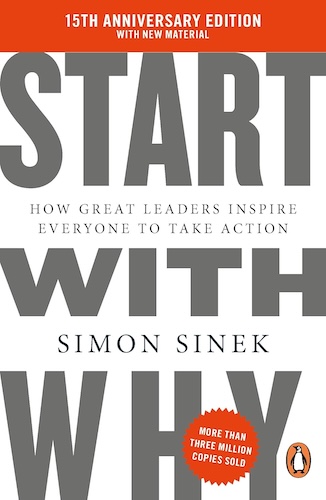
3 | Start With Why by Simon Sinek
What it’s about:
Start With Why is basically Simon Sinek’s answer to one question:
Why do some leaders, companies, and people manage to genuinely inspire others, while others (often with better products, more resources, or smarter strategies) completely fail to?
His answer is that the inspiring ones always start with their “why.” Not what they do, not how they do it, but the deeper belief or purpose driving the whole thing.
He calls this the Golden Circle, and once you’ve seen it, you start spotting it everywhere.
Why it landed for me:
I read this when I was at a bit of a crossroads with Notes by Thalia.
The blog was working, but I’d lost sight of why I’d started it in the first place. I knew what I was doing (writing about burnout) and how I was doing it, but if you’d asked me to explain why, in a way that wasn’t just generic “I want to help people,” I would’ve struggled.
Start With Why gave me the language to actually figure out why this work matters to me.
And once I had that, everything else got easier — what to write about, where to focus my time, and even which collaborations to say yes to and which ones to turn down because they didn’t align.
Why I recommend it:
If you’ve ever caught yourself describing your work in a way that sounds generic (or even boring), this is the fix. It tells you exactly how to explain why you do what you do, in a way that doesn’t sound like a LinkedIn bio.
And it’s surprisingly useful even if you’re currently in-between jobs or still in the “figuring it out” stage, as the same questions apply to bigger life stuff:
- Why do you want the thing you say you want?
- Why do you do what you do?
- Why does any of it matter to you?
A quick heads up: You can probably get most of the core idea from his TED talk. But the book is worth it when you actually want to sit with the framework and apply it to your own stuff, rather than just nod along to the concept.
“The work we’re doing now is better than the work we were doing six months ago. And the work we’ll be doing six months from now will be better than the work we’re doing today. Because we wake up every day with a sense of WHY we come to work. We come to work to inspire people to do the things that inspire them.”
Simon Sinek | Start WIth Why
4 | The Daily Stoic by Ryan Holiday
What it’s about:
Stoicism is one of those things everyone keeps telling you to read about.
But let’s be real, it isn’t exactly the easiest thing to digest. That’s where The Daily Stoic comes in. Because Ryan Holiday has already done the heavy lifting.
It’s structured as 366 daily entries — one for every day of the year. Each one gives you a short quote from one of the ancient Stoics, followed by a paragraph or two of Holiday’s own commentary explaining why it matters and how to apply it.

Why it landed for me:
I’d been wanting to get into Stoicism for ages, partly because everyone in the self-improvement space won’t shut up about it, and partly because the core idea (focus on what you can control, let go of what you can’t) sounded exactly like what I needed when I was deep in burnout and trying to control everything.
But every time I tried to read the actual ancient texts, I was bored AF. The language is heavy, my brain would check out, and I’d give up halfway through.
The Daily Stoic was the thing that finally made it click.
Why I recommend it:
Ryan isn’t asking you to read ancient essays. He’s translated them, applied them, and broken them into bite-sized chunks you can actually digest with your morning coffee.
The page-a-day format takes all the pressure off, too, because you’re not trying to absorb a whole philosophy in a week. You’re just sitting with one idea, for one day, and seeing how it shows up in your life.
A quick heads up: it does require some consistency, and if you tend to fall off habits, you’ll probably find yourself a few entries behind at some point. That’s fine. There’s no rule that you have to read it in order, or even read every entry. I dip in and out depending on what kind of week I’m having, and it still does the job.
“You have power over your mind – not outside events. Realise this, and you will find strength.”
Marcus Aurelius
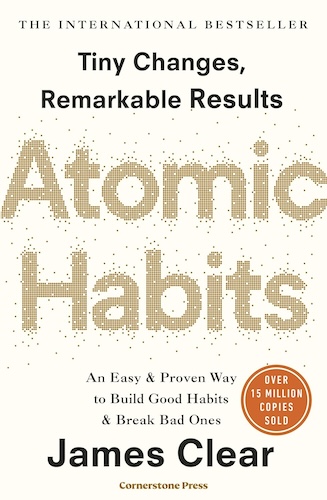
5 | Atomic Habits by James Clear
What it’s about:
Atomic Habits is THE book that explains why building good habits has always felt so hard, and why most of the advice you’ve heard about willpower and motivation is missing the point.
James Clear’s whole argument is that tiny changes, repeated consistently, compound into remarkable results.
The framework is simple: every habit comes down to four steps (make it obvious, make it attractive, make it easy, make it satisfying). And the book is essentially a guide to applying those four steps to whatever habit you’re trying to build or break.
Why it landed for me:
Before I read this book, I was knee-deep in hustle culture and convinced there was something wrong with me. I’d see other female business owners online wake up at 5 am, work out, eat breakfast, bullet journal, and start their to-do list all before sunrise, and I’d try to copy them. But every single time, I’d just fall apart after two days.
The line that completely changed things for me was this one: “There is a version of every habit that can bring you joy and satisfaction. Find it.”
It sounds so obvious in hindsight, but I’d genuinely never considered that the problem wasn’t me, it was that I was trying to build habits that suited someone else. I wasn’t a morning person. Once I gave myself permission to actually figure out which habits suited me, the whole thing got infinitely easier.
This is also, weirdly, the book that planted the seed for Notes by Thalia. The whole “there’s a more sustainable way to work” ethos I write about now started here. Without Atomic Habits, I’m honestly not sure the blog would exist.
Why I recommend it:
The framework actually works, which is more than I can say for most habit advice.
Clear isn’t telling you to force yourself into better habits. He’s showing you how to design your environment, your triggers, and your rewards so the habits build themselves.
The other thing he gets right is habit stacking, which is basically attaching a new habit to something you already do. After I brush my teeth, I’ll do x. Before I make my morning coffee, I’ll do y. It’s such a small mental trick, but it’s the difference between “I should really start meditating” and actually meditating.
“There is a version of every habit that can bring you joy and satisfaction. Find it. Habits need to be enjoyable if they are going to stick… tailoring your habits to your personality is a good start.”
James Clear | Atomic Habits
Bonus | Stay & Slay: How To Beat Burnout Without Quitting Your Job
What it’s about:
(Yes, I know this is a shameless plug, but hey, it’s my blog, and I know for a fact that it’s exactly what you need.)
Stay & Slay is the book I wrote when I realised most burnout advice falls into one of two camps. Either “quit your job and move to Bali,” or “just take more bubble baths.” Neither of which actually works for most of us.
It’s built around my 3-Part Anti-Burnout Framework™ (alignment, mindset, and self-care) and walks you through the actual work of recovering from burnout without having to blow up your entire life to do it.
There are reflection prompts, real client stories, and a workbook so you can apply each chapter as you go rather than just reading and forgetting.

Why I wrote it:
This is the book I wish I’d had when I was deep in burnout and convinced quitting was my only option.
Don’t get me wrong, my job at the time was toxic, and I knew I couldn’t stay. But what I didn’t realise until much later is that quitting didn’t actually fix the burnout. It took me a few more years to figure out what was really going on and build a career that actually feels good.
Stay & Slay is everything I learnt along the way, minus the years of trial and error.
If you’re stuck, exhausted, or just want a more sustainable way to work and live, I genuinely think you’ll find something in here that helps.
“It will get better. You will experience better things, meet better people and step into a job (and life) that feels better. You will become better, stronger, and more aligned with who you’re meant to be. Trust the process, because the best is yet to come.”
Thalia-Maria Tourikis | Stay & Slay
Final thoughts
Most self-improvement books won’t change your life. And after reading over 50 of them, I can say that with full confidence.
But every so often, you’ll find one that actually shifts something in you. And six months from now, you’ll randomly think back to a line and realise it’s been quietly reshaping how you think.
These are the ones that did that for me:
- The Mountain Is You by Brianna Wiest
- The Gifts of Imperfection by Brené Brown
- Start With Why by Simon Sinek
- The Daily Stoic by Ryan Holiday
- Atomic Habits by James Clear
- Stay & Slay by Thalia-Maria Tourikis
If you end up reading any of these books, I’d love to know which one and how it lands for you. And if there’s a book you think should’ve made the list, send it my way. I’m always looking for recommendations.
Until next week,
Thalia xx
Just a heads up — This post contains affiliate links. If you make a purchase using the links above, then I will be rewarded at no extra cost to you. Thank you, as always, for your support.






Naomi Oghene-udi
I love to be reading the seven books listed above for free
Tammie
These sound like amazing books.
L.H.Weiss,
“Think & Grow Rich” Napolean Hill
Positive Mental Attitude, Dale Carnegie, Master the Game,
Tony Robbins, Sermon on the
Mount, Jesus….
MOETI Motšeo
I need help about improving my self-image. I do not have confidence in myself like something I don’t know.
I wanna be able to speak before a great number of people
Thalia
Building confidence takes time, but it’s definitely doable 😊 Start small by speaking out loud to the mirror, practicing in front of smaller groups first, then gradually work your way up. The more you do it, the more confident you’ll feel. You’ve got this!
Oliver bennett
The Mountain Is You lived rent-free in my head for months. Self-sabotage as protection instead of laziness completely reframed things for me.