
Let’s address the elephant in the room.
Because no matter what you’ve heard, procrastination is not laziness. You’re just tired of forcing yourself to do the stuff that drains you.
The thing is, you always start the day with the best intentions.
You’ve got your to-do list all written out, coffee in hand, and you’re ready to carpe diem. But then one urgent email derails you, and suddenly it’s 4 pm, and you’re wondering where the day went.
You tell yourself you’ll get on top of things tomorrow, but when 5 pm rolls around, you still haven’t made a dent in your list and end up moving everything to the next day (again).
You’re constantly stuck in catch-up mode and you can’t remember the last time you had your shit together.
Look, I know it sucks. I’ve been there and know these patterns all too well. And just between us, procrastinating is extremely common among the other girlies who read this blog, so you’re definitely not alone.
The good news is you can 100% turn it around and stop procrastinating. Promise!!
Procrastination isn’t a personal flaw.
It’s just your way of coping with stress and overwhelm, especially when you’re exhausted and teetering on the edge of burnout.
But with a few new habits, lazy-girl hacks (my personal faves), and solid boundaries, you can finally break the cycle, get ahead of your to-do list, and stop feeling so behind.
And that’s exactly what I’m going to help you build right now.
Let’s dive in…
P.S. If you’re new here, hey! I’m Thalia. I help 30-something girlies beat burnout and unf*ck their life through 1:1 coaching and self-paced tools. Every week(ish), I share content on burnout recovery, self-development, finding joy, and career growth. Subscribe here so you never miss a debrief.
Signs you’re a procrastinator
When I was burning out (and didn’t even realise it yet), I’d sit at my desk staring at my inbox, telling myself I’d start in five minutes.
Of course, those five minutes turned into an hour. Then three.
By lunchtime, I’d wasted the whole morning scrolling through The Daily Mail or buying clothes I didn’t need on ASOS.
Realising my mistake a little too late, I’d then have to cram all my work into the afternoon just to leave at a decent time.
Back then, I thought procrastination was me being lazy or undisciplined, but it wasn’t. Procrastination was just my way of coping with the stress of a toxic job and demanding workload.
I was so drained that even the easiest task felt impossible, so I’d avoid it. Then I’d feel guilty. Then I’d avoid it even more because now it felt ten times bigger than it actually was.
If any of this is sounding a little too familiar, then I hate to break it to you, but you’re probably a procrastinator too.
Here are all the signs:
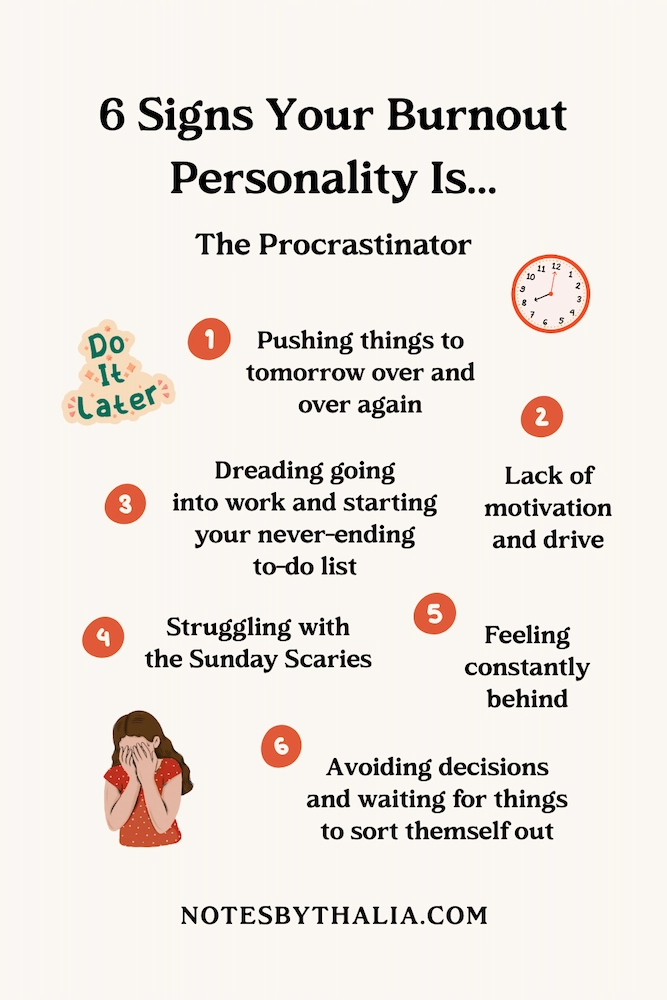
- You keep putting things off: You tell yourself you’ll start when you have more energy, but somehow the day is gone and you’ve achieved absolutely nothing
- Your to-do list never ends: You write it all down, swear today’s the day, but most of it just gets rolled over to tomorrow (again)
- You dread opening your laptop: Even simple tasks feel like climbing a mountain, so you keep avoiding them until it’s absolutely urgent.
- You’re living in guilt: You spend more time beating yourself up for not doing enough than actually doing the thing
- You’re busy, but not productive: You’ll tidy your desk, reformat documents, send a couple of emails, or reorganise your inbox so it feels like you’re at least doing something
- You’re stuck in catch-up mode: No matter how hard you try, you can’t seem to get ahead — there’s always something unfinished, overdue, or hanging over your head
- Sunday Scaries hit hard: The thought of another work week fills you with dread, even if you’ve done absolutely nothing all weekend
- You’ve lost your spark: Everything you used to do for fun now feels like a chore, and you can’t remember the last time you genuinely felt excited about something
P.S. Wanna know if you’re a procrastinator like me? Take my viral burnout girlie quiz and find out what your biggest burnout trigger actually is.
How to stop procrastinating
Look, I’m not here to tell you to buy another productivity planner or wake up at 5 am. We all know that stuff is BS, especially when you’re burnt out.
What actually helps is figuring out why you’re avoiding things in the first place.
And if you’re anything like my clients, you’re likely doing work that doesn’t align with your strengths or skills, and it feels meaningless, hence why you keep putting it off.
Your main focus right now should be on alignment so you can finally feel motivated by what you do, instead of drained by it.
I suggest following the framework below step-by-step from start to finish. These tips aren’t random; they are personalised to you, so don’t skip the ones that feel uncomfortable.
P.S. I encourage you to save this post (like now!!) so you can come back to it whenever you need to.
1 | Create a lazy-girl SOP for hard tasks
What’s that one task you keep avoiding?
If you’re anything like me, it’s probably opening your inbox on a Monday morning, seeing 47 unread emails, and quietly closing the window again, pretending it doesn’t exist.
Or telling yourself you’ll start your to-do list after lunch… then suddenly it’s 4 pm.
This used to be me all the time.
I was always putting things off and off and off, until finally, I spoke to my coach about it, and he said, “Stop overcomplicating everything. Make it feel stupidly simple.”
Mind-blown. Because if you know me, you’ll know I love to overcomplicate things and make them 10 times harder than they need to be.
So, I followed his advice and created my own lazy-girl way of getting unstuck when I’m procrastinating.
What I do now is simply write an SOP (standing operating procedure) for any challenging tasks or anything I can’t be bothered to do. My clients absolutely love using this SOP, so I wanted to share it with you because, honestly, I really think it’ll help.
Action steps
- Pick a task: Choose one thing you’ve been avoiding and commit to starting there
- Break it down: Reduce it to the smallest possible action steps (think “open the doc,” “add title,” “write the first sentence”)
- Keep it easy: Each step should feel ridiculously simple — that’s the point
- Start and tick: Do the first step, mark it as done, and actually give yourself credit for it
- Keep going: Move on to the next step and repeat until it’s done
2 | Ditch, delegate, do
I don’t know about you, but my to-do list can often look like a CVS receipt:
- Reply to those 17 emails I’ve been ignoring
- Book hair appointment
- Finish that digital product I’ve been avoiding since Tuesday
- Call Mum back before she disowns me
- Somehow fix my entire life before 5 pm
And so it goes on and on… and on.
The irony is that most of the stuff on my to-do list is just busywork. It doesn’t actually help move the needle forward.
And that’s the thing with burnout. When you’re exhausted or overwhelmed, your brain can’t tell the difference between what’s urgent and what’s just mental clutter.
So instead of tackling what truly matters, you end up checking your inbox for the fifth time in a row or reorganising your desktop folders because at least it feels productive.
Before I dive deep into values and only doing work that aligns with your strengths, skills, and what actually lights you up, I want you to try out this next lazy-girl hack.
It’s basically a sexy take on The Eisenhower Matrix.
This method isn’t about doing less; it’s about stopping yourself from doing everything at once because (and I hate to break it to you), as a classic procrastinator, you’re setting yourself up to fail.
Action steps
- Ditch: Look at your to-do list and cross off anything that isn’t important right now, like updating your LinkedIn bio or colour-coding your planner
- Delegate: Hand over the stuff that doesn’t specifically need you to do it. This might look like outsourcing basic tasks to someone else on your team, or using AI to do the heavy lifting
- Do: Circle 3 things. Yep, only 3. Those are your top priorities for the day and what will actually move the needle forward
3 | Break through limiting beliefs
Okay, so I’ve kinda been going easy on you so far.
This framework has been packed with quick wins you can apply right now to stop procrastinating. But the truth is, beating procrastination goes way deeper than just a few lazy-girl hacks.
Your progress will only go as far as your mindset allows it.
Sure, you can download another productivity app, time-block your calendar, or buy a new planner, but if you’re still stuck believing that you’re not doing enough or being productive enough, nothing will ever change.
Learning how to stop procrastinating isn’t just about the external stuff — it’s also about doing the mindset work to support it.
And I think this is the part that everyone wants to avoid. Because it’s hard and uncomfortable AF.
But if self-development has taught me anything over the past 5 years, it’s that the hardest lessons usually give you the biggest breakthroughs.
So before I take you any further, I want you to take a step back and get honest about the stories you’ve been telling yourself, and start creating new ones that will actually help you move forward.
Action steps
- Write down one negative belief you have about yourself when you procrastinate: Like “I’m useless and lazy,” “I’m not disciplined enough,” or “I’ll probably mess it up anyway.”
- Reflect on where this belief came from: Was it an old boss who only praised last-minute wins, parents who called you unmotivated, or just years of tying your worth to productivity?
- Challenge this belief: List all the ways this isn’t true
- Reframe this belief into a more empowering statement: e.g. “I’m not lazy, I just need structure that works for my energy,” or “I don’t need last-minute pressure to do great work.”
- Repeat this work consistently: New limiting beliefs will always pop up, but the more you practice, the easier self-acceptance becomes
P.S. If you hit any blocks in the process, comment SOS, and I’ll work through it with you.
4 | Reconnect with what drives you
A few years ago, when I was deep in burnout, I was doing work that felt totally meaningless.
Most days, I’d ignore it, scroll on Insta, declutter my desktop, and hope it’d magically sort itself out, which obviously never happened. Instead, my to-do list just kept growing and growing.
Over time, it wasn’t just my to-do list I was neglecting.
I started avoiding everything else that overwhelmed me, like goals, exercise, and even messages from friends. Classic procrastinator move.
What changed things for me wasn’t waking up at 5 am or reading Atomic Habits for the fourth time.
It was paying attention to why I was putting things off in the first place — I was stuck doing work that didn’t light me up or inspire me.
And this is where it starts to get interesting.
We think burnout happens because we’re stretched to our limit, but really, it’s because we’ve lost the spark for what we do.
When your job stops aligning with what you care about most, it starts to feel like a grind, and procrastination becomes your default way to cope.
Breaking the cycle of procrastination really comes down to figuring out your core values.
Once you’re clear on what your values are, you can start to rebuild your role to support them and stop pouring your energy into things that don’t serve you.
P.S. If you haven’t done this exercise yet, I 100% suggest following along with me in this step-by-step breakdown.
Action steps
- Reflect: Think about all the times when you felt truly alive, happy and energised
- Identify the values that were present: Was it creativity, connection, freedom, helping others, etc?
- Add to your list: Continue to write down 10-15 values that deeply resonate with you
- Narrow it down to just 5 core values: These will become your guiding principles for making decisions
- Bridge the gap: Use this workbook to help you apply your values IRL
5 | Find your Ikigai
If you’re drowning in tasks you hate and rarely do the ones that energise you, of course, you’re going to keep putting things off.
Procrastination is basically your subconscious protecting you from doing stuff that feels pointless.
This is where the concept of Ikigai comes in.
It’s a Japanese idea that translates loosely to “reason for being”, and although it’s an ancient philosophy, it’s still ridiculously relevant today.
Finding your Ikigai helps you build a life that feels satisfying and authentic, as it’s guided by what truly motivates you.
It involves identifying the sweet spot between four key areas:
- What you love
- What you’re good at
- What the world (or your company) needs
- What you can be paid for
When all four of these things overlap, work stops feeling like a grind and starts feeling like something you actually want to get out of bed for. And in the end, you’ll stop procrastinating naturally because you actually love what you do.
Action steps
- Brainstorm your passions: Make a list of everything that brings you joy
- Identify your skills: Reflect on your strengths, talents, and the things you’re naturally great at
- Connect the dots: Explore how your skills and passions meet a need in the world. What problems can you solve, or what value can you bring?
- Research opportunities: Look into jobs, roles, or projects that align with your unique combination of passions, skills, and purpose
- Find the sweet spot: Reflect on the overlap between what you love, what you’re good at, what the world needs, and what you can be paid for

Bonus | Read Stay & Slay™
Let’s zoom out for a sec because everything we’ve covered so far — the lazy-girl hacks, the self-trust, the values — they all fit into a bigger system that I break down in:
This is the book I wish I had when I was deep in burnout and thought the problem was me. Because if you’re a chronic procrastinator, then I’d say that perfectionism is probably in the mix too.
Your tasks never get finished because they never feel good enough.
Projects stay on your to-do list for weeks at a time because you’re always waiting for the right time to start.
Emails get drafted and redrafted because you don’t trust yourself enough to send them.
None of this is laziness.
It’s perfectionism working against you at the same time as procrastination.
You’re too drained to start and too much of a perfectionist to finish so your to-do list grows, the guilt builds, and nothing actually gets done.
In Stay & Slay™, I go way deeper into all of this and show you how to finally break the cycle so you can close your laptop on a Friday knowing your shit is done and actually enjoy your weekend without dreading another Monday morning.

The TL;DR version
I like to call this the TL;DR version because if you’re anything like the other procrastinators out there, you probably got to “signs you’re a procrastinator” and started skim-reading the rest.
So here are the key takeaways from this post:
Your energy drainers:
- Long AF to-do lists
- Doing work that doesn’t light you up
- Guilt for not doing enough
- Living in catch-up mode
- Random productivity hacks
- Sunday night anxiety
Your energy givers:
- Focusing on 3 things each day
- Simple systems for big tasks
- Planning the night before
- Boundaries around rest
- Celebrating your small wins
Things to avoid:
- Multi-tasking
- Waiting for motivation to strike
- Being busy, not productive
- Overcomplicating things
- Treating rest like something you earn
What to do next:
- Create a lazy-girl SOP for tasks you tend to avoid
- Ditch anything that’s not important, delegate the rest, and focus on just 3 things
- Break through the negative beliefs keeping you stuck in procrastinator mode
- Figure out your core values and reshape your role around them
- Read Stay & Slay™ (the book I wrote)

Final thoughts
When I was deep in burnout, it wasn’t just my energy that disappeared — it was my spark. I’d sit at my desk, reread the same email ten times, and still feel unsure how to reply.
Some days I’d open my laptop, stare at my to-do list, and completely freeze.
I stopped going to the gym, stopped cooking, and even stopped hanging out with my friends because I didn’t have the capacity.
That old version of me sucked. She’d lost herself to a draining AF job, and it was making her miserable. I’d doom scroll through my evenings, bed rot every weekend, and binge-watch Netflix to escape.
But could you really blame me?
I was doing work that sucked the life out of me. Yes, it was demanding, but it didn’t excite me. It was the same thing over and over again, and it just felt meaningless.
I remember waking up every single morning and just dreading going into the office. And when I was there, I’d procrastinate like crazy.
I’d literally find any excuse to fill my time without doing any actual work.
Any sane person would have quit their job, but not me: a classic people-pleaser who didn’t want to let anyone down.
I didn’t want to admit that I’d failed. I’d spent years working my arse off, so why would I throw it all away? What a waste. I managed to talk myself out of quitting so many times that I convinced myself it was just easier to stay. So I did.
But the burnout never went away. That emptiness never went away. That feeling in my gut that something was wrong never went away.
I just kept pushing it further and further down and procrastinating more and more to ignore it all. Eventually, I hit a point where I couldn’t do my job anymore. I couldn’t enjoy life anymore.
Maybe that’s where you are right now — convincing yourself to push through, waiting for things to get better on their own, but they rarely ever do.
What that season taught me most of all is that burnout doesn’t just drain your time and energy. It drains your soul and makes you question everything from your identity to your self-worth.
And once I understood what was actually burning me out, I started showing up differently — softer, smarter, more aligned.
If your spark has faded too, and you’ve been feeling this way for a while, I want you to know that it can come back.
But not magically. You need to give yourself the right tools and space to find it again.
You’ve got this.
Thalia xx