I walked away from a career in fashion over 8 years ago. (I know where has the time gone?!)
But even now, years later, that job still messes with my head.
Not only do I have nightmares that I’m still working in a toxic AF office (how is this even possible?!!), but I’m also terrified of managing people.
What if I become my ex-boss? What if I repeat the same toxic patterns I experienced with someone else without realising it? What if I accidentally disrespect someone else’s boundaries?
These fears are probably what keep me from hiring a proper team and building the business I know I’m capable of.
Maybe you’re not scared of becoming a shitty boss like I am, but I’m willing to bet you’re still dealing with some inner demons. Maybe you’re scared to ask for a promotion because you got looked over last time, or you’ve stopped speaking up in meetings because staying quiet feels safer.
And look, none of this is our fault.
We were never really taught how to communicate in life, let alone work. We just had to figure it out by ourselves one day and hope for the best, which is why we’re probably struggling now.
But imagine having the confidence to navigate these sticky situations by knowing what to say and how to say it?
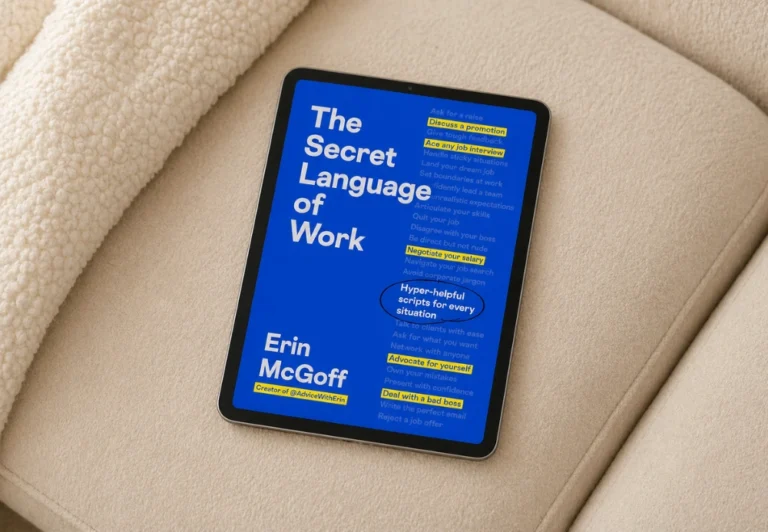
That’s exactly what Erin McGoff, aka @advicewitherin, gives you in The Secret Language of Work — a book I so desperately needed in my twenties.
Here’s my hot take.
P.S. If you’re new here, hey! I’m Thalia. I help 9-to-5 girlies beat burnout and build a career they love through 1:1 coaching and self-paced tools. Every week(ish), I share content on burnout recovery, self-development, finding joy, and career growth. Subscribe here so you never miss a debrief.
The lowdown on The Secret Language of Work
The Secret Language of Work isn’t a one-and-done read. (A lot like the other self-development books I keep going back to.)
It’s a career playbook you’ll keep referring back to again and again because it shows you exactly how to communicate at work — both professionally and confidently.
Erin basically gives you a script for every awkward or high-stakes situation you’ll ever face at work, from acing a job interview to handling difficult conversations with your boss and setting boundaries.
What I loved most is that Erin doesn’t just tell you what to do, she gives you the exact words to do it. Like word for word. And having it all spelt out for you is a lifesaver, especially when you’re burnt out.
Burnout doesn’t just mess with your energy. It also affects your ability to articulate your thoughts or even advocate for yourself.
Sure, knowing the right words is a good start, but understanding when and how to use them matters just as much. And that’s why this book is a 10/10 read. Because it covers both.
How easy is The Secret Language of Work to read?
In short, very easy.
Erin McGoff built her brand on short-form content on social media, so she knows a thing or two about how to make complex topics (like asking for a raise) simple to digest.
So yes, unlike a lot of self-development books that feel like homework (aka Slow Productivity, no hate), I whizzed through this one.
Erin writes exactly how she speaks: warm, no-nonsense, and relatable. There’s no complicated language or pretentious terms. It feels like a conversation with a really smart friend who just so happens to know everything about workplace communication and uses fun analogies to keep you engaged.
She also includes super helpful (or should I say hyper-helpful wink wink) diagrams to visually summarise each point.
The only thing I wish is that this book were longer.
Reading it on my Kindle, I got to the “Acknowledgements” at 70% (!!!) Turns out the last 30% was the notes and references section. Sigh.
My 3 biggest takeaways from The Secret Language of Work
As a girl who runs their own business and has no intention of going back to a 9-to-5, you might be asking why I even chose to read this book in the first place.
The truth is, I’ve been where you are now. Scared to ask for a raise or even negotiate, unable to speak up for myself, and not honouring my own boundaries.
And to be perfectly honest, I’m still trying to navigate some of this stuff now.
So these takeaways aren’t just the bits that landed the hardest for me. They’re also the things I wish I’d known back then, and the reminders I still need now.
P.S. I encourage you to save this post (like now!!) so you can come back to it whenever you need to.
1 | How to communicate properly
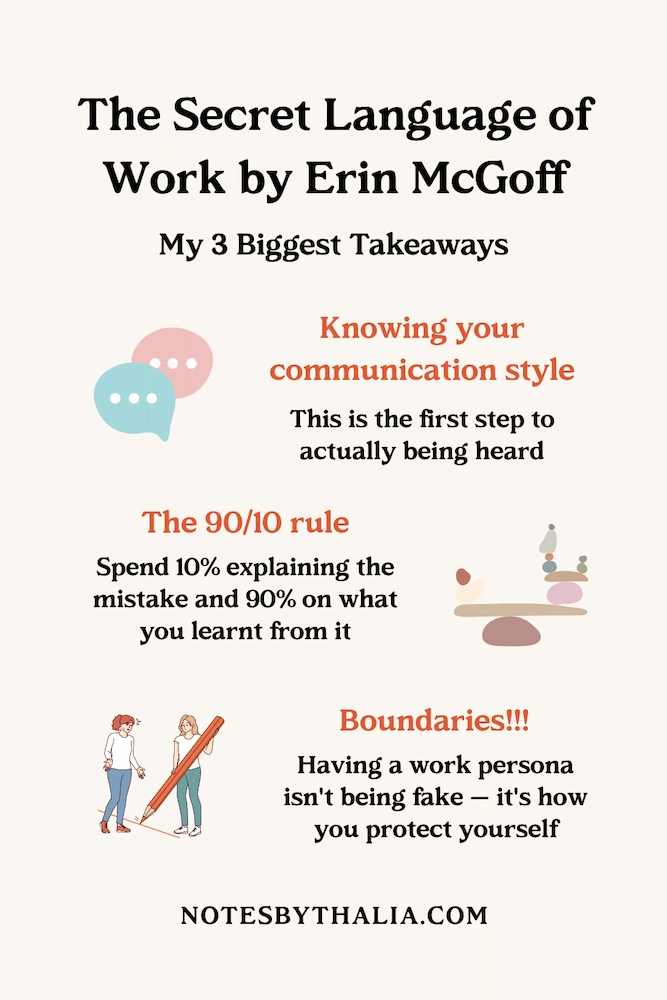
As Erin points out, “Everyone has certain communication styles that trigger their emotions.”
This landed so hard for me because the moment my business partner (slash husband) says the wrong thing, I’m transported right back to my old boss yelling at me for something that was completely out of my control. That’s probably why I still struggle with constructive criticism.
And apparently, there’s a reason for that.
Erin breaks down communication into four styles: passive, passive-aggressive, aggressive, and assertive. And if I’m being honest, I spent most of my career bouncing between passive and aggressive with very little in between. I’d either say nothing, stew about it for days, then send a strongly worded email, or I’d completely lose my patience.
Looking back, half the time the problem wasn’t even my colleagues or my clients. It was just how I was reacting to things. Or not reacting. I was either too much or completely checked out, and neither was doing me any favours.
The goal is to be assertive, which sounds obvious until you realise how many years you’ve spent either not speaking up or snapping when you’ve reached the end of your tether.
Wanna know how to communicate like a pro? You gotta read the book!
2 | The 90/10 rule
If you’re anything like me, your default is probably talking shit about yourself to another person every time you’re describing a mistake or failure at work.
I hate to break it to you, but this isn’t great for either your self-esteem or self-image.
It’s also not a great look for the other person, either — nobody wants to sit there while you rip yourself apart.
The 90/10 rule helps you communicate your setbacks in a way that actually works in your favour. So instead of leading with everything that went wrong, Erin encourages you to spend only 10% of the conversation on the mistake itself, and the other 90% on what you learnt from it, how you fixed it, and how you’ve grown.
Well, colour me sideways because this is genius.
I think about how many job interviews I fumbled because I spent the entire answer dwelling on what I did badly instead of where it took me. Or how many times I’ve over-apologised to a client when a simple “here’s how I fixed it” would have done the job.
It’s a small shift, but it changes everything about how you come across to others.
“Notice how a true BFF doesn’t sugarcoat it with a heavy layer of toxic positivity, but instead is encouraging while giving it to you straight. This is how I want you to start speaking to yourself. Be your own ally, role model and best friend, and your confidence and success will start to soar.”
Erin McGoff
3 | Boundaries, boundaries, boundaries
To say I had no boundaries during my 9-to-5 was an understatement. I was friends with coworkers, followed clients on Instagram, and partied with the models we represented.
There was no line that hadn’t been crossed; the girls I worked with knew everything about me. My dirty laundry was their Monday morning gossip.
In my defence, this is very common for the fashion industry. The long hours and stressful workload mean you bond more quickly with those you work with, and soon, they can start to feel like family.
8 years later, I can now see how irresponsible and damaging this was for my career. Let’s put it this way — it’s hard to respect someone when you know every single detail about their Friday night.
The problem was that I was never clued in on setting boundaries at work. I mean, is anyone? It’s not like we’re taught this stuff in school. We were basically pushed into the deep end at 21 and told to figure it out ourselves.
Well, better late than never, right?! Because we finally have the HOW thanks to our online bestie, Erin. So, if you take anything away from this book, make it this chapter on boundaries.
Don’t try to bring your ‘full self’ to work, unless you want work to start expecting your ‘full self’.
Erin McGoff
Final thoughts
I’ve spent a lot of time over the years unpacking why my previous job still mentally impacts me. And what I’ve realised is that toxic workplaces don’t just burn you out while you’re there.
They completely fuck with how you see yourself and what you think you deserve.
To this day, I still downplay my wins, second-guess everything, and stay in situations that drain me because they feel familiar.
But slowly, slowly, I’m starting to unlearn these patterns.
And although I haven’t quite figured it all out yet, what I do know is that leaving a draining job doesn’t fix everything.
I thought once I quit, I’d be fine, that I’d move on and feel better, but it was all a lie. Sure, you can escape a job you hate, but you can’t escape yourself.
You’re still the same person stuck in the same old beliefs.
The hardest part isn’t just recovering from burnout — it’s building self-trust. And that really comes down to knowing what TF to say at work, how to say it, and when to say it. Which is exactly what this book is for.
You’ve got this.
Thalia xx
Just a heads up — This post contains affiliate links. If you make a purchase using the links above, then I will be rewarded at no extra cost to you. Thank you, as always, for your support.