I think I’ve turned stupid. Seriously, I’m not even kidding.
Because I honestly struggled with this book.
Self-development is usually my jam, but I really felt like I was dragging myself through each chapter of Slow Productivity and rereading every word.
I worry that maybe I’ve lost the ability to appreciate powerful, intellectually-driven writing by focusing solely on self-help books written by women who are known more for their social media following than their depth of research or originality of thought.
And no shade to Cal Newport (I’m a huge fan of his after reading Deep Work and Digital Minimalism), he’s clearly intelligent, thoughtful, and a great writer. But for a book about doing less and feeling better, I kept wondering why I was feeling more mentally exhausted the deeper I got into it.
Oh, the irony!!
I do have to admit though, I read Slow Productivity during a particularly busy and exhausting season, so maybe non-fiction books aren’t the best reading material for when you’re in the orange zone. Note to self.
That said, I did still get a lot of value from this book (yes, I read it twice for it to really land). I already follow the core principles outlined by Cal, which felt like confirmation that I’m not just winging it. This shit works.
So, if you’re a 9-to-5 girlie currently drowning in deadlines, meetings, and the existential dread of being productive all the time, you’re 100% going to find this book pretty helpful for what you’re going through.
But let’s be honest — if your brain feels like mush right now, you probably don’t have the attention span of a saint. So I’ve broken it down for you.
Here’s my hot take on Slow Productivity!
P.S. If you’re new here, hey! I’m Thalia. I help 30-something girlies beat burnout and unf*ck their life through 1:1 coaching and self-paced tools. Every week(ish), I share content on burnout recovery, self-development, finding joy, and career growth. Subscribe here so you never miss a debrief.
The lowdown on Slow Productivity
The idea behind this book is pretty simple: we’ve confused being busy with being productive.
Look at any 30-something-year-old, and I bet her calendar is jam-packed with meetings, deadlines, social events, workouts, family gatherings, plus an inbox that’s overflowing and in desperate need of attention.
We’re so used to saying yes to everyone, over-committing, and planning our lives 3 months in advance that being busy has turned into our new normal.
(Overachiever, I see you. 👀 😉)
The problem is that all the constant doing isn’t really helping. It just makes you more exhausted and less effective at work.
Sure, you’re ticking all the boxes, but you’re not giving it your best.
This is where Cal Newport comes in.
Because his approach to productivity means that being chronically busy doesn’t need to become your entire personality.
Instead of grinding 24/7, Cal suggests a gentler, more sustainable path to getting things done.
His core ideas of:
- Doing fewer things
- Working at a natural pace
- Obsessing over quality
… all work together to help you stay focused, protect your energy, and actually get shit done without burning out.
And before you freak out over the “do less” part, his method isn’t about completely checking out and quietly quitting.
It’s about focusing on what truly matters so you can do the right things well without losing your sanity.
How easy is Slow Productivity to read?
I’m all about keeping it real, so I have zero shame admitting that I struggled… big time.
I like my self-development books the way I like my TV shows: relatable and easy to digest.
Sure, there’s nothing wrong with the way Cal writes. He’s incredibly well-read, articulate, and extremely thoughtful in how he builds his arguments. But Slow Productivity isn’t exactly the easiest read. Especially if you’re burnt out and looking for straightforward advice on how to feel less overwhelmed at work.
It might take a bit of patience for his ideas to land, as there is a lot of depth to this book.
Cal doesn’t just present ideas. He backs them up with deeply researched evidence from historical figures like Jane Austen and Benjamin Franklin (which was actually super interesting to read about), and cultural case studies to show that his strategy works.
So yes, if you can stick with this book, you’ll honestly find a lot of insight in here that can really shift how you think about your work.
And if not, here are my Cliffs Notes…
My 3 biggest takeaways from Slow Productivity
Full disclosure: I read this book twice before it actually landed for me.
So if you don’t have the bandwidth to do the same right now (fair, given the whole point of this book is doing less), here are the three things that stuck with me the most, and the ones I think you need most if you’re deep in it right now.
P.S. I encourage you to save this post (like now!!) so you can come back to it whenever you need to.
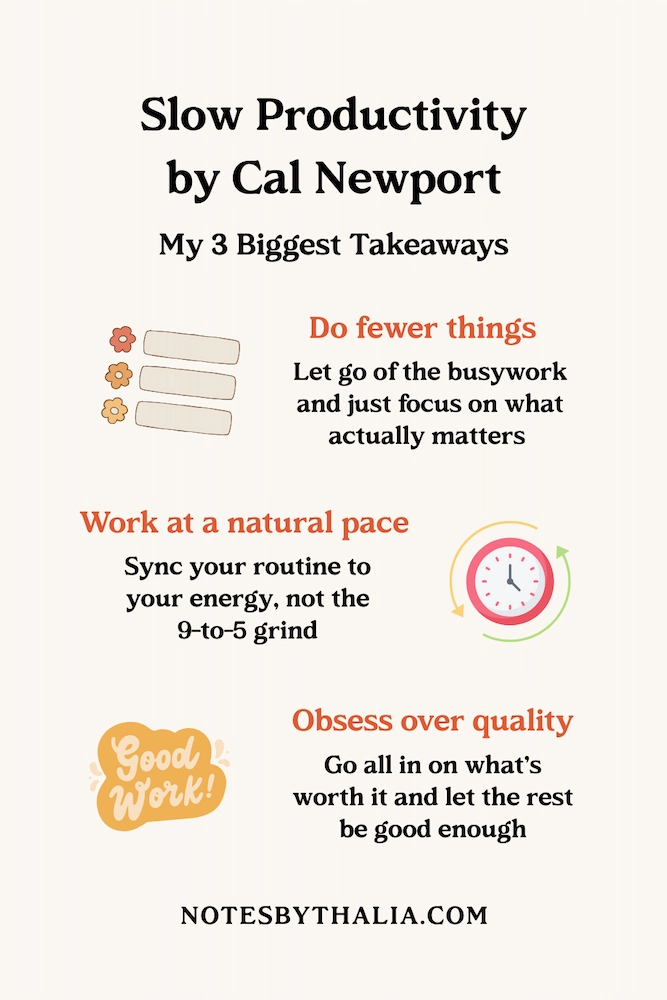
1 | Do fewer things
I’ve always been a big fan of the power of 3 — 3 creative projects max per quarter, 3 goals at any given time, and 3 daily priorities.
For me, the number 3 hits that sweet spot between ambition and actual capacity. It’s enough to move the needle forward and feel accomplished, but not enough to trigger overwhelm.
So having Cal Newport echo that same idea in Slow Productivity made me feel like, okay cool, maybe I do know what I’m doing. 😉
Cal explains that every new thing you add to your plate creates more admin, more tracking, more effort. And that type of mental clutter adds up fast.
A few years ago, my todo list was never-ending. Everything felt urgent and important.
The irony was that most of it was just busywork. It was stuff I agreed to without thinking or out of guilt.
And that’s the thing about burnout.
When you’re exhausted, your brain can’t tell the difference between what’s truly important and what’s just faff, meaning you spend the day reacting to tasks instead of moving forward with purpose.
This principle allows us to take a step back and audit what’s actually moving the needle vs. what’s just making us busy. It’s basically a sexy take on the Eisenhower Matrix.
So, in future, ask yourself, “What’s actually essential here?” and then let the rest go.
“There exists a myth that it’s hard to say no, whether to someone else or to your own ambition. The reality is that saying no isn’t so bad if you have hard evidence that it’s the only reasonable answer.”
Cal Newport
2 | Work at a natural pace
This principle didn’t surprise me — it validated what I’ve already been practising.
Because if you’ve been around here for at least a minute, you’ll know I design my work around my energy, my cycle, and what’s happening in my personal life.
I gave up on trying to give 100% every day a long time ago because it stopped working for me when I started my own business. I’d have a burst of focus one day and then completely crash the next. I used to push through, but now I plan for it.
Reading this section felt like a relief.
Because if you know me, you’ll know I’m the type to call myself lazy for not being a morning person, so I’ll literally do anything to wake myself up at 5 am, fail miserably, and then wonder if the problem is actually me.
Slow Productivity gave me the words to what I’ve been building intuitively: a rhythm that allows for ebb and flow. A way of working that feels doable and sustainable — not hyper-productive and rigid.
So if you take anything away from this book, make it this: You don’t have to be constantly busy to be productive. You just need to get to know your “natural pace” and work with it, not against it.
3 | Obsess over quality
Out of these three principles, this was probably the one I had to sit with the most.
At first glance, “obsessing over quality” felt a bit like my old perfectionism creeping back in with a new name. But the more I thought about it, the more I realised: this isn’t about nitpicking every detail — it’s about choosing what’s worth going deep on.
For me, that shift has been huge.
I care deeply about the work I put into my coaching and resources because they’re the things that actually support the people I work with. So that’s where the majority of my energy goes. Meaning I’ve now stopped overthinking the small stuff.
I’ll still pour time into creating tools that genuinely help my clients. But I’m no longer spending hours nudging elements around on Canva because I’ve convinced myself the design could look better. (Remember, done is better than perfect.)
This principle reminded me that quality isn’t about being flawless — it’s about being intentional.
It’s asking yourself: What deserves my best? And just as importantly: What doesn’t?
“Obsess over the quality of what you produce, even if this means missing opportunities in the short term. Leverage the value of these results to gain more and more freedom in your efforts over the long term.”
Cal Newport
Final thoughts
Without fail, I will always bring it back to values.
They’re literally the foundation of everything (aside from self-love, IYKYK). At this point, values are basically becoming my trademark.
And personally, I think they’re the missing piece in Slow Productivity. Because you can’t really slow down if you don’t know what you’re slowing down for.
We think burnout happens because we’re stretched to our limit, but really, it comes from a deep-rooted belief that tells us we’re not worthy unless we’re achieving something. So we overcompensate to prove ourselves, and end up abandoning our needs in the process by forgetting who we are and what we really stand for.
And when you don’t know what you value most in life, everything feels like a non-negotiable.
You say yes to things that secretly drain you, chase the “shoulds” instead of goals, and continue to push through because slowing down feels impossible.
Getting clear on my values is what helped me slow TF down. They gave me direction, helped me filter out the noise, and reminded me that I don’t have to do everything – just the things that matter to me.
Yes, Cal Newport’s framework is super helpful. But without knowing your values, it’s easy to turn slow productivity into another thing you need to achieve.
It starts with knowing what you care about. Because these principles will only work if the work you’re doing actually feels meaningful. So don’t just do less for the sake of it. Do less of what doesn’t align with you and more of what lights you up.
You’ve got this.
Thalia xx
Just a heads up — This post contains affiliate links. If you make a purchase using the links above, then I will be rewarded at no extra cost to you. Thank you, as always, for your support.