I see you… You’re totally over it.
You do what’s expected of you, but without any enthusiasm, passion, or energy, and immediately check out afterwards.
Emails and messages get a reply only if absolutely necessary, and when a colleague asks for help, you shrug and keep your distance. After work, you switch off completely and do the bare minimum.
Your energy is flat, you sleep fine (or even a lot), but it doesn’t make a difference because your motivation to move, socialise, or try something new is just gone. You’re dragging your feet through mornings, and weekends are mostly about chilling and doing nothing. You see other people chasing goals or sharing wins, but you couldn’t care less.
Overall, you’re coasting along on autopilot and feeling totally disconnected from your work, your tribe, and even yourself.
But here’s the thing…
You’re not lazy or unambitious. You’re just totally worn down from giving so much for so long. Giving the bare minimum is your way of protecting what little energy you have left.
The good news? You can 100% turn it around.
With a few gentle shifts, you can reconnect with what lights you up and start feeling excited about your career again, even if that spark feels like a million miles away right now.
P.S. If you’re new here, hey! I’m Thalia. I help 30-something girlies beat burnout and unf*ck their life through 1:1 coaching and self-paced tools. Every week(ish), I share content on burnout recovery, self-development, finding joy, and career growth. Subscribe here so you never miss a debrief.
What’s the deal with quiet quitting?
Okay, so just so we’re all clear, quiet quitting doesn’t actually mean quitting your job quietly. (I know, it confuses me too, but it’s just a metaphor, kinda like naked quitting)
You’re technically still doing your job, but only what you’re paid for.
You don’t stay late just to get ahead, say yes to random projects that don’t move your career forward, or answer emails on your day off just because you feel guilty.
For a lot of corporate gals, quiet quitting is a much-needed rebellion. We’ve been conditioned to give 110% at all times, even when our energy, motivation, and dating life are all falling apart.
Quiet quitting can feel like taking back control.
But here’s the thing…
While quiet quitting can be a great short-term reset, coasting your way through work long-term can end up making you feel uninspired, unfulfilled and disconnected. Your work feels meh, meaning the days just blur together, and the drive to grow in your career is non-existent.
And we all know what happens when you stop feeling challenged or even excited about your job… hello burnout.
The lowdown on quiet quitting: why do we do it?
I don’t think we wake up one morning and decide, “You know what? I’m going to start caring less about my career today.”
Quiet quitting is a slow, gradual process that builds up over time from frustration, feeling undervalued, and losing sight of why your work matters.
But sometimes it’s not just about the job—it’s something deeper. Quiet quitting can stem from feeling out of alignment in other areas of life, feeling lost, or being unclear on what you want to achieve.
The most common triggers I see in my clients are:
- Feeling invisible: You’re putting in the work, but it’s like no one even notices. Promotions pass you by, praise is rare, and it’s starting to feel like… why bother?
- Stuck in career limbo: You’ve been in the same role forever, doing the same tasks, and there’s no sign of a next step.
- Your values don’t match your company’s: The way they do things just doesn’t sit right with you, so it’s hard to get excited about the bigger picture.
- Toxic vibes: Whether it’s an unhelpful boss, a demanding workplace, or zero support, it’s exhausting to keep showing up.
- Running on empty: You’ve been in go-go-go mode for so long that the only thing you have energy for now is pulling back (from everything).
- Work is taking over your life: Deadlines and demands keep eating into your evenings, weekends, and anything that actually brings you joy.
- Your skills are going to waste: You know you’re good at what you do, but no one’s tapping into it, so why bother giving more than the bare minimum?
5 Things to do instead of quiet quitting
When your hard work goes unnoticed, your role feels stagnant, the company’s values don’t match your own, and your days are ruled by toxic leadership or never-ending demands, it’s no wonder your motivation starts to fade.
Add in the exhaustion from overworking and the frustration of your skills going untapped, and quiet quitting can feel like the only way to cope.
But it doesn’t have to stay that way.
With the right shifts, you can protect your energy and find ways to actually enjoy your job (and life) again.
Here’s where to start…
P.S. I encourage you to save this post (like now!!) so you can come back to it whenever you need to.
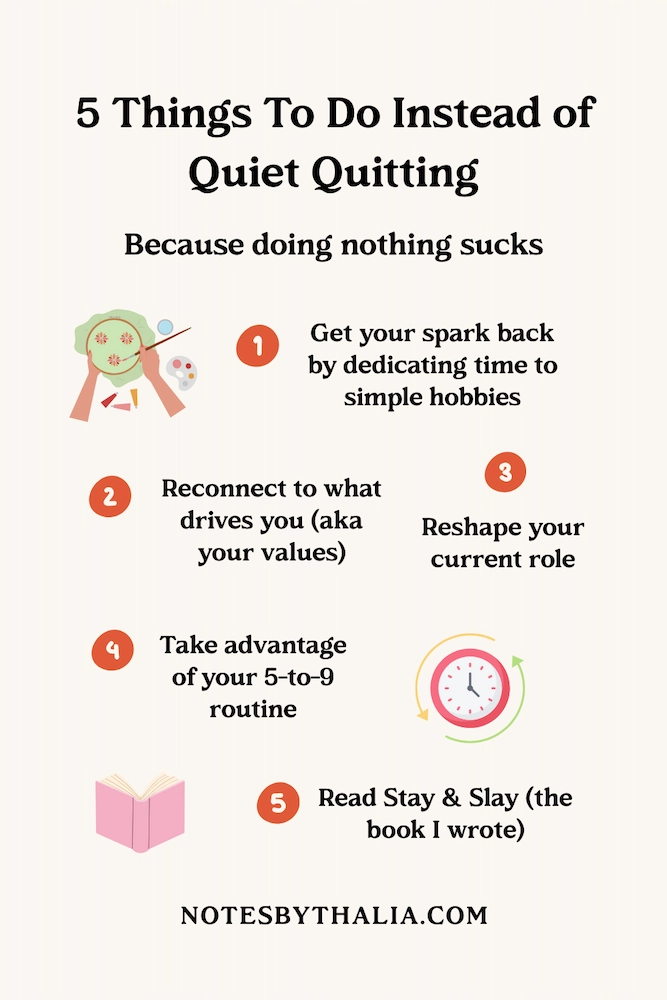
1 | Start small, get your spark back
When you’ve been feeling “meh” for a while, it’s easy to forget what it was like to feel excitement.
You’ve been stuck in neutral for so long that the idea of actually enjoying your job feels almost impossible.
But… it is doable.
Instead of putting pressure on yourself to suddenly overhaul your career or find your passion, just look for tiny wins.
The small stuff that makes you feel a little more alive (even if it’s just for 5 minutes).
It could be as random as helping a colleague untangle a problem, finally speaking up with an idea in a meeting, or doing something that’s got nothing to do with work at all, like cooking a meal you actually enjoy eating, walking to your favourite coffee spot, or creating a playlist for your commute.
I’m not expecting you to find your “purpose” from this blog post, but you can start to think about those small, feel-good moments that help you feel more like yourself.
What to do next:
- Write down 3 things (big or small) that have felt good in your job (or life) lately
- Pay attention to what comes naturally to you or feels easy in a good way.
- Ask yourself: How can I invite more of this into my week?
- Pick one ritual and do it again this week
- Repeat
2 | Reconnect to what drives you (aka your values)
When you feel disconnected from work, it’s often because it no longer reflects what’s most important to you. Your values might have shifted over time without you noticing, or your role might never have aligned with them in the first place.
That’s exactly what happened to me. It wasn’t just that I hated my 9-to-5 job; I had outgrown the fashion industry. I was no longer vibing with the work I was doing, I didn’t respect the people I was working with, and I didn’t respect the person I’d become.
What I know now is this: if your job doesn’t align with who you are and what you value, it will always feel like a grind. (Hello, burnout.)
The way out of quiet quitting starts with getting crystal clear on your core values, so you can make career decisions that actually feel good instead of draining you.
Think of your values as your internal compass. Without them, you’ll drift. With them, you can choose work that feels purposeful, even if the role itself isn’t perfect.
The easiest way to start is to get brutally honest about what matters to you right now.
Maybe five years ago, it was ambition and career progression, but now it’s stability and flexibility. Or maybe it’s the other way around. There’s no “right” answer, only your answer.
Hot tip: If you haven’t done this exercise with me yet, I 100% suggest doing it now and following along with this step-by-step breakdown.
What to do next:
- Reflect on your most rewarding, satisfying and fulfilling moments
- Identify the values that were present within these moments and write them down
- Continue to add to your list until you have 10-15 values that all resonate with you
- Narrow down your master list to just 5 core values
- Use this workbook to help you apply your values IRL to bridge the gaps
3 | Reshape your current role
POV: Your job isn’t the problem.
It’s probably how you’re spending your time in it. You might be spending too much time on tasks you hate and not enough on the ones that actually energise you.
This is where the concept of Ikigai comes in.
It’s a Japanese idea that translates loosely to “reason for being”, and while it’s ancient wisdom, it’s still ridiculously relevant today.
Finding your Ikigai helps you build a life that feels satisfying and authentic, as it’s guided by what truly motivates you.
It involves identifying the sweet spot between four key areas:
- What you love
- What you’re good at
- What the world (or your company) needs
- What you can be paid for
When all four of these things overlap, work stops feeling like a grind and starts feeling like something you actually want to get out of bed for.
Doing this exercise while you’re still in your role can help you spot opportunities to shift your focus, volunteer for projects that match your strengths, or approach your current work in a way that feels more aligned.
What to do next:
- List out everything you’re passionate about and that brings you joy
- Identify your natural strengths and skills
- Find the overlap between what you love, what you’re good at, and what the world needs
- Look into roles or projects that align with your “sweet spot”
- Start making small shifts toward work that fulfils you rather than drains you
4 | Take advantage of your 5-to-9 routine
If you want to stop coasting and start enjoying your job (and life) again, you need something going on outside of work.
Because if work’s all you’ve got, every bit of frustration will feel bigger than it is. Having something to look forward to makes the tough days so much easier to handle.
And your 5-to-9 routine is probably the best chance you’ll get to focus on what truly matters to you.
This isn’t about filling your evenings with a bunch of random hobbies just to keep busy — it’s about making space for the things that feel like a hell yes. Training for a 10k, taking a ceramics class, joining a book club, planning that big trip… whatever gets you out of autopilot and back into your life.
Because when your identity isn’t tied completely to your job, you can show up to work with way more freedom, and your self-worth isn’t riding on how one project goes.
What to do next:
- Pick one thing you’ve always wanted to try, and actually do it this week
- Plan one hell yes activity for after work—something you’ll genuinely look forward to
- Block it in your calendar so work can’t take over
- Swap one evening of scrolling or Netflix for something that makes you feel good
- Keep a running list of after-work ideas so you’re never stuck for options
5 | Read Stay & Slay (the book I wrote)
I hate to break it to you, but doing the bare minimum and waiting for motivation to magically return rarely works.
You’ve probably tried “resting more,” zoning out, or coasting along, but you just feel more disconnected and numb because feeling like yourself again takes intentional shifts, not just time.
Imagine a version of you who feels excited to wake up in the morning because something in your life actually lights you up again.
She feels genuine passion for her work (or something outside of it), chooses to show up fully as she has enough energy to do more than the basics, and makes space for real joy.
She laughs, cares, dreams, and lets herself want more because she finally believes she deserves it.
Stay & Slay is your first step toward that version of you.
It’ll show you how to move out of autopilot mode, rediscover what excites you, and start slaying—at work and beyond.
What to do next:
- Get your copy of Stay & Slay
- Sit somewhere quiet and read one chapter at a time (no need to rush)
- Highlight or jot down anything that resonates with you
- Slay-as-you-go by working through the companion workbook alongside each section
- Come back to your favourite sections whenever you need a boost or reminder

Final thoughts
Quiet quitting can be a super useful reset button, but it’s not a long-term solution. If you stay too long in autopilot, you risk losing the very things that make you feel alive and motivated in the first place.
The sweet spot is protecting your energy while still finding ways to grow, learn, and enjoy your career (even if it’s not your dream job).
You don’t have to overhaul your entire life to get there. Start with small sparks, reconnect to what drives you, reshape what you can, and fill your life with “hell yes” moments.
The rest will build from there.
You’ve got this.
Thalia xx