
Ikigai is the secret to a long and happy life.
It’s the reason you get up in the morning.
It’s the reason you live with intention and meaning.
It’s your reason for being.
And once you find your Ikigai, you will feel unstoppable when it comes to creating your dream life.
Here’s the exact 5-step framework you need to follow to find your Ikigai.
P.S. If you’re new here, hey! I’m Thalia. I help burnt-out girlies like you build a life that’s aligned, magnetic, and unapologetically yours. Every week(ish), I share content on burnout recovery, self-development, finding joy, and career growth. Subscribe here so you never miss a debrief.
Ikigai in a nutshell
I first heard about “Ikigai” back in 2020 during lockdown.
I’d just turned down an English teaching job in Japan and was coming to terms with having to stay in the UK amid travel restrictions.
This was before I started my business, and although I continued to teach English online, I lacked motivation and inspiration for daily life.
I knew I was capable of more.
On my 30th birthday, I was gifted a book — Ikigai by Héctor García and Francesc Miralles.
I read it in one sitting.
It was exactly what I needed at that point in my life. And I’ve been fascinated with the concept of Ikigai ever since.
Rooted in ancient Japanese philosophy, Ikigai, meaning ‘reason for being’ encourages you to discover your life’s purpose.
“Iki” stems from the meaning of “living” in Japanese, while “gai” describes value or worth.
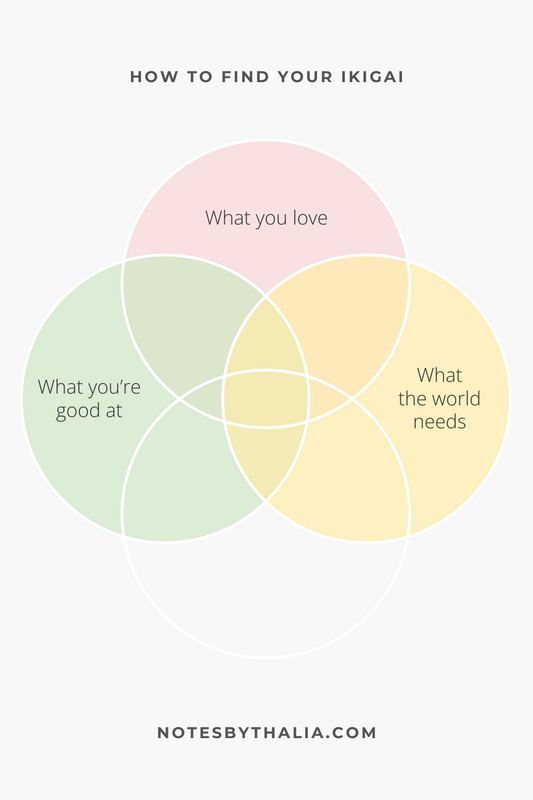
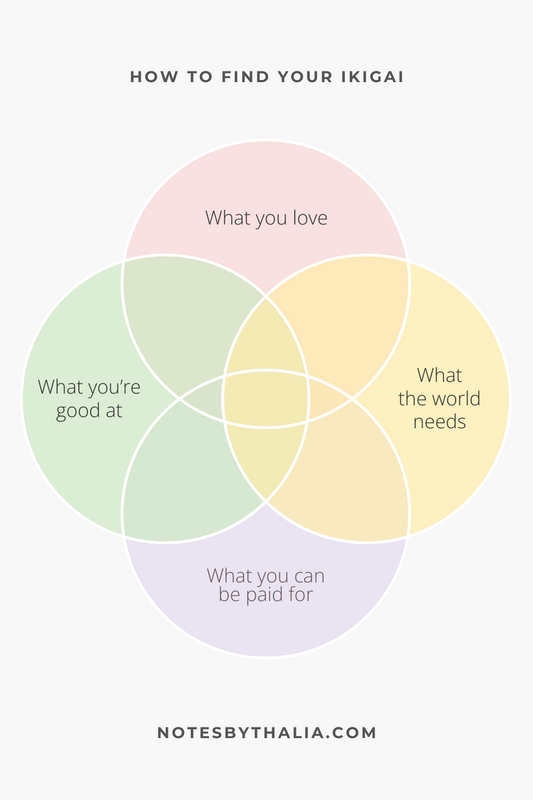
It involves finding the sweet spot between four parts:
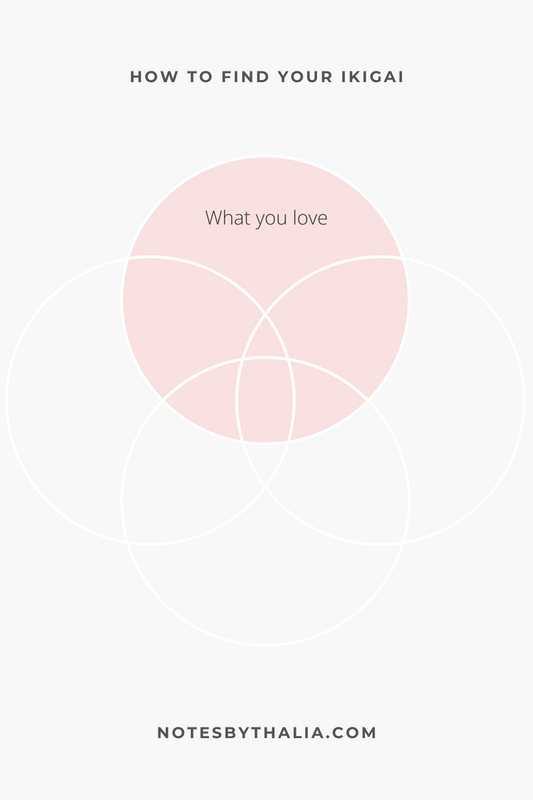
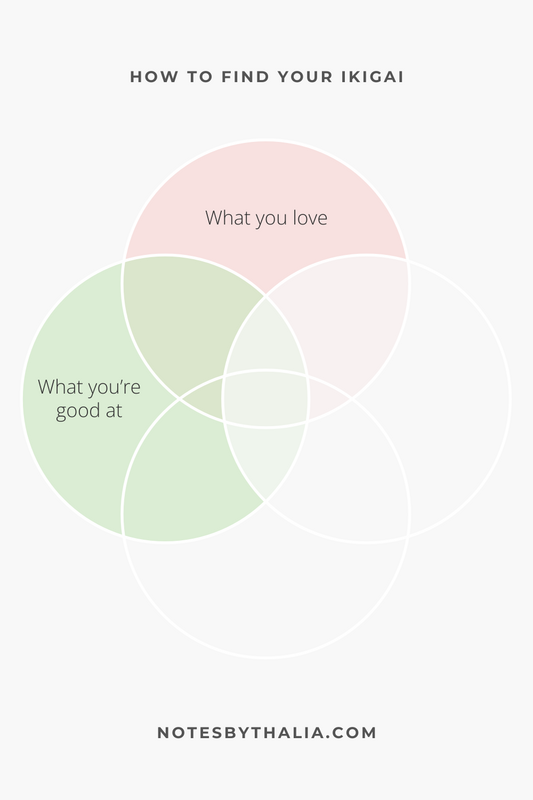
- What you deeply love
- What you’re really good at
- What the world actually needs
- What you can be paid for
When you find your Ikigai, you have essentially found your “bliss”, which leads to a deeply satisfying and fulfilling life. You are driven to get out of bed every day as you are pursuing something that truly resonates with your authentic self.
Why it’s worth finding your Ikigai
Do you ever feel like you’re walking through life without any direction or meaning?
You’ve gone from school to university to a full-time career without ever questioning whether that’s something you truly want.
You’ve outgrown the monotony of your daily life but stay stuck and unfulfilled because you’re told that’s the norm.
Instead of creating a meaningful life, you’ve created a bog-standard living.
The truth is — life isn’t about living the same year 75 times. (Robin Sharma) It’s about self-discovery and cultivating a life of deep happiness and fulfilment.
The good news — creating a life you love is within your reach.
The first step — doing the below exercise to find your Ikigai (a.k.a discovering your real purpose).
Other perks of finding your Ikigai include:
- Knowing your true self better
- Living a more authentic and aligned life
- Greater self-belief, resilience and awareness
- Feeling more confident in your daily decision-making
- Being more driven, motivated and productive to work towards your goals
- Cultivating deeper and more meaningful relationships with yourself and others
- Being mentally healthier and emotionally stronger
- Feeling happier and more satisfied in daily life
Save these benefits on Pinterest for later:

5-step proven framework to find your Ikigai
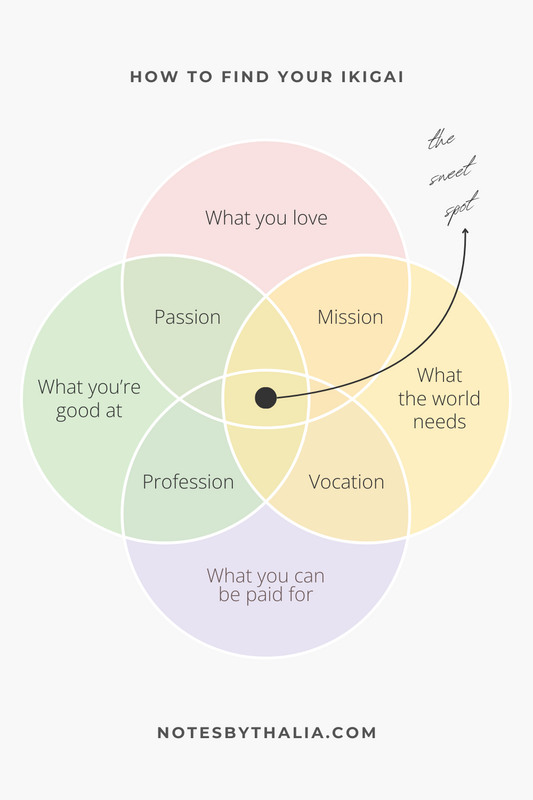
Ikigai is the sweet spot between your passion, mission, vocation and profession.
Not sure what either of these four things mean to you? Don’t worry; I’ve got you covered with this 5-step framework.
- Passion = what you love + what you’re good at
- Profession = what you’re good at + what you can be paid for
- Vocation = what you can be paid for + what the world needs
- Mission = what the world needs + what you love
I encourage you to bookmark this blog post so you can refer back to it whenever you need to.
1 | Rediscover the things you love
Finding your Ikigai is a process of discovery.
It’s not as simple as waking up one morning and deciding on the spot what your purpose is going to be for the rest of your life.
As we evolve and grow, our values and interests will shift. And I think it’s time to normalise this.
There’s an ongoing narrative that suggests we’re supposed to stick to the same thing for 40 or so years. At 17, we’re expected to pick a subject to study at university, and after graduation, the pressure is on to find a job in that field.
There’s zero breathing space.
Eventually, we wake up and realise that this profession no longer suits us for various reasons. This then brings up feelings of guilt, confusion and doubt.
If you listen to your gut and quit your job, you’re seen as a “quitter.”
If you do a total 180° and learn something new, society labels you as a “flake” who can’t make decisions.
But I think this is absolute BS.
You should totally have the freedom to explore different opportunities without judgment. I mean, what’s life without a little bit of self-discovery and fun thrown into the mix?
And I believe that passion is at the core of this process.
Passion fuels motivation and drive. If you’re not passionate about something, chances are you’ll get bored easily.
So do not skip this step — brainstorm the activities you love doing first, and then the rest will fall into place.
Journal prompts:
- What activities or hobbies bring you genuine joy?
- What do you love doing in your free time?
- What makes you lose track of the minutes and hours?
- Reflect on your most satisfying and fulfilling moments. What were you doing?
- What activities would you like to pursue if money wasn’t an object?
2 | Identify your natural strengths and skills
When we play to our weaknesses, we hold ourselves back.
We don’t allow ourselves to take risks that will move us forward in life, and instead, we remain playing small. This is usually out of a fear of getting it wrong, failing or looking bad in front of others.
This adds to the cycle of low self-esteem and confidence, contributing to a lack of purpose.
If you keep holding yourself back, you stick with the belief that you’re not capable of anything. But when you lean into your natural strengths, you gain the confidence you need to achieve more.
By focusing on your inherent skills and expertise, you empower yourself to grow and thrive. You have the confidence to push yourself out of your comfort zone to find real purpose.
Journal prompts:
- What are you really good at? What comes naturally to you?
- What skills do you have that many others do not?
- What skill(s) have you been spending time to practice?
- What do people look to you for help with?
- What are your strengths? List at least 8
3 | Align your interests and skills with what the world needs
You are two steps away from creating a purpose-driven life!!
How does that feel?
Sit in this step for a while. Go back through the previous steps and journal prompts. Does everything you’ve written down still resonate and sound true to your inner self?
Sleep on it or come back to this exercise in a couple of weeks (you can easily add a bookmark from your browser toolbar).
When you come back to it, do another deep dive:
- What else pops up?
- What are you holding yourself back from putting down?
To find your real purpose, you need to be completely open and honest with yourself.
Don’t write down what you think you should be writing down. Dive deep inside yourself and write down those core passions, skills and desires. Otherwise, you’ll forever be looking for more.
Once you’re happy you’re on the right track, it’s now time to map out how your skills and interests can help the world (or less overwhelming — a specific market).
Journal prompts:
- What industry or market can benefit from your skills?
- What specific challenges is this industry or market currently facing?
- What problems or needs can you solve with your skills?
- How do your passions and interests align with the needs of this market or industry?
- How can you specifically leave a positive impact on this industry or market?
4 | Explore ways to get paid for what you love, skills and value
Money might not technically buy happiness, but it does pay for things that bring you joy. Think trips abroad, spa days and that Gucci belt around your waist.
Having money simply makes life easier.
It opens up a world of opportunities and possibilities. So if you can get paid for your purpose, then you’re basically winning at life, right?
That’s why this next step is essential — explore how you can get paid for what you love, your skills and your value to the world.
Journal prompts:
- What skills do you have that are in high demand?
- How can you leverage your interests to provide value to others and make money?
- What industry or target market would benefit from your interests and skills?
- What job opportunities align with your interests and skills?
- How can you level up your skills to stay relevant and in demand?
Hot take: Getting paid for your interests and skills might not necessarily be limited to typical job roles. It might allow you to venture out on your own and create a business or side hustle.
5 | Find the overlap between what you love, your skills, value and income opportunities
Once you’ve completed the above 4 steps, you’ll hopefully discover that there’s an overlap between all these areas.
Overlap is good.
These overlaps are where you want to hang out for a while, as this is the step where everything comes together.
To break this down into tangible actions, you’ll want to:
- Identify the overlap between what you love and what you’re good at (passion)
- Identify the overlap between what you’re good at and what you can be paid for (profession)
- Identify the overlap between what you can be paid for and what the world needs (vocation)
- Identify the overlap between what the world needs and what you love (mission)
The last and final step is to identify the overlap between your passion, profession, vocation and mission. This is the sweet spot — a.k.a. your Ikigai.
Simply put, you’re looking for the thing that’s common in all four of these areas.
One final note on finding your Ikigai
It’s important to note that your Ikigai is not set in stone.
It may change and evolve, and that is completely okay. You might also find that you may not be able to find your Ikigai after doing this exercise. That’s fine, too.
The whole point of this framework is to help get you started.
Don’t feel annoyed or frustrated if you need more time. Finding your purpose in life is a process of self-discovery and only really comes about when you start doing.
You can also have more than one Ikigai.
Self-discovery means exploring as many passions, skills and opportunities as you want. So why does that mean we have to settle on just one Ikigai?
It’s not an “absolute all-or-nothing purpose” (Eduard Klein)
You can change and redefine your Ikigai as many times as you need to.
So, I encourage you to do multiple versions of this exercise. Find 2-3 different Ikigai that excite and energise you to wake up in the morning and that give your life extreme meaning.
Save this mini-guide on Pinterest for later:

Final thoughts
Exploring my own Ikigai showed me that:
- I was passionate about writing
- I was great at writing
- I could empower other women with my writing
- I could get paid to write
And so the idea of Notes by Thalia was born. I then worked with a mindset coach to help make it happen.
Since then, I’ve:
- Reached over 20,000 women with this life-changing blog
- Left the UK to pursue my dream digital nomad lifestyle
- Qualified as a health and wellness coach
- Evolved from writing about my own experience to coaching and mentoring unsatisfied women to create a life they love
Having spent the majority of my twenties feeling lost, I now have a soul purpose that fuels me daily and excites me to wake up every morning.
I now live and breathe my “Ikigai” as it’s the foundation of the life I have created for myself. I’ve officially found my bliss
So whatever path you choose to take in life, make sure it aligns with your sweet spot — a.k.a. your Ikigai.
Don’t be influenced by what the social norms say you “should” be doing.
Create the life YOU want to live. And don’t let anyone stand in your way.
You’ve got this,
Thalia xx





Randee
As a 78 year old woman, Ikigai sounds like a very worthwhile way to discover one’s purpose. But looking for a way to make money with my skills & interests seems unlikely. Found a work around by substituting “volunteer ” instead of “making money”. Now I can explore my Ikigai!!
Thalia
Love this adjustment 👌🏼 so glad it worked for you!
DAWODU FUNKE
I want yo discover my IKIGAI & work with it.
I’m a Professional Nurse in Nigeria.
I started my Nursing career in 1982.
I’m still working at the age of 63years but I’m totally fed up with the job.
I have passion for sewing since my youthful life.
I started learning the sewing, later I left it for this my new job.
But right now, I want to quit the job & rest & resume my sewing. I’m tired of every day routine of waking up early to prepare for work.
I need advice & direction.
I’m a bit confused. I need the money that I’m getting from the job but I feel unfulfilled going out for job every morning.
Thalia
Thanks for sharing this and adding to the conversation! I’ve just sent you an email xx