“Should I quit my job?” is probably the question I get asked the most.
And it’s such a nuanced question because there’s really no right or wrong answer.
Sure, some girlies will tell you, “Yes, of course, if you hate it, just quit.” Others will claim, “No one actually likes their job, just suck it up and deal with it.”
But I would say: don’t listen to either of these girlies because there are so many layers to this question than a simple yes or no. It’s not just about your boss being annoying or your commute being long. It’s about you, your values, and the bigger picture.
Here’s everything you need to know about when it’s time to quit your job.
P.S. If you’re new here, hey! I’m Thalia. I help burnt-out girlies in their 30s unf*ck their life through 1:1 coaching and self-paced tools. Every week(ish), I share content on burnout recovery, self-development, finding joy, and career growth. Subscribe here so you never miss a debrief.
Prefer to watch and listen? I’ve got you!
Hit play on my latest YouTube video, where I break down the 3 steps I wish I’d done first before quitting my 9-to-5 so you don’t waste years stuck in limbo like I did.
How to navigate conflicting thoughts about your job
Let me guess, you’re a corporate girlie who got her “dream” job straight out of college.
Now you’re sitting at your desk 6 years later, asking yourself, “Is this really what my life will be like for the next 40 years?”
I get it. I’ve been there.
But before you respond to passive-aggressive Slack messages with 🖕 or impulsively send a resignation letter to your boss, it’s essential that you take a step back and assess whether there’s any truth to your doubts.
Because personally, I think it’s totally normal to go through career highs and lows.
You can’t love your job all the time.
- Maybe you’ve been promised a promotion, but it hasn’t happened yet, so you’re getting frustrated
- Maybe you’ve been told that you’ll be working on a new project, but nothing has fallen into place yet, and you’re losing patience
- Maybe you’ve been working overtime without acknowledgement, and you’re feeling underappreciated
- Maybe Karen in HR said ‘no’ to your holiday request, and you’re pissed off
Having conflicting thoughts about your job is super common. You’re not alone.
It also shows you care about your career growth and its direction.
I’m not saying ignore the signs.
Yes, it’s important to stay flexible. You need to learn to ebb and flow with the demands of your job and the quiet periods. But it’s also essential to listen to your gut because feelings of discomfort can be a sign that something deeper needs to change.
Here are 5 things you can do right now to feel a little more at peace with your career ups and downs.
P.S. I encourage you to save this post (like now!!) so you can come back to it whenever you need to.

1 | Write a pros and cons list
I know this sounds too simple to be true, but trust me on this; it’s super effective.
A pros and cons list visually highlights what you like about your job, because sometimes, when we’re stuck in either burnout or boredom, it can be hard to see the good things.
Under the pros column, list everything that you enjoy or appreciate about your work. This might look like having a great team, flexible hours or opportunities to learn new skills.
On the opposite side, write down what’s frustrating or stressful about your job. Maybe it’s long hours, a lack of support or feeling like there’s no opportunity to grow in your role.
Get radically honest with yourself here. This will only work if you sit with yourself in silence and dig deep.
So don’t hold back.
Seeing how you really feel about your job, why you want to quit in the first place, and if there are any redeeming qualities, can help you find clarity on what steps to take next.
Hot tip: If your pros list is longer than your cons list, then you might just be going through a rut. Stick with it for now and start finding ways to make your job more enjoyable. If your cons list is longer than your pros list, it might be time to quit your job.
2 | Figure out your core values
If your job doesn’t align with who you are and what you care most about, it will always feel like a grind. You can chase promotions or pay rises all you want, hoping they’ll fix the emptiness, but deep down you’ll still feel like something’s missing.
The real work is figuring out your core values.
What do you value above everything else? Is it creativity, freedom, authenticity, compassion, autonomy, etc.? If you’re anything like my clients, it will be things like joy, gratitude, or flexibility, but only you can define yours.
Once you’re clear on what drives you, you can start to ask: Does my current job support these values?
For example, if you value creativity but feel your job doesn’t let you use your creative side, then you’re always going to feel stuck.
Or if you value health and adventure but your role keeps you tied to a desk all day with little opportunity for travel or physical activity, it might be time to rethink things.
Getting honest about your values gives you the clarity to reshape your current role, find one that fits better, or create a lifestyle outside of work that reflects what truly matters.
P.S. If you haven’t done this exercise with me yet, I 100% suggest doing it now and following along with this step-by-step breakdown.
Action steps
- Reflect on your most rewarding, satisfying and fulfilling moments
- Identify the values that were present within these moments and write them down
- Continue to add to your list until you have 10-15 values that all resonate with you
- Narrow down your master list to just 5 core values
- Use this workbook to help you apply your values IRL to bridge any gaps
3 | Improve your life outside of work
Quitting your job is not a quick process.
There’s the resignation period, you might get put on gardening leave, and then there’s the brutal process of actually finding a new job. Everything takes time.
So before fully committing to quitting, try to improve your current situation first. Because trust me on this, it might not be your job that’s causing you these negative thoughts.
It might go deeper, and you’re feeling unsatisfied in your social life, dating life, relationships, appearance, etc. So give yourself space to audit your entire life.
You’ll be surprised that if you actively work on bringing up your satisfaction levels in other areas of your life, then your job won’t feel so bad.
In fact, you might actually start to enjoy it.
Action steps
- Draw a circle on a piece of paper and split it into 5-8 equal sections
- Write an important area of your life in each section, e.g. money, hobbies, health, etc.
- Go through each area and ask yourself on a scale of 1 to 10 how satisfied you are
- Reflect on the areas with your highest scores
- Looking at your lowest scores, choose an area to work on
4 | Journal
Most people think the hardest part is quitting. But it’s not.
The hardest part is getting brutally honest with yourself about whether you’re staying because it’s truly right for you or because you’re scared of what happens if you leave.
That’s where journaling comes in.
It cuts through everyone else’s BS and pushes you to stop running on autopilot, dig deep, and actually get real about what you want, not what you’ve been told you should want.
When you see your thoughts written down, the patterns become clearer, and the decision you’ve been avoiding starts to feel less overwhelming.
This is all about giving yourself space to actually hear and make sense of your thoughts.
So don’t skip this step!
Action steps
- Grab the notebook you use for self-development
- Carve out a little space for yourself, even if it’s just 10 minutes
- Choose 2-3 of these journal prompts that feel right for where you’re at
- Get brutally honest with yourself
- Reflect on your answers — what are they telling you?
5 | Read Stay & Slay™
This is the book I wish I had when I was deep in burnout and thought the only way out was quitting.
Don’t get me wrong, my job was toxic, and I knew I couldn’t stay. But after walking away, it took me another few years to figure out how to recover from burnout and build a career that actually feels good.
This book is everything I learnt along the way (minus all the trial and error).
If you’re feeling stuck, exhausted, or just want a more sustainable way to work, I honestly think you’ll find something in here that helps.
Action steps
- Get your copy of Stay & Slay now
- Sit somewhere quiet and read one chapter at a time (no need to rush)
- Highlight or jot down anything that resonates with you
- Slay-as-you-go by working through the companion workbook alongside each section
- Come back to your favourite sections whenever you need a boost or reminder

Should I stay or should I go? Here are the signs!
Choosing to quit your job, whether that’s to take a break, change career or travel the world, is a BIG decision. A decision that shouldn’t be taken lightly. (Kinda like making the decision to get married or have kids.)
There are so many factors to consider, from financial stability to feeling mentally and emotionally ready.
Quitting your stable corporate job also means stepping out of your comfort zone, which can be absolutely terrifying. Not to mention, it can bring up a whole bunch of mindset blocks and self-doubt.
Choosing to stay or quit your job also no longer comes down to the paycheck.
There’s so much more to think about.
For example, does your job align with your values and authentic self? Do you feel a sense of fulfilment in what you do?
It can be very tempting to romanticise the idea of quitting your job and pressing pause on life. But you need to make sure you’re making the right choice for you.
No one else can make that choice for you or influence your decision. But because I’m here to help and inspire you in any way I can, let me outline the signs for you to be aware of.
Signs it’s safe to stay in your job
Starting off with the positive signs because I’m all about the feel-good vibes.
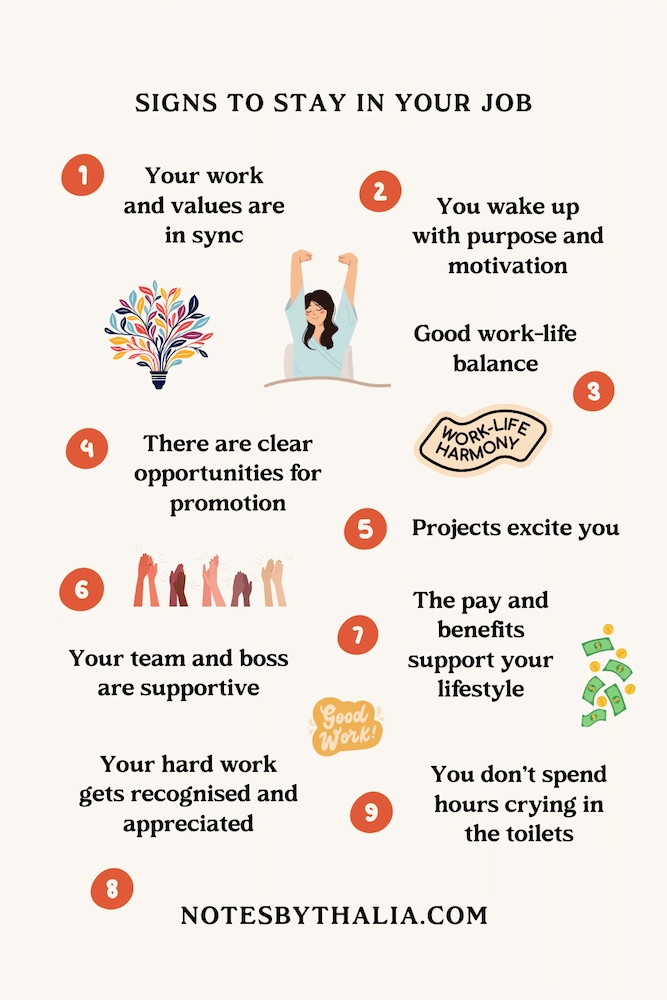
Here are some telltale signs it’s safe to stay in your job:
- You’re growing and learning in your role
- You wake up with purpose and motivation
- Upcoming projects excite you
- Your team and boss are supportive
- You have a good work-life balance
- The pay and benefits support your lifestyle
- There are clear opportunities for promotion
- Your hard work gets recognised (and appreciated)
- You align with the company’s values
- You don’t spend hours crying in the toilets
If most of these sound like your situation, it’s a pretty good sign that your current job is worth keeping.
Sure, you might experience ups and downs (hence why you’re reading this post), but overall, it sounds like you’re in a pretty fulfilling job. How good does that feel?
Signs it’s time to quit your job
Here’s what I was dealing with when I knew it was time to break free from the 9-to-5.
- Unhealthy work-life balance
- Burnout
- Low moods and always waking up in a funk
- Overwhelm and anxious thoughts
- Clock-watching
- Lack of energy and enthusiasm for the day ahead
- Excessive drinking to escape my current reality
- Having zero purpose or direction
- Low confidence
- Crying at work (mainly in the toilets)
- No passion or excitement for life
If you’re experiencing one or more of the above issues, just know that you are not alone. There are a lot of other women out there going through the motions, too.
I was one of those women. But I managed to overcome the obstacles that I was facing by removing myself from a toxic situation and quitting my job.
Here are the exact steps I took to quit my job with confidence.

Final thoughts
Just because you feel unsatisfied in your job now doesn’t mean you’re stuck there. You always have the power to pivot.
Pivot your goals
Pivot your relationships
Pivot your identity
Pivot your thoughts and beliefs
Pivot your career
Pivot your environment
Pivot your life.
But only if it feels right.
Go through the above tips and make your decision based on the facts. Is it time to move on from your job and potentially change career or direction, or travel the world? Or do you feel more grounded and settled knowing this is the right job and you’re just going through a rut?
Take your time, get radically honest, and prepare for an awakening that could change everything.
You’ve got this.
Thalia xx