Did you know that one of the main red flags of burnout is irritability?
This means that when you’re stressed TF out at work, you might notice you have less patience, roll your eyes way more than usual, and maybe even say harsh things in the heat of the moment
If this sounds like you, I want you to know it’s not your fault. Burnout clouds your judgment, making it harder to communicate what you need.
You’re not trying to be rude. But you’re also not about to let people walk all over you.
And sometimes the words you choose can come across the wrong way. Or you freeze and say nothing at all.
That’s why having certain phrases up your sleeve is non-negotiable. They help you stop reacting and start responding — clearly and respectfully.
This list is for those moments when you’re juggling too much and you’re inches away from exploding at the next person who says, “Got a sec?”
These phrases will help you stay calm under pressure without sounding like a bitch, falling into people-pleasing mode (aka saying “yes” when you really want to say “no”), or regretting what you just said five minutes later.
Let’s dive in.
P.S. If you’re new here, hey! I’m Thalia. I help 30-something girlies beat burnout and unf*ck their life through 1:1 coaching and self-paced tools. Every week(ish), I share content on burnout recovery, self-development, finding joy, and career growth. Subscribe here so you never miss a debrief.
What NOT to say at work
When you’re at breaking point, it’s easy to either say nothing or say too much.
Sometimes you bottle things up, slap on a fake smile, nod along, and try to push through. Other times, you snap. You sound blunt in meetings, send cold emails, vent to the wrong person, and say things that sound way harsher than you intended.
I’ve been that girl.
During my 9-to-5 era, I worked in an extremely toxic workplace. The kind where shouting was the norm, emails came through at midnight, and at least someone was crying in the toilets, but everyone was just too burnt out to care.
The problem wasn’t just my boss or colleagues. It was also me. (Hard pill to swallow, admitting that.)
I had a short fuse and struggled to communicate clearly under pressure. I’d get frustrated with models, clients, and even my own team, snapping over small things, being passive-aggressive, or sometimes even starting arguments.
I had no healthy language for stress, no real boundaries, and definitely no emotional regulation.
The truth was, we were all stressed out. It wasn’t a healthy environment to work in, and nobody had the tools to cope. We were all just reacting.
Looking back, something as simple as saying “I’ve got your back” or “Let’s figure this out together” could’ve softened the situation and created more trust.
But instead of being supportive, what came out were things like:
- “I don’t have time for this.” (When I meant, “I’m at capacity and need to reprioritise.”)
- “Fine.” (when it wasn’t fine at all)
- “Are you serious right now?” (paired with sarcasm and eye-rolls)
- “Ugh, whatever.” (aka: total shutdown.)
- “Can someone else just deal with it?” (out of pure overwhelm, not laziness)
- “This is ridiculous.” (usually loud enough for the wrong people to hear)
- “I guess I’ll just do it then.” (resentful martyr vibes)
- “It’s not my job.” (even when it technically wasn’t — still not helpful)
These phrases might feel justified in the moment, but they break down trust, stir up tension, and leave you feeling worse because you’re not showing up as the best version of you.
I didn’t want to sound rude, but when you don’t have the language to say how you really feel without losing your cool, it’s easy to say something you don’t mean.
If this sounds like you, too, don’t beat yourself up.
The problem isn’t that you’re too sensitive or not tough enough. It’s that no one has ever taught you how to navigate this kind of stress in a healthy and respectful way, for yourself and the people around you.
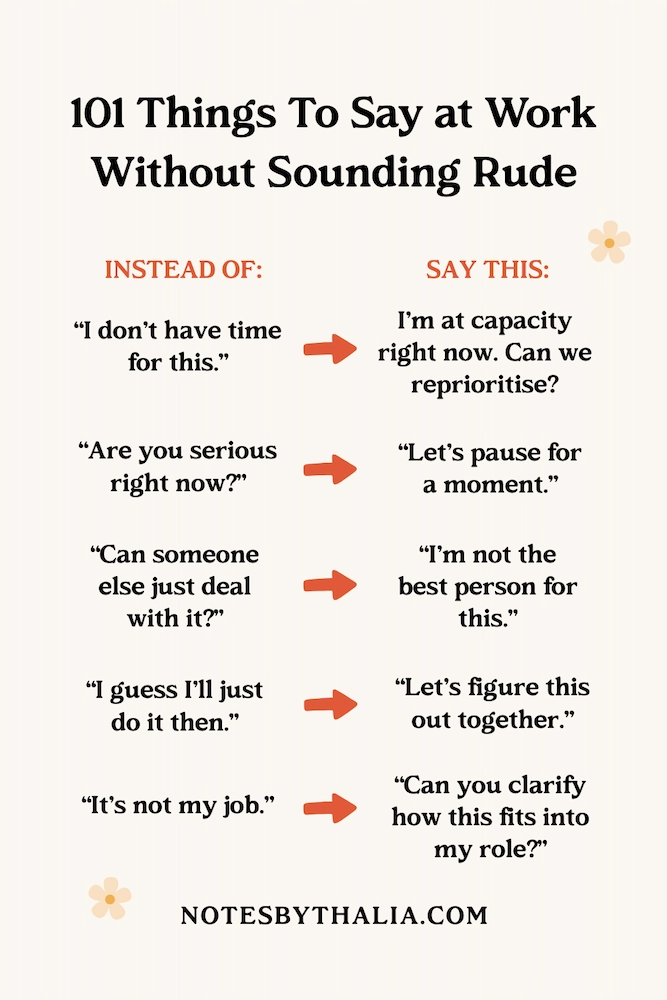
101 Things to say at work without sounding like a bitch
This list gives you something to say when your mind goes blank or your emotions are running the show.
Each section covers a different moment, from dealing with pushy colleagues to shutting down shady comments. You’ll find language that’s clear, respectful, and honest.
I’m diving deep into:
- What to say to demanding colleagues
- What to say instead of ‘no’
- What to say to protect your time
- What to say when declining a meeting
- What to say when you need more time
- What to say to passive-aggressive comments
- What to say when things get awkward
- What to say when self-doubt hits
I encourage you to save this post now so you can come back to it whenever you need to.
What to say to demanding colleagues
- Hey, I’m deep in something right now, can we chat at [specific time] instead?
- Happy to connect, can we schedule 15 mins tomorrow? I want to give it my full attention.
- I’m currently at full capacity. Can you let me know the deadline so I can prioritise accordingly?
- Thanks for sending this over. Just a heads up, I won’t be able to get to it until [day/time].
- Appreciate you flagging this. Is this something you’d like me to prioritise over [X]?
- Quick check-in: Is this urgent or can it wait until [later time]?
- I’m managing a few competing deadlines right now. Can we touch base next week instead?
- Would it be helpful if I looped in [another team member] so this doesn’t hold up progress on your side?
- Can you drop that in an email? I want to make sure I don’t miss anything while I’m juggling a few things.
- I’d love to help, but I need to wrap up [X task] first. Can we touch base after?
- Just to manage expectations, my plate’s pretty full today, so I might not get to this until [insert day/time].
What to say instead of ‘no’ (even when it’s not a yes)
- I don’t have the capacity for this right now. Can we revisit next week?
- Happy to support, but I’d need to shift something else. Can we go through what is a priority?
- I’m at maximum capacity at the moment. Can someone else jump in on this one?
- Thanks for thinking of me! I won’t be able to take this on right now.
- I’m currently focused on [X], so I wouldn’t be able to give this the attention it deserves.
- This isn’t something I can commit to at the moment.
- I’d love to help, but my plate’s full. Can I recommend someone else?
- That’s not something I’m able to take on at this time.
- Full transparency, I can’t give this the time or attention it deserves right now. I’m happy to suggest someone else, though.
- I’d need to say no to something else to make room for this. Can we go through who can take it on instead?
- If the deadline is flexible, I could potentially fit this in later. Let me know.
- Appreciate you reaching out! I need to pass this time to stay on track with other priorities.
What to say to protect your time
- I’m stepping back from this for now so I can refocus on my priorities.
- I’m offline after [X time], but I’ll get to this first thing tomorrow.
- I’m not available at that time, but I can offer [alternative time or format].
- I’d prefer to keep this within work hours. Can we reconnect tomorrow?
- I’m pausing notifications so I can stay focused. Feel free to email if it’s urgent.
- I’ll need to pass on this to stay on track with my current projects.
- I’m fully booked today, can we revisit this next week?
- That’s not something I can take on right now, but I’ll let you know if anything changes.
- I’m happy to support, but I’ll need clearer priorities before I commit.
- I’ll be unavailable during that window. Can we do this [insert date + time]
- I’ve blocked out time for focused work, so I’ll be unavailable until [X time].
- I’ve noticed I work better when I have some space between meetings, so I’m keeping that time blocked.
- I’m only saying yes to the work that really matters right now.
What to say when declining a meeting
- I’ve got quite a few deadlines coming up, so I need to sit this one out to stay on track.
- I won’t be able to join this one, but please feel free to share any key takeaways.
- I’d like to pass on this for now, but happy to check in afterwards on anything important if that’s helpful.
- I’ll have to decline due to scheduling conflicts. Can we catch up another way?
- Thanks for the invite! I’m not available, but please loop me in on anything relevant afterwards.
- I’m opting out to keep my day manageable. Thanks for understanding.
- I need to skip this one to make space for deep work, but let me know if my input is urgently needed.
- I’ve reviewed the agenda and don’t think I’m needed for this. Happy to be pulled in if that changes.
- I need to prioritise some focused time today, so I’ll be stepping back from this meeting.
- My plate’s full right now, and I’d rather give you my full attention when I can.
- I’ll pass on this one, but feel free to drop me any notes or questions you have for me afterwards.
What to say when you need more time
- I’m still working through this and could use a bit more time to wrap it up.
- This is taking a little longer than expected, and I want to make sure it’s done properly. Can we extend the deadline by [insert length]?
- I want to make sure this gets the attention it deserves. Can we extend the timeline slightly?
- I’m juggling a few other priorities right now. Can we push this back to [insert day/time]?
- I’d rather take an extra day and deliver something solid than rush it through.
- If the deadline is flexible, I’d love a little breathing room to finish this well.
- Just making you aware that I might need a bit more time to complete this thoroughly.
- This is in progress, but I want to double-check a few things before finalising.
- I’m making progress, but I’d rather not rush this. Can we revisit the deadline?
- I’m running behind, but I’ve got a clear plan to finish by [insert new timeline].
- I’m hitting some obstacles with this, which is pushing back my progress. Can we chat about adjusting the deadline?
- I’m still on it, but need to move the timeline slightly to maintain quality.
What to say to passive-aggressive comments
- Just to clarify, what did you mean by that?
- I’m not sure I understand the intention behind that comment.
- That sounded a little harsh. Was that your intention?
- If there’s something you’d like to address directly, I’m happy to have that conversation.
- I’m not comfortable with that tone. Can we reset?
- Let’s keep this focused on the work, not personal digs.
- I’d appreciate it if we could keep feedback direct and constructive.
- I’m open to hearing concerns, but not through sarcasm.
- I’m not sure if that was a joke, but it didn’t land well.
- That feels a little off. Can you help me understand where you’re coming from?
- If there’s an issue, let’s talk about it openly instead of letting things linger.
- I’d rather we be direct with each other so we can stay aligned. Side comments just slow things down and make it harder to collaborate.
- I’d prefer we keep the conversation respectful, as it helps everyone stay on the same page.
What to say when things get awkward AF (e.g. office gossip, conflict, etc.)
- I don’t really feel comfortable weighing in on that.
- Not sure I’m the right person to comment on this.
- Let’s keep this one professional.
- I’d rather focus on the task at hand.
- Happy to chat about this, but let’s bring it back to the actual work.
- I think we’re veering off track. Should we loop back to the main point?
- I’m not sure that’s something we need to get into right now.
- That’s between them, I’m staying out of it.
- Let’s park that convo for another time.
- I don’t think it’s fair to make assumptions without context.
- Probably best we keep that between the people directly involved.
- That feels like more of a private conversation.
- I’m not really comfortable getting involved in this.
- I’m going to step away from this chat. I’ve got a few things to finish up.
- I’m going to leave this one alone, it’s not really my business.
- Oof, I think I’m going to stay neutral on this one.
What to say to yourself when self-doubt hits
- I’ve done hard things before, I can handle this too.
- I don’t need to be perfect. I just need to keep showing up and doing my best with what I’ve got.
- Feeling uncertain doesn’t mean I’m doing it wrong; it just means I’m growing.
- I’m not behind, I’m on my own timeline, and it’s allowed to look different from everyone else’s.
- I have everything I need within me to handle this.
- I’ve made it through every tough day so far. I can trust myself to handle this one, too.
- Just because I’m doubting myself doesn’t mean I’m not capable.
- I don’t need to feel 100% confident to take action. I can do this.
- I’ve done enough. I am enough.
- I don’t need to downplay my wins just to make other people feel more comfortable. I’m allowed to take up space.
- I belong in this room, even when I’m doubting it.
- I don’t need to have it all figured out to be proud of how far I’ve come.
- You’ve got this.
![Infographic titled “101 Things To Say at Work When You’re Stressed.” It features six calm, respectful phrases for setting boundaries and protecting your time at work. Examples include: “Hey, I’m deep in something right now, can we chat at [specific time] instead?” and “I’d love to help, but my plate’s full. Can I recommend someone else?” The phrases are shown in different colours for visual contrast.](https://notesbythalia.com/wp-content/uploads/things-to-say-at-work-infographic.webp)
Final thoughts
POV: You don’t need to suck it up, play nice, or keep saying “yes” just to avoid awkwardness.
What you do need is language that protects your energy and helps you hold your boundaries without sounding rude.
These phrases won’t fix a toxic workplace, but they will help you respond clearly, calmly, and with confidence. They’ll give you a way to stay grounded, even when the pressure’s high and your patience is thin. Because you deserve better than crying in the office toilets over something you said.
You’ve got this.
Thalia xx