If you’ve ever said “yes” to a work thing when every cell in your body was screaming “HELL NO,” this post is for you.
If you’ve ever let a friend trauma-dump on you at 10 PM when you were one minute away from crashing or felt like your boss low-key owns your life… again, welcome!
Boundaries aren’t about being selfish or difficult. They’re about being conscious. Conscious of what you need, what drains you, and what keeps you grounded.
I didn’t always get this.
Back in my 9-to-5 job, I was that girl who answered emails at midnight, couriered office keys at 1 AM (yep, for real), and let my boss treat me like I didn’t have a life of my own.
And outside of work?
Same story. I couldn’t say ‘no’. I said yes to every invite, every night out, no matter how drained I was. I drank through the exhaustion because the FOMO was louder than my need for rest, until my body said, “Enough.”
Let me guess: You’ve been pushing through the burnout too, as if it’s just part of the job. And you can’t shake that feeling that you’ve completely neglected yourself.
If that’s you, don’t worry. We’re about to change that.
P.S. If you’re new here, hey! I’m Thalia. I help 9-to-5 girlies recover from burnout and transform their draining AF job into a magnetic career they love. Every week(ish), I share content on burnout recovery, self-development, finding joy, and career growth. Subscribe here so you never miss a debrief.
Signs you need better boundaries
Before we dive into the how, let’s talk about the why.
Setting boundaries at work isn’t just about doing less—it’s about protecting the parts of you that matter most.
They give you space to breathe, think, and actually feel like yourself again.
When you’ve got clear boundaries, you’re not running on empty or reacting to everyone else’s needs—you’re grounded, focused, and way more connected to what you want.
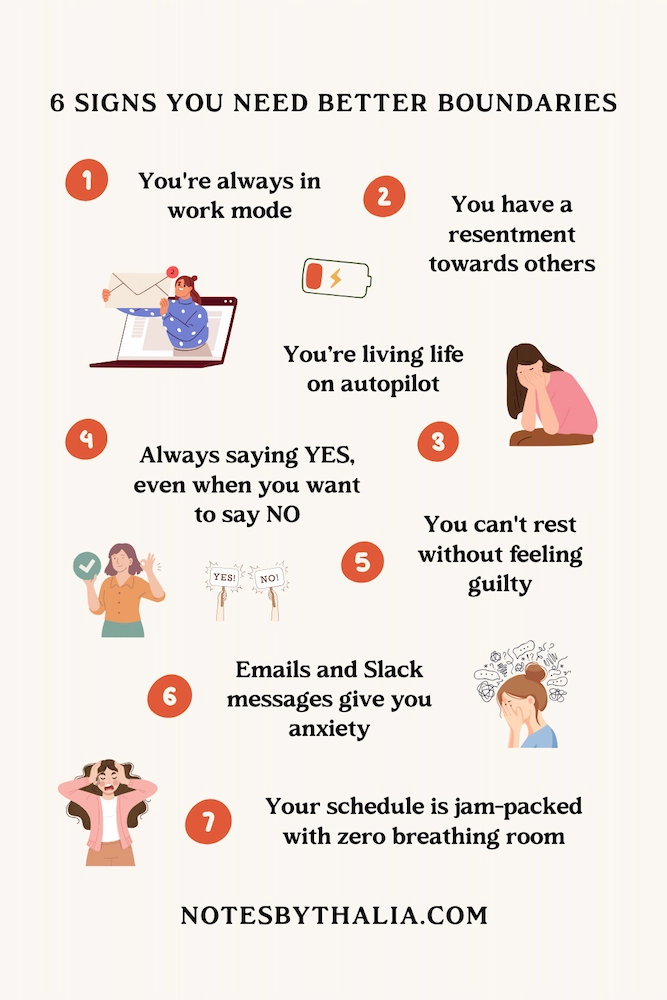
If you’re experiencing any of these signs, chances are your boundaries need a serious upgrade:
- You feel resentful toward people but can’t explain why
- You’re always “on,” aka. You never clock out, even if you work remotely
- You say yes, then instantly regret it
- You avoid checking your messages or get anxious when your phone buzzes
- You struggle to rest without feeling guilty
- You feel responsible for other people’s emotions
- Your schedule is jam-packed with zero breathing room
Let’s get one thing straight…
This isn’t just about being busy. It’s about being too available. The first step: Get radically honest with yourself and ask, “Am I choosing me, or just trying to keep everyone else happy?”
Want to set better boundaries? Start with yourself.
Most people think setting boundaries at work is just about saying “no” to other people.
But the truth? The real transformation happens when you start setting them with yourself.
It’s about holding yourself to the same standard you hold everyone else to. Logging off when you said you would. Taking breaks without feeling guilty. Not saying “yes” to things you deep down know aren’t aligned.
Because if you don’t respect your own time and energy, it’s hard to expect anyone else to.
You need to start showing up for yourself.
Not just once, but over and over again, with consistency, with compassion, and without apology. Here’s how…
P.S. I encourage you to save this past so you can come back to it whenever you need to.
1 | Put yourself first, always
This is where it all begins.
You’ve been taught to believe that putting yourself first is selfish.
But it’s not. It’s self-respect. Because when you constantly put everyone else’s needs ahead of your own, you end up exhausted, resentful, and totally disconnected from who you are.
Putting yourself first isn’t about ignoring others. It’s about checking in with you first. Before you say yes. Before you commit. Before you put everyone else’s needs above your own.
It’s asking: What do I need right now?
And then actually giving that to yourself without guilt. Because you can’t show up fully for anyone else until you’ve shown up for yourself first.
Action steps
- Start your day with 10 minutes of you time before opening your phone or emails
- Block out non-negotiable time in your calendar for rest, food, movement or stillness, and stick to it
- Say “let me get back to you” before giving a “yes”
- Create a “Hell Yes or No” list to help you filter invites, commitments and favours
- Before doing something for someone else, ask: Do I actually have the capacity for this right now?
2 | Use the “let them” theory
If you’re drained AF from constantly managing other people’s expectations or behaviour at work (e.g. clients, coworkers, your boss, etc.) The Let Them Theory by Mel Robbins offers a simple fix: let them.
Let your boss micromanage.
Let them send passive-aggressive emails.
Let them be annoyed.
Let your colleague be competitive.
Let them take credit.
Let them have their opinions.
Let them judge.
Because guess what? You don’t have to fix it, explain yourself, or carry the emotional weight. Their behaviour is a reflection of them, while your peace is a reflection of you.
Action steps
- The next time someone acts out of line, pause and say (in your head): Let them.
- Set a boundary around your response time (FYI, you don’t need to reply immediately)
- Create a “not mine to carry” list—note what behaviours, comments or dynamics you’re choosing to stop taking personally
- Mute Slack channels, WhatsApp chats or social media accounts that drain your energy
- Write a sticky note that says “Let them” and keep it somewhere visible as a daily reminder
3 | Challenge negative self-talk
I use this one a lot when I catch myself spiralling or being hard on myself. It’s a quick mental check-in that helps me move on instead of getting stuck in the loop.
Here’s how it works:
When a negative thought pops up (e.g. “I’m falling behind” or “I’m not doing enough”), pause and ask:
a. Is this trash?
Meaning: Is this thought untrue, unkind, or just plain unhelpful? If yes, bin it. You don’t need to carry that around.
b. Or is it a tool?
Maybe this thought is making you aware of something.
Like you’re being stretched too thin, or your current work situation actually does need to change. In that case, great, use it. Take action from a place of awareness, not panic.
This filter helps you separate the noise from the truth. You don’t have to let every anxious thought to dictate your actions.
You’re the CEO of your mind, so start acting like it.
Action steps
- When a negative thought pops up, ask: Is this trash or a tool?
- Keep a sticky note or journal nearby and write down recurring thoughts to notice any patterns
- Set a 5-minute timer to brain-dump your worries, then walk away from the page
- Replace common toxic thoughts with neutral ones (e.g. “I’m behind” → “I’m moving at my own pace”)
- Create a “reality check” folder in your Notes app with reminders, wins, and voice memos to ground you when self-doubt hits
4 | Create white space in your day
In a world obsessed with productivity, white space is radical.
Blocking out 15–30 minutes a day to pause might sound unproductive, but it’s exactly what you need to avoid burnout.
No meetings. No todos. No multitasking. No guilt. Just a window of time where you’re not in constant “go, go, go” mode.
White space gives your brain a break. It’s where you process things, reset your energy, and actually catch your breath.
This isn’t about checking off another self-care activity. It’s about giving yourself space so you can show up to the rest of the day feeling like a 10 out of 10, and not someone who’s about to lose their shit.
Action steps
- Block out 15–30 minutes of white space in your day and commit to it like a meeting
- When it’s time, ask yourself: What do I need right now? (This might look different every day)
- Step away from your screen and move your body (even if it’s just to stretch)
- Create a short playlist that helps you reset mentally and emotionally
- Keep a physical reminder on your desk (like a sticky note) so you don’t forget to pause
5 | Keep the promises you make to yourself
Boundaries mean nothing if you’re not sticking to them.
You can set all the intentions in the world: log off by 5 pm, say “no” to extra work, stop doom-scrolling, etc. But if you keep breaking your own rules, you’re telling yourself that your needs don’t matter.
Self-respect isn’t just about what you say.
It’s about what you do.
So if you want your boundaries to actually stick, you’ve got to follow through with them and be consistent.
Action steps
- Choose one small boundary to practise daily (e.g. no work after 6, take a proper lunch break)
- Add it to your calendar and treat it like a commitment
- Set a phone reminder that says: “Keep the promise”
- Celebrate it when you follow through (celebrating wins builds consistency)
- If you fall off track, no worries—just notice it, reset, and start again
Bonus | Use these email templates
The hardest part about setting boundaries, especially at work, is finding the right words.
Maybe you’re afraid of being seen as “difficult” or sounding dramatic, so you just keep quiet. That’s where email templates can make your life so much easier.
Having a done-for-you script as a starting point takes out the awkwardness and second-guessing, so you can clearly communicate what you need (and actually stick to it) without the stress or guilt.
Action steps
- Use these templates as inspo
- Pick the template that fits your situation best—whether you’re pushing back on a deadline, saying no, or asking for support
- Edit the customisable sections so it feels personal and true to you
- Copy and paste into your work email, take a deep breath
- Hit send with confidence, knowing you’ve finally said what you needed to say—clearly and professionally

How to ditch the guilt when setting boundaries
Let’s face it: setting boundaries is easy.
The hard part is actually sticking to them without guilt.
Guilt doesn’t mean you’re doing something wrong—it just means you’re doing something new. Especially if you’re used to always saying yes and pushing through.
This 3-part framework will help you hold your boundaries at work with confidence.
1 | Notice any patterns
Before you can stop guilt from taking over, you’ve got to notice where it’s creeping in.
When do you feel that internal ugh after setting a boundary? Is it with certain people? Certain situations? Certain times of the month? Is it fear of being seen as difficult? Or letting someone down?
Grab a journal and brain dump it out. You don’t need to find the answers yet. Just get curious. Guilt loves to sneak in when you’re not paying attention. Awareness is what shuts it down.
Hot tip: Scroll through your calendar or messages and ask, “Where did I neglect my needs this week?” Let those receipts speak for themselves.
2 | Know your why
Your boundaries are only as strong as the reason you set them. So ask yourself: What am I really trying to protect here?
Your sanity? Your rest? Your creative energy? Your ability to not scream into a pillow at 7 PM?
Write it down. Make it sacred. Post it on your mirror if you need to. When the guilt creeps in (and it will), always come back to your why.
Remember: You’re not being rude. You’re being responsible with your energy, your time, and your well-being.
3 | Own your boundaries
You don’t need to overexplain or justify your boundaries.
Just be clear, kind, and direct.
Try saying:
- “I don’t check messages after 6. I’ll reply in the morning.”
- “That doesn’t work for me, but here’s what does.”
- “I’ve got a lot on right now — can we pick this up next week?”
Then stick to it. No backtracking. No playing small. No over-apologising.
You’re allowed to protect your time and energy without feeling bad about it.
Final thoughts
Look, setting boundaries at work isn’t always easy. Especially if you’ve spent your life putting others first. It will feel uncomfortable at first. You might second-guess yourself. You might feel guilty.
But every time you choose yourself, you’re rewriting your story.
You’re saying: “I matter. My needs matter. My energy matters.”
And guess what?
You don’t owe anyone 24/7 access to you. You don’t have to explain why you need rest, space, or silence. You’re allowed to choose you, without guilt or apology.
So whether it’s your boss, your best friend, or that overactive voice in your head—it’s time to draw the line.
Boundaries aren’t a luxury. They’re non-negotiable. And they’re the difference between staying stuck in a job that’s draining the life out of you vs. slaying in it.
So don’t skip this step.
You’ve got this,
Thalia xx