

If your job is slowly draining the life out of you, you’re not imagining it.
And you’re definitely not the only one.
Maybe you’re emotionally exhausted and crying at your desk more than you’d like to admit. Maybe you’re losing sleep, drinking more than usual, or having full-blown nightmares about work.
Whatever it looks like for you, it’s a sign that something needs to change.
But that doesn’t mean you have to hand in your notice tomorrow.
Quitting impulsively rarely ever works, and if you’re already overwhelmed, the last thing you need is to make another big decision from a place of burnout.
What you DO need is a survival plan.
Something to help protect your well-being now while you figure out what’s next.
Let’s dive in.
P.S. If you’re new here, hey! I’m Thalia. I help 30-something girlies beat burnout and unf*ck their life through 1:1 coaching and self-paced tools. Every week(ish), I share content on burnout recovery, self-development, finding joy, and career growth. Subscribe here so you never miss a debrief.
Signs you’re stuck in a toxic job
I stayed in a toxic job for 6 years before I finally walked away.
And honestly, that’s because I was blindsided by the version of success everyone else was buying into.
I had the kind of job that looks great on Instagram and has everyone telling you how lucky you are. Sure, to an outsider, my fashion career was glamorous AF. Good salary, busy social life, cool industry perks.
But my life didn’t feel like mine.
It was controlled by a demanding boss, a chaotic schedule, and the constant pressure to keep up. I was waking up every morning with what felt like the weight of the world on my shoulders. My weekends were ruined by work stress, and my relationships were suffering.
And when I looked in the mirror, I didn’t even recognise myself anymore.
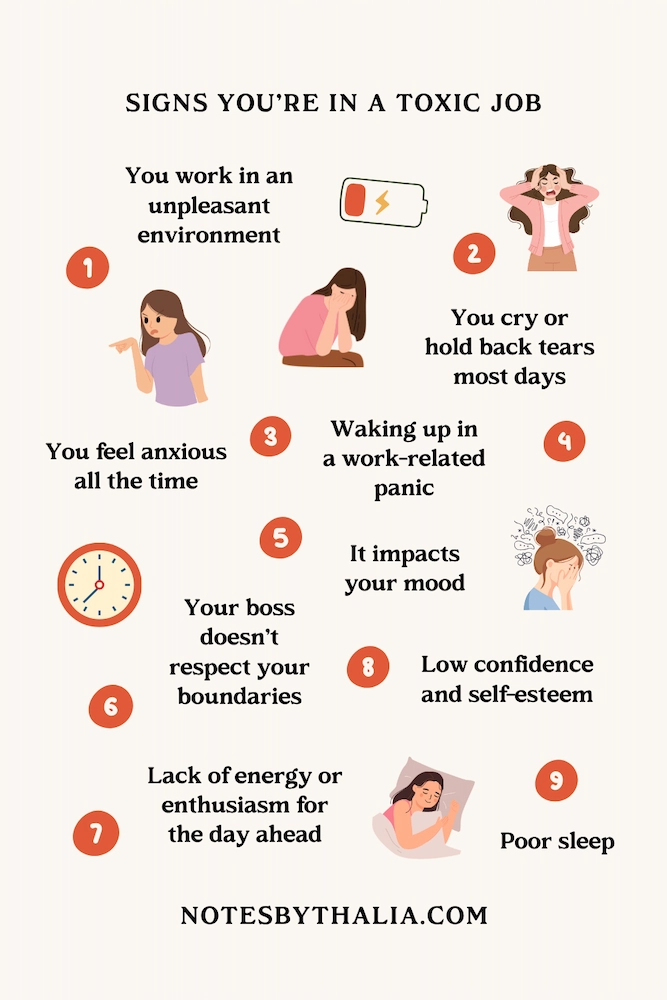
I was also dealing with:
- An unpleasant environment (aka bitching, yelling, gossiping, passive-aggressive comments)
- Crying or holding back tears
- Burnout
- Feeling anxious all the time
- Poor sleep
- Waking up in a work-related panic (to this day, I still have nightmares)
- Low moods
- Lack of energy and enthusiasm for the day ahead
- Excessive drinking to escape my current reality
- Low confidence
- No passion or excitement for life
If you’re nodding along like crazy, I want you to know you’re not alone. There are a lot of women going through the exact same thing.
I was one of them. And while my situation got bad enough that I eventually had to leave, the steps below are the things that helped me survive it while I was deep in it.
What to do if you’re stuck in a toxic job
Just a heads up — this blog post is based on my own experience.
I’m not a clinical mental health expert, but I’ve coached a lot of women through this exact situation, and I’ve lived it myself.
So I share these tips in the hopes they’ll help you in some way, whether that’s to give you support, inspire you to make a change, or allow you to feel less alone.
P.S. I encourage you to save this post (like now!!) so you can come back to it whenever you need to.
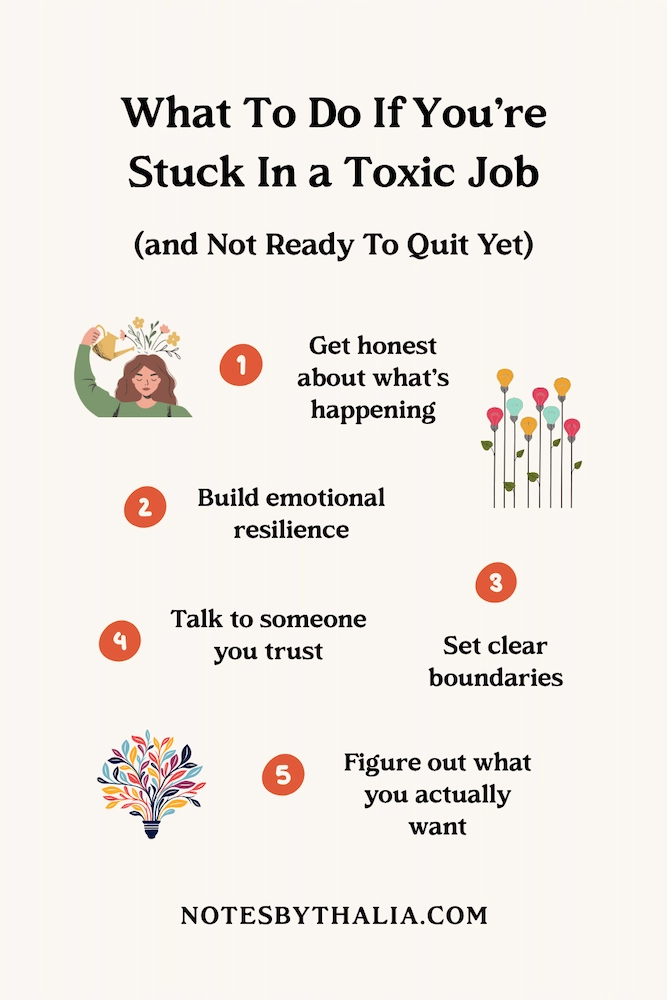
1 | Get honest about what’s happening
There’s a lot of denial that comes from being in a toxic job. I mean, hands up if any of these sound familiar:
“No one likes their job.”
“Maybe I’m just being too sensitive.”
“I should be grateful for this opportunity.”
I told myself these things for years. I was so deep in survival mode that I’d convinced myself that feeling miserable from 9 am to 5 pm, 5 days a week, was the norm.
It’s not by the way. Take it from someone who stayed in a toxic job for 6 years out of fear — pushing your feelings down doesn’t make them go away. It just makes them louder.
To better navigate a toxic work situation, you first need to acknowledge what’s actually happening. Not the watered-down version you tell your mum, or the dramatic AF version you tell your friends.
The version you tell yourself at 11 pm on a Sunday.
Because once you stop lying to yourself about how bad it actually is, you can finally start doing something about it.
Action steps:
- Write down what your job is really like (the unfiltered version)
- Notice when you’re brushing off how bad it actually is
- Identify what’s triggering your anxiety (e.g. your boss, the workload, the commute, etc.)
- Pay attention to where you feel the stress in your body
- Stop comparing your situation to people who “have it worse”
2 | Build emotional resilience
The one thing I wish I’d done while I was in my toxic job was build resilience.
I’ve always been sensitive, but working in a stressful environment broke me down even more, to the point where I’d crumble under the pressure and cry in the office toilets most days.
Instead of building up my resilience to handle challenges better, I put up a barrier to protect myself from all the negativity.
Unfortunately, those walls I put up to protect myself turned me into a cold-hearted bitch. Oops.
When I finally walked away, I had to shed that version of me and reconnect with my true self. (aka a soft girlie.)
Anyway, take it from me, that’s not the kind of work you want to be doing AFTER you’ve left your job. You want to be building yourself UP while you’re still in the situation, so the situation doesn’t break you down further.
Resilience isn’t about pretending things don’t bother you. It’s about being able to feel the feelings, process them, and not let them define how you show up in the rest of your life.
So do not skip this step!
Action steps:
- Practice gratitude so you notice the good, not just the bad
- Adopt healthy habits that support your nervous system (e.g. sleep, movement, fresh air, etc.)
- Prioritise rest every single day (not just when you’re falling apart)
- Spend time with people who fill up your cup, not drain it
- Consider therapy or coaching if you’ve got the resources
3 | Set clearer boundaries
Setting boundaries is key to surviving a toxic job. And I’m not talking about being mean or shutting people out.
I’m talking about protecting your time, your energy, and your mental health so you can stop letting the toxicity bleed into every other part of your life.
I was weak and allowed my toxic job to impact my entire life.
I’d take work calls at weekends, reply to emails at 10 pm, and skip lunch breaks to catch up on work. I’d also bring work stress home and then drink a bottle of wine to numb it.
Spoiler: none of this helped. It just meant my job became 100% of my life.
The truth is, boundaries feel terrifying when you’re scared of being seen as difficult. But the alternative is letting your job take over, which is so much worse.
Boundaries aren’t about being bitchy or selfish. They’re about deciding what you will and won’t accept, then communicating that without apologising for it.
Action steps:
- Work out where you draw the line, then actually draw it
- Practice saying no out loud before you have to say it for real
- Schedule proper lunch breaks
- Stop checking emails outside of work hours
- Add things to your desk that bring you joy
4 | Talk to someone you trust
This was the step I avoided for the longest time.
For years, I didn’t tell anyone how bad things really were. Mostly because I didn’t have the words for it, and also because I was embarrassed. I felt like I was the only one struggling, and that admitting it would mean admitting failure.
I was wrong on both counts.
When I finally opened up to my bestie, it felt like a weight had been lifted from my shoulders.
I finally had someone in my corner. Someone who could see what I was going through, validate it, and help me think through what to do next. That made a big difference.
So give yourself permission to open up. Sometimes it’s nice to hear someone say, “I’m here for you.” Remember, you don’t have to figure this out alone.
Also, while I’m here, just an FYI — avoid speaking to colleagues. They’re dealing with their own shit and probably aren’t the right people to vent to.
If you have an HR department, just be aware that HR’s primary job is to protect the company, not you.
That doesn’t mean they can’t help, but go in with realistic expectations. Document everything, have a clear ask, and don’t expect them to fix the bigger cultural problems.
Action steps:
- Stop keeping it all in your own head
- Open up to a friend or someone you trust about what’s actually going on
- Be clear on what you need from them — are you venting, wanting advice or a plan, etc.?
- Use a script if you don’t know how to start the conversation
- Check if your workplace has free counselling
5 | Figure out what you actually want
When you’re burnt out, your brain doesn’t make good decisions. You can’t think clearly about what you actually want when you’re operating from exhaustion, resentment, and panic.
The first four steps are about getting yourself to a place where you CAN think clearly.
Once you’re there, it’s time to get honest.
Do you actually want to leave this job, or do you just want it to stop feeling so bad? Those are two different things, and they have two different solutions.
If staying is the better option for you right now, then your focus is on making the situation better. Stronger boundaries, deeper resilience, more support, a clearer divide between work and the rest of your life.
If leaving is the right call, then your focus should be on planning a clean exit. That means thinking about finances, what you want next, and how to leave without burning bridges.
There’s no universal right answer. There’s only the answer that’s right for you, in your specific situation, with your specific bills, ambitions, and tolerance for risk.
Action steps:
- Get honest about which option you actually need and want
- Look at the practical realities, e.g. finances, savings, job openings, etc.
- Write a who am I essay and dive deep into who you are beyond your job title
- Ask yourself the difficult questions about what you really want from life
- Map out an exit strategy if you do decide to quit
How to take this work deeper
If, after working through all of this, you decide that staying is the right move (and you want to genuinely thrive in your job, not just survive it), Stay & Slay was written for you.
This is the book I wish I had when I was deep in burnout and thought the only way out was quitting.
I definitely stayed in my toxic job for way too long, but even after I left, it took me a few more years to figure out how to actually heal from burnout and build a career I love.
Stay & Slay is everything I learnt along the way (minus all the trial and error).
It breaks down The Anti-Burnout Framework™ into a digestible roadmap that teaches you how to rebuild your confidence and stop letting your job run your life.
You’ll learn the truth about what’s actually causing your burnout and how to fix it from the inside out so you can finally feel energised, fulfilled, and back in control.
And because I’m not here to waste your time, it comes with a 50-page workbook so you can implement every strategy and actually see results IRL

Final thoughts
If you’ve made it this far, then go you.
You’ve already done the hardest bit, which is admitting something needs to change.
A lot of us corporate girlies spend years convincing ourselves that we’re just being over-dramatic and things are actually fine, so do not underestimate this. It’s a big deal.
And whatever you decide to do next — stay and make things better, or work towards leaving — you don’t have to figure it all out today.
You just need to know that you don’t have to keep feeling like this forever. There are options. And you’re allowed to want more for yourself than what you’ve got right now.
Take it slow. Be kind to yourself. And trust that you know what you need.
You’ve got this.
Thalia xx






Mark J Maciariello
Is it okay If I am not a woman, but just someone who really could use some help? Or can you recommend someone for me? I have been struggling mentally for about 6 years at my current job (mechanic). I really need to find a way out of this whole career. I can’t keep up with the technology of cars and after 35 years of doing this I am done with buying new tools out of my pocket to do my job. Please let me know and thank you for this page I found, very insightful!
Keena
Hi Mark! I too am a random reader that read this entire page because of my own work experiences I’m going through right now. I was wondering if you were able to find any help or resources? Or did you ever get a response from Thalia?
Thalia
Thanks for sharing this and adding to the conversation, Keena! I’ve just sent you an email xx