Burnout makes everything feel harder.
Even the small things like waking up, sending emails, sitting through meetings, or remembering to respond to messages can all feel like too much.
And when you’re in that space, asking for help can feel weirdly impossible.
You don’t want to seem like you’re not coping, so you say nothing and just keep going. But staying quiet doesn’t make burnout any better.
In fact, it makes it worse.
If you’re barely holding it together and not sure how to speak up for yourself, this post is for you.
You don’t need an award-winning speech or to explain your whole life story.
You just need a few clear, honest sentences that let your boss know what’s really going on so you can open the door for support.
P.S. If you’re new here, hey! I’m Thalia. I help 9-to-5 girlies recover from burnout and transform their draining AF job into a magnetic career they love. Every week(ish), I share content on burnout recovery, self-development, finding joy, and career growth. Subscribe here so you never miss a debrief.
Why it’s worth speaking up
Let’s be real…
Talking about burnout at work can feel uncomfortable because you don’t want to seem like you’re not coping.
I mean, no one wants to be that girl who’s always asking for time off or pushing back on deadlines. So you keep your head down, push through, and tell yourself to deal with it when things calm down.
But by now, you know as well as I do that the moment never comes. Things never really slow down. If anything, they pick up. Your schedule gets busier, and the workload just keeps piling up.
And even if your boss isn’t toxic, they’re not a mind reader. If you don’t say anything, they’ll probably assume you’re fine even though you’re waking up exhausted, holding back tears at your desk, and lying awake at night worrying about work.
I know it feels easier to say nothing, but I also know how much better things get when you finally do.
Speaking up doesn’t mean you’ve failed or you can’t do your job. It means you care enough to want to keep doing it well, and you’re asking for the support you need to make that happen.
Here’s what else happens when you speak up:
- Your boss finally knows what’s going on and can actually help
- You protect your energy before things get to crisis mode
- You create space for real, honest conversations about what needs to change
- You build more trust and transparency with your team
- You quietly set the tone for healthier boundaries (even if no one else is doing it)
- You’re way more likely to get support before you fully burn out
- You stop silently pushing through and start creating a way of working that actually feels good
- You take back some control over your time, your energy, and how you show up
So, if you’ve been waiting for the right time or the perfect way to say, “Hey, I’m burnt out”, this is it.
Because the longer you wait, the heavier it feels. And you deserve better than just surviving the workweek on caffeine, adrenaline, and hope.
How one conversation can change everything
I’ve seen this happen with so many of my clients, like Natalie.
When we first started working together, she was running on empty. She couldn’t sleep properly, struggled to focus, and felt overwhelmed most days. From the outside, it looked like she was doing fine. She was juggling a part-time job alongside her business and was still showing up daily.
But on the inside, she was barely holding it together.
Just a few weeks in, Natalie decided to quit her job. She told me it felt like the only way to find relief. And at the time, it made sense.
But even after she handed in her resignation, the burnout didn’t go away.
Because it wasn’t just the job that was draining her, it was the pressure she’d been carrying for years. The perfectionism. The guilt. The constant need to prove she was doing enough.
So we took a step and started again.
We worked through the beliefs that tied her worth to how productive she was and rebuilt her routine around rest, intention, and self-trust.
When Natalie felt ready, she went back to her employer to have an honest conversation about how she was feeling, and they redesigned her role to better support her.
She didn’t need to quit everything. She just needed space to figure out what was actually going on and the confidence to ask for something different.
That’s the power of speaking up. It doesn’t always mean walking away. Sometimes, it’s the thing that helps you stay (and slay).
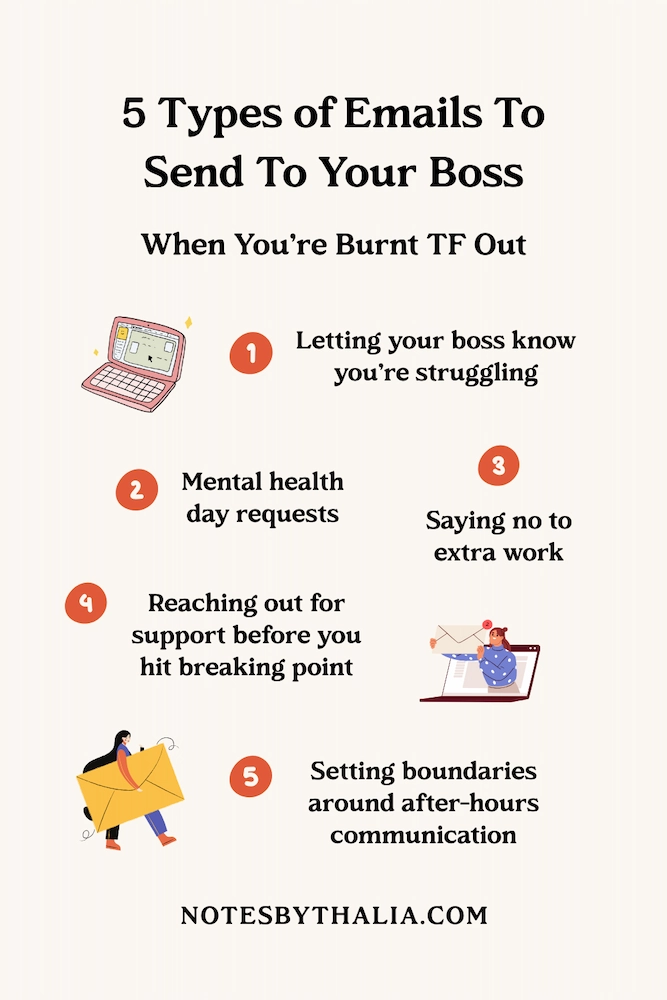
5 Emails to send to your boss when you’re burnt TF out
If you’re unsure how to bring up burnout at work, I’ve got you.
Below are five emails you can send to your boss when you feel yourself burning out. Each one includes some guidance on when to use it and why it works, so you don’t have to overthink every word.
These emails help you start the conversation in a way that’s clear, respectful, and grounded. You’re not saying, “I can’t do my job”—you’re saying, “I want to keep doing my job well, and I need support to do that.”
I encourage you to save this post so you can come back to it whenever you need to.
P.S. I’ve added an extra two templates (!!), so keep reading until the very end.
Email #1: Letting your boss know you’re struggling
Subject: Can we talk through my workload?
Hi [Your boss’s name],
I’ve been meaning to flag this for a little while, as I’ve been feeling pretty overwhelmed and mentally exhausted lately. While I’m still getting through my workload, I can feel the pressure starting to take a toll on my energy, motivation, and overall well-being.
I’m not looking for special treatment; I just want to be proactive before it gets to a point where I can’t show up fully.
Would you be open to a quick check-in this week? I’d really appreciate the chance to talk through what’s on my plate and whether we can make any short-term tweaks. That might mean shifting a couple of deadlines, redistributing some tasks, or simply agreeing on what can wait.
I care about the quality of my work, and I want to keep delivering. But right now, I know I need a bit of breathing space to make that sustainable.
Thanks for your understanding,
[Your Name]
When to send this email: When work feels like a constant grind, and you’re not coping like you usually do. You’re tired all the time, zoning out in meetings, or just not feeling like yourself, and you know it’s not going to pass with a bubble bath or lie-in at the weekend.
Why it works: This email is calm and professional, but honest. It’s giving your boss a heads-up before things get really bad, and it opens up the conversation for a more sustainable way of working.
Email #2: Asking for a mental health day
Subject: Taking a day to recharge
Hi [Your boss’s name],
I wanted to make you aware that I haven’t been feeling 100% myself lately (mentally or physically), and I’d like to take the day off to rest, as I know that stepping back briefly now will help me come back sharper.
I’ve wrapped up [X task] and will catch up on [Y task] when I’m back tomorrow.
Do let me know if you need anything else from me on my end.
Thanks for your understanding.
[Your Name]
When to send this email: When your body’s running on empty, and you know you’re not in the right headspace to do your job properly. Even if you’re not technically sick, this is an effective way to call in a mental reset day without needing to over-explain.
Why it works: It keeps things simple and respectful. You’re not asking permission to be unwell, you’re informing them that you’re taking care of yourself. You’re also proactively showing responsibility by flagging priorities, which builds trust.
Email #3: Saying ‘no’ without burning bridges
Subject: Quick heads up
Hi [Your boss’s name],
Just so you know, I’ve already got [X, Y, Z] on my plate today.
If this new task is the priority, I can reshuffle things around, but it might push [other task or deadline] back a little. Let me know how you’d like me to handle it.
[Your Name]
When to send this email: When your boss or colleague drops something on your desk last minute, but you’re already at capacity and know that saying yes means either staying late or letting something else slip.
Why it works: It’s not a hard no, it’s a gentle reality check. You’re being transparent about what’s already on your plate and giving your boss the chance to make the call. It shows you’re being mindful, not difficult.
Email #4: Asking for support before you hit breaking point
Subject: Quick check-in?
Hi [Your boss’s name],
I just wanted to check in, because I’m starting to feel a bit stretched with everything on my plate right now. While I’m still managing, I can feel the signs of burnout creeping in, and I’d rather speak up now than wait until I hit a wall.
Would it be possible to review priorities together sometime this week?
I’d love to talk through what’s urgent vs what can wait, and whether there’s anything that could be paused, adjusted or shared out with the team.
I really care about doing good work and showing up fully, and I want to make sure I’m doing that in a sustainable way.
Thanks for your time and support.
[Your Name]
When to send this email: When you’re managing, but just barely. Your stress levels are high, your motivation’s dropping, and you can feel your body or brain sending warning signs.
Why it works: You’re not waiting until things fall apart. You’re flagging it early, showing self-awareness, and offering solutions rather than just offloading stress. It sets the tone for a collaborative convo instead of an emergency meeting.
Email #5: Reclaiming your boundaries after hours
Subject: Logging off this evening
Hi [Your boss’s name],
Just a quick heads up, I’ll be logging off fully from [insert time] this evening. If anything urgent comes up, feel free to flag, and I’ll jump on it first thing tomorrow. Otherwise, I’ll be offline and back at my desk in the morning.
Thanks for your understanding,
[Your Name]
When to send: When late-night emails, after-hours messages, or weekend “quick favours” are becoming a habit, and it’s starting to mess with your sleep, mood, and general sense of peace.
Why it works: It’s clear, respectful, and low-drama. You’re not shutting the door completely, you’re just setting the tone for healthier working hours.
Email #6: Pushing back on a deadline without guilt
Subject: Quick update on [project/task]
Hi [Your boss’s name],
I wanted to give you a heads up that [insert task/project] is taking a little longer than expected, mainly due to [insert reason: e.g. higher volume, unexpected complexity, competing priorities].
Rather than rush it and compromise quality, I’d suggest moving the deadline back to [insert new date] if that works for you. That way, I can make sure it’s done properly and doesn’t knock anything else off track.
If this isn’t workable, I can shift around a few other things. I just wanted to flag it early so we can adjust if needed.
Let me know your thoughts.
Thanks,
[Your Name]
When to send this email: When you know you won’t hit a deadline and need to let your boss know in a way that’s honest, responsible, and non-apologetic.
Why it works: This email takes the pressure off without making excuses. You’re flagging the issue early and offering a solution, which makes you look responsible, not flaky. It also gives your boss a chance to reprioritise, rather than being caught in headlights at the eleventh hour.
Email #7: Calling out unrealistic expectations
Subject: Timeline / capacity check-in
Hi [Your boss’s Name],
I wanted to raise a quick concern about [insert task, deadline, or deliverable]. Based on the current expectations, it’s feeling a little unrealistic given [insert reason: competing deadlines, size of the task, current bandwidth].
I’m happy to give it my best shot, but I think we might need to reassess either the scope, the timeline, or what other priorities can be shifted to make this possible.
[Optional: I know we’re all juggling a lot right now, so I wanted to raise it early rather than push through and deliver something rushed.]
Appreciate your input on the best way forward.
[Your Name]
When to send this email: When the workload is starting to feel like an uphill battle, and you’re being asked to deliver more than one person can realistically handle. You’re already stretched to your limit, and another urgent task might just push you over the edge.
Why it works: It opens up a conversation about what’s actually doable. You’re not kicking off or causing drama – you’re calmly raising a red flag and inviting your boss to reassess with you.
PSA: Burnout doesn’t just disappear because you sent one email
You’ve taken the first step by speaking up at work. Woo! 👏
But if you’re now starting to realise that burnout runs deeper than a single “can we talk?” email, you’re not alone.
I’ve been there. I used to think one tough conversation would magically fix everything, but the overwhelm just kept coming back. I remember sitting at my desk, feeling like I was drowning in todos, wondering if I’d ever feel like myself again.
So I did what I thought I had to do: I quit my job, packed my bags, and bought a one-way ticket to Southeast Asia. Because back then, I honestly believed the only solution was to burn it all down and escape to somewhere tropical.
And while it helped a little, I’ve learnt something BIG since then… You don’t need to quit your job or escape to Bali to heal from burnout.
You just need a smarter, more sustainable strategy. And that’s exactly what I teach you inside my eBook, Stay & Slay: How To Beat Burnout Without Quitting Your Job.
This is your step-by-step guide to setting boundaries, reclaiming your energy, and SLAYING at work without the burnout.
Inside this ebook, you’ll:
- Feel even more confident asking for what you need
- Understand what’s really burning you out (hint: it’s not just the workload)
- Set boundaries that stick without the guilt
- Rewire the perfectionism and people-pleasing keeping you stuck (this is the stuff most burnout advice misses)
- Build habits that actually support your energy (not just your productivity)
When burnout makes it hard to speak up, these email templates get you started. But if you want to understand what’s really driving your burnout and break the cycle for good, my ebook is your step-by-step roadmap.

Final thoughts
If you’ve made it this far, first of all, go you. 👏
It’s not easy to admit that you’re burnt out, let alone do something about it. But the fact that you’re reading this means you care and that you want to make a change.
You don’t need to have the perfect words or wait for the ideal time.
You just need to take that first step, no matter how small. And that right now can look like sending one email, having one honest conversation, and actually choosing you over the pressure to always have it together.
You’ve got this.
Thalia xx
P.S. The email templates provided in this article are for educational and informational purposes only. While they are designed to help you communicate effectively and set healthy boundaries at work, every workplace and situation is different. You are solely responsible for reviewing, editing, and using these templates in a way that suits your circumstances. The creator of this document is not liable for any outcomes, consequences, or reactions–positive or negative–that result from the use of these templates. By using these materials, you agree to take full responsibility for your communications and decisions.