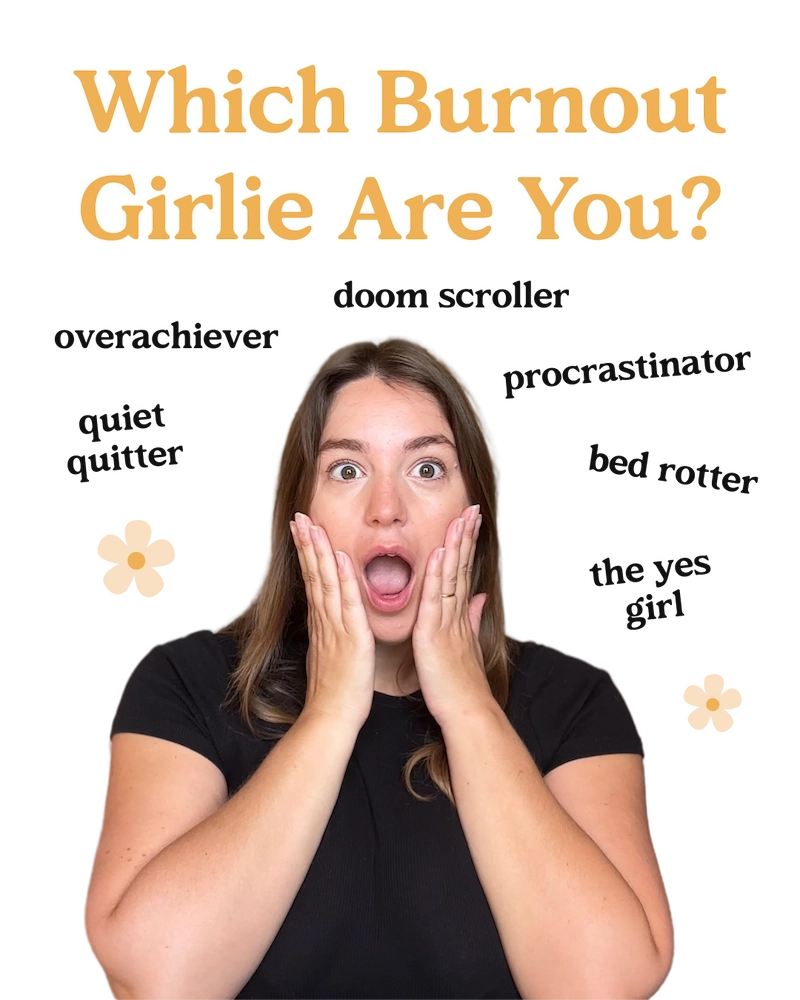
We all know the classic symptoms of burnout: exhaustion, mood swings, low energy, and brain fog.
But since doing more and more research over the past year, I’ve realised burnout goes way deeper than just the physical symptoms.
In fact, burnout is so subtle sometimes that you might just pass it off as having a bad day. I mean, you might wake up feeling totally fine and have the energy to work through your todo list, but deep down, you feel empty.
Or maybe you’re that girlie doing all the “right” things like eating well, going to the gym, getting your steps in and staying hydrated. You’re functioning, but you feel completely disconnected from yourself.
And that’s the problem. We think burnout looks like a full-on mental breakdown in the office toilets. But usually, it’s really not that obvious.
Burnout no longer just messes with your body. It messes with your emotions, your headspace, your personality, your motivation, the way you connect with people, and your spark. (I personally blame social media, but that’s a story for another time.) And when you don’t know the signs, it’s easy to miss them and just brush them off as nothing.
That’s why this post exists.
To help you spot the secret symptoms because you might not be experiencing burnout physically — it might be emotionally, mentally, socially or creatively.
So, how can you tell if you’re actually burnt out, or just having a shitty day? Let’s break it down…
P.S. If you’re new here, hey! I’m Thalia. I help 30-something girlies beat burnout and unf*ck their life through 1:1 coaching and self-paced tools. Every week(ish), I share content on burnout recovery, self-development, finding joy, and career growth. Subscribe here so you never miss a debrief.
Physical burnout
The OG burnout symptoms are the easiest to spot as they usually attack our entire system, like your sleep, energy, mood, basically all the stuff you need to function as a normal human being.
Red flags to look out for:
- You’re constantly exhausted: Whether you’re sleeping loads but still waking up tired, or you’re tossing and turning because your brain won’t switch off, your energy inevitably crashes halfway through the day, making everything 10 times harder
- You’re irritable and on edge: The tiniest inconvenience, like someone walking too slowly in front of you or shitty weather, can set you off, leaving you feeling more frustrated than usual
- Your body has lost its glow: You’ve got constant headaches, stomach issues, unexplained aches, and, quite frankly, you just feel off
- Your hormones are all over the place: Chronic stress can seriously mess with your hormones, leading to things like night sweats, disrupted sleep, and those brutal energy crashes. Supporting your body with the right nutrition, including adding foods that fight hot flashes during menopause to your meals, can help support hormone balance, improve your sleep, and ease some of that physical stress.
- You rely too much on quick fixes: You reach for coffee, energy drinks, or sugary snacks just to get through the day
- You bed rot… a lot: Your bed has become your safe space, not for rest but for zoning out completely. You tell yourself you’re recharging, but endless hours of binge-watching Netflix just leave you feeling numb and more disconnected
What to focus on: sustainable habits
When you’re physically burnt out, the last thing you need is a dramatic life change. You just need small, sustainable habits that help your body feel calm and less stressed. Nothing fancy, just simple things that fit into your lifestyle and support you through this messy season.
The trick is choosing habits that match your energy, rather than at random, because not every habit is going to serve you the same way every day. They need to vibe with where you’re at right now.
- Choose a habit that matches your energy: Pick something that actually fits how you feel today, not how you wish you felt
- Start small: A five-minute walk or one page of a book still counts — your body needs consistency way more than it needs perfection
- Create a non-negotiable wind-down: One simple evening ritual that helps your brain switch off (like leaving your phone in another room or doing a quick stretch before bed)
- Build habits into things you already do: Stretch while the kettle boils, breathe while your laptop loads, or step outside while your lunch is heating up
- Track your body signals, not just the habit: Pay attention to how your sleep, mood, and energy respond. The whole point is to help your body reset, not tick another box
Mental burnout
When your brain has had enough, it’s not always obvious at first. You’re still showing up, still doing the work, still replying to emails… but it feels like you’re operating on 1% battery. Things that used to take you ten minutes now take an hour or more, your thoughts feel heavier, and even simple decisions feel like a burden.
Red flags to look out for:
- Brain fog and zero focus: You read the same email three times, forget the simplest things, and feel like your brain has lost all function. Tasks you used to fly through now feel weirdly difficult, and even keeping up with your own todo list feels like a full-time job
- You overthink everything: From tiny decisions like what to eat for lunch to big life choices you normally wouldn’t stress about, your brain just won’t switch off, and it leaves you feeling drained before the day’s even started
- You replay conversations at night: You lie awake worrying if you upset someone, said the wrong thing, or should’ve done more
- You feel guilty when you rest: If you are not being productive, you feel lazy or behind
- You compare yourself constantly: Your never-ending self-doubt convinces you that everyone is more successful, prettier, or further ahead than you, and you’re falling majorly behind
What to focus on: mental rest
Brain fog and overwhelm are signs that you are in serious need of some mental rest. This basically means engaging in simple rituals that allow you to pause, reset and help your brain feel less cluttered.
- Brain dump: Get everything out of your head and onto paper so you’re not mentally carrying it around all day
- Do one thing at a time: Finish one task first before jumping to the next, so your brain has a chance to shift too
- Get some fresh air: Step outside, even for five minutes. A quick walk or just standing in the sun clears away the cobwebs
- Lower the pressure: Swap “perfect” for “done” so your brain stops working overtime on things that don’t matter
- Limit decision-making: Plan little things in advance, like meals, outfits, and breaks, because, and trust me on this, the fewer decisions you need to make, the calmer your brain feels
Emotional burnout
Emotional burnout hits when you’ve been holding in way too much for way too long. You’re more sensitive than usual, on edge, and everything feels a lot heavier than it should.
Red flags to look out for:
- You spend entire days in bed: Weekends or days off disappear into Netflix, snacks, and scrolling under the duvet.
- Sunday Scaries hit hard: The thought of another work week fills you with dread, even if you’ve done absolutely nothing all weekend
- You feel guilty for wanting to say no: Even when you’re exhausted, the thought of turning someone down makes you feel like a bad friend, partner, or employee
- You live in a constant state of overwhelm: Everything feels bigger than it should, your anxiety’s louder than usual, and you just feel on edge without being able to explain why
- You struggle to ask for help: You’d rather take on more and quietly struggle than risk feeling like a burden
What to focus on: setting boundaries
When you’re emotionally drained, the goal isn’t to be stronger and just suck it up. It’s to take some of the weight off. That usually means saying no more often, giving yourself space to feel things without judging them, and not jumping the second someone needs something from you.
- Put yourself first: Start asking, “What do I need right now?” before you put everyone else’s needs above your own
- Use the “let them” theory: Let people be who they are, without trying to change, fix or micro-manage them (because the truth is, you can’t control other people) and then shift the focus back to yourself and what you can control, e.g. your choices, your emotions, your boundaries, etc.
- Challenge negative self-talk: The next time a negative thought pops up, ask: Is this trash or a tool? Bin the BS and move on
- Create white space: Block 15–30 mins a day to just be
- Keep your own promises: Boundaries mean nothing if you break them every time someone pushes your limit. You’ve got to follow through with what you say and mean it. So don’t just set boundaries— honour them
Social burnout
Social burnout means being in that space where even the fun stuff feels like too much. Of course, you still love your tribe, but the idea of actually showing up for them, texting back, hanging out, or even small talk feels way too exhausting.
Red flags to look out for:
- Your social battery is dead: The group chats are on fire, but the idea of actually meeting up makes you want to fake a last-minute emergency. Even casual coffee dates feel like way too much effort
- You feel withdrawn: You ignore texts, emails, or calls because replying feels overwhelming
- You resent your own commitments: You look at your calendar and feel annoyed at plans you agreed to, but don’t have the energy for anymore
- Instagram is your biggest escape: Whenever life feels too much, you reach for your phone to zone out. It’s your go-to way of coping with overwhelm, even though the constant overstimulation leaves you more drained, wired, and exhausted than before
- You feel disconnected from real life: Nothing offline feels as stimulating anymore, and even the fun stuff doesn’t hit like it used to
What to focus on: slowing down
You don’t fix social burnout by forcing yourself to be more social. You fix it by giving yourself permission to take a step back, keep things simple, and only show up in ways that don’t drain you out.
- Choose low-effort ways to stay connected: Think about sending a quick voice note, meme, or emoji that shows your family and friends you’re still thinking of them
- Don’t over-explain: If you’re tired, you’re tired, you don’t need to justify why you can’t hang out
- Plan one thing at a time: Stop planning social events months ahead of time and do what feels good in the moment
- Mute what or who drains you: Group chats, Slack messages, Insta stories, that OTT influencer — anything that triggers overwhelm when you’re already at your lowest
- Take yourself out on a solo date: Go for coffee, on a walk, or do something touristy so you can breathe but still have fun without anyone demanding your attention and energy
Creative burnout
Also known as writer’s block or being in a rut, creative burnout impacts your motivation more than anything. I know it’s easy to say, “Fuck my mood, follow the plan” like Leila Hormozi famously says all the time, but when you’re exhausted, everything can feel like a chore.
Red flags to look out for:
- Work is draining AF: The job you once loved is now a never-ending grind, and the only thing getting you through is that last-minute vacation you’ve booked
- You do the bare minimum: You get through what’s required and nothing more, and honestly, you’re spending half the day watching the clock and planning your exit
- You’re not proud of your output: You’re hitting your deadlines, but it doesn’t feel creative, fun, or like you anymore
- You’ve lost your spark: Everything you used to do for fun now feels like a chore, and you can’t remember the last time you genuinely felt excited about something
- You’ve stopped caring: Projects, relationships, your personal goals, etc., all feel pointless, and tbh you’re not even bothered
What to focus on: getting your spark back
When you’ve been feeling meh for a while, it’s easy to forget what excitement even feels like. You’ve been stuck in limbo for so long that getting out of a creative rut seems impossible, but it isn’t.
Instead of forcing yourself to overhaul your career or find your passion, just look for small moments of joy that make you feel a bit more alive (even if it’s only for five minutes).
- Reflect: Write down 3 things (big or small) that have felt good in your job (or life) lately
- Do something fun for no reason: Make a playlist, walk to your fave coffee spot, cook something new, etc.
- Notice what doesn’t drain you: Pay close attention to the stuff that feels easier than everything else. It usually tells you where your energy actually wants to go
- Ask yourself how to get more of that: Literally, “How do I bring more of this into my week without overthinking it?”
- Repeat the good stuff: If something gave you even 1% more energy, do it again this week

Final thoughts
Burnout hits hard, and it doesn’t just mess with your 9-to-5.
It seeps into everything, like your health, mindset, energy, relationships, creativity and even your sense of self. Burnout makes everything feel harder, and the longer it goes unchecked, the more it takes over.
I hope you feel some relief knowing you’re not imagining it — what you’re feeling is real, and it’s not just because you’re having a shitty day. (10/10 recommend saving this post so you can come back to it whenever you need the reminder.)
And just because you’ve recognised a few of these burnout symptoms doesn’t automatically mean you need to quit your job or start over. You’re allowed to pause. You’re allowed to make small changes. You’re allowed to come back to yourself at your own pace.
Burnout is fixable, especially when you catch it early, and you’re already doing the hard part by paying attention.
You’ve got this.
Thalia xx