

Okay, this topic is a little rogue coming from me.
Because yes, I did quit my job.
In all fairness though, my job was toxic, so I couldn’t exactly stay. But after walking away, it took me a good few more years (and a lot of blood, sweat and tears) to figure out how to actually recover from burnout and build a career I love.
Yep, quitting was so much harder than simply handing in my notice. Even now, I still struggle. (I mean, if building a business was easy, everyone would be doing it right?!)
That’s why I’m not the type of girlie to tell you to quit.
Because you’re not just walking away from your job. You’re walking away from your entire identity and safety net. And let’s be real, that’s absolutely terrifying and can just add to the burnout.
So no, I’m not here to sugarcoat things. Burnout won’t magically disappear once you quit, and sometimes it gets messier before it gets better.
Here’s exactly what it’s really like to quit your job (from someone who’s been there), why it’s not the easy fix people make it out to be, and what to do instead.
P.S. If you’re new here, hey! I’m Thalia. I help burnt-out girlies in their 30s unf*ck their life through 1:1 coaching and self-paced tools. Every week(ish), I share content on burnout recovery, self-development, finding joy, and career growth. Subscribe here so you never miss a debrief.
1 | It’s a lot of work
I swear, if I had a penny every time I saw an influencer romanticise quitting their job, I’d be a millionaire by now.
Certain people looove to act like quitting is as simple as handing in your notice on a Friday and by Monday you’re a yoga-teaching girlie, who journals every morning and magically knows what she wants to do with her life.
(Not to mention already creating content for brands and probably selling something that shows you how to do the same. 🙃)
Like I said before, I’m not here to sugarcoat things. This “success” rarely ever happens unless you’ve spent the past year planning every last inch of your resignation period. But if you’re as burnt out as I think you are, there’s no way you just spent 12 months juggling your draining AF job with a side hustle.
What actually happens after you quit is… your brain goes, “Oh, shit. What now?!” Or if you’ve jumped straight into a new job, you’ve probably been thinking, “Oh crap. I feel the exact same.”
It’s not that quitting your job is wrong. (I mean, I did it.)
But without a clear plan, you risk making moves you might regret. And let’s not forget, burnout makes it hard to see things clearly, so making impulse decisions becomes your default.
Figuring out what comes next takes time and effort, and it’s highly unlikely you’ll find all the answers overnight.
Sure, maybe you do want to quit so you can go start your own business, or even travel. Or maybe deep down, you do actually want to stay, but you’re just too scared to ask for a raise, or you want to reshape your role so it feels more aligned to your values.
Action steps
- Get clear on what you want next: Before you make any moves, write down what you actually want your work and life to look and feel like
- Journal for clarity: Use these career journal prompts to figure out what’s driving your urge to quit and what you actually want instead
- Reconnect with your strengths: Identify the skills you’re good at (not the ones your job forced on you), and how you can use them moving forward
- Map your options: Look at roles, paths, or lifestyle shifts that match your strengths and values (even if they feel unrealistic right now)
- Choose your immediate next step that moves you forward: If you need help figuring this out, book a career blueprint call with me, and we’ll map it out together.
2 | Stress gets moved to your finances
Okay, so this was something I was completely unprepared for.
I was so desperate to get out of my toxic job that all my energy went into surviving my 3-month notice period. I wasn’t really thinking about what I’d do without a stable monthly salary.
I quit to travel and I did have a bunch of savings which I genuinely thought would last forever.
But I didn’t have a plan for what would happen when it ran out. (Cue me getting a job as a TEFL teacher so I could earn money and still travel.)
I also learnt that quitting your job doesn’t just press pause on the admin of being an adult. Bills still gotta get paid.
Let’s just say… I’ve grown up a lot since then, and getting radically honest about money is the first thing I mention to anyone looking to quit their job. It makes all the difference. Because if you don’t have a backup plan, the weight of your job just moves to your finances.
Knowing how much money you’ve got helps you figure out how long you can support yourself for without stressing TF out.
If it’s a lot, then sure, theoretically, you could quit your job tomorrow.
But if you’re down to your last $100, chances are you either need to stick it out a bit longer or at least line up something new before you quit.
Action steps
- Get clear on your monthly costs: List down all your expenses like rent, bills, food, phone, the basics, etc.
- Audit your finances: Look at your savings and work out how many months they realistically cover
- Cut where you can: What unnecessary subscriptions can you pause for now? e.g. Netflix, Headspace, Birchbox, etc.
- Consider extra income: Note down any simple ways you could bring in additional money
- Make a short-term plan: Create a basic 3–6 month budget and review it once a month
3 | It’s potentially career suicide
I know this one sounds harsh, but hear me out.
Leaving your job impulsively can make things a little tricky later. Not because quitting is bad or irresponsible, but because future employers love to follow the same type of narrative:
“So, tell me about this gap on your CV?”
Obviously, you can’t say, “I just cracked one day and stormed out after crying in the bathroom for 20 minutes.” (I mean, you could, but I don’t recommend it.)
The thing people don’t tell you is that when you quit without thinking it through, you forget about “future you” who has to talk about it one day. Months later, you might find yourself sitting in an interview, rambling on, trying to explain something you never actually processed yourself.
When you quit from a place of pure exhaustion instead of clarity, you’re not the one making the decision; burnout is, which makes it even harder to justify your choices.
And this is why quitting isn’t always the answer to burnout.
Not because you shouldn’t quit (you absolutely can), but because quitting out of panic often creates new problems you’re not mentally prepared for yet.
If you’re going to leave, you want to feel grounded in your decision, not like you ran out of the building with mascara down your face.
Action steps
- Look at the bigger picture: Write down what you want your career to look like in 3-5 years
- Choose your theme: Pick one word that sums up what you want this next chapter to be about (e.g. growth, leadership, creativity, impact, etc.)
- Break it down into focus areas: Turn that word into 4-6 smaller focus areas you care about (e.g. leading more projects, hiring team members, outsourcing, etc.)
- Make it visual: Create a simple mind map or vision board so you can see what you’re working towards
- Check if quitting helps or hurts that vision: Be brutally honest here
4 | Social pressure is real
People love to share their opinions. And they won’t always be kind.
That’s because we live in a culture where your job title is treated like your identity, your worth, your personality, and even how valuable you are as a human being. So when you say you want to quit, everyone will panic.
Your friends might question why you’d leave a “perfectly good job,” family might worry you’re throwing your life away, and your coworkers might look at you like you’ve completely lost the plot.
When I quit, all I got was:
“Stop complaining, no one likes their job.”
“You’re too old to be doing something like that, you need to think about settling down.”
“Your job won’t be here when you get back, you know.”
“You’ll regret it.”
To say that quitting my job was an extremely tough and lonely time in my life would be an understatement. Burnout was already making me doubt myself, so hearing other people’s fears on top of my own just made things even harder to process.
The thing is, when people don’t understand why you’re quitting in the first place, it adds emotional pressure instead of taking it away. You might second-guess yourself more, feel embarrassed for wanting something different, start believing the doubts people project onto you and even worry you’ve made the wrong decision.
If you quit without doing the inner groundwork first, the doubts don’t go away — they just follow you into whatever comes next.
Action steps
- Name your biggest fear about quitting: Write down the exact thought that keeps looping in your head
- Dig a little deeper: Ask yourself, “And then what?” until you hit the real thing underneath it
- Spot the pattern: Notice whether the fear is coming from burnout, perfectionism, people-pleasing, or past experiences
- Find the smallest next step: Write down one small thing that would make the fear feel 1% less scary
- Ground yourself in reality: Separate what’s actually true right now from the story your anxious brain is telling you
5 | Doubt will 100% kick in
Even if you have planned everything out perfectly, like you’ve saved money, researched new positions, journaled, cried, talked it out, blocked your boss on LinkedIn, etc., doubt will still kick in.
It always does.
Quitting isn’t just about leaving your job — it’s a mindset shift. You’re stepping outside of the comfort zone that’s felt familiar and safe for years, which can feel absolutely terrifying.
You’re not just walking away from your 9-to-5 life; you’re walking away from an entire identity.
So trust me, it’s 100% normal to have thoughts like, “Was this a mistake? What if I made things worse?” And navigating this part is so much harder than people think.
This is why the inner work matters way more than writing your resignation letter.
You need the clarity and confidence to stop questioning yourself every five minutes, and you need the courage and resilience to stay grounded when things feel uncertain.
Because here’s the bit no one talks about: if you don’t work through the beliefs that got you burnt out in the first place (e.g. guilt around rest, the pressure to be perfect, the fear of letting people down), you’ll just carry them wherever you go next.
Building a stronger mindset is the foundation that makes everything else feel doable.
Action steps
- Journal what’s really going on: Get those doubts out of your head and onto paper so they stop taking up mental space
- Name the belief underneath the fear: Is it perfectionism? People-pleasing? Not feeling good enough?
- Lean into your strengths: Write down what you’re genuinely good at and where you’ve handled hard things before
- Practise small acts of self-love: One kind sentence to yourself, one boundary you actually stick to, one small choice that backs who you’re becoming
- Celebrate every win: No matter how small
6 | It takes way longer than you think
You might think that quitting your job is as simple as handing in your notice and posting a “new chapter” selfie on Instagram. But the truth is, it takes way longer than you think.
From wrapping up responsibilities to saving money and mentally preparing for such a massive change, quitting isn’t a quick-fix solution.
And if you’re anything like me, the mental prep is the part that takes the longest.
The truth is, it took me a good two years to finally quit my job. And even after I left, I still had zero clue what I wanted to do with my life. Sure, I went travelling, but after five months in Southeast Asia, I came home feeling more lost than ever.
So much so that I escaped yet again to South America just to avoid the overwhelming feeling of having to figure out what was next.
And this is the part people don’t talk about enough: even if you’re financially and physically ready to quit, you also need to be emotionally ready.
You need to be able to handle the unknown — the messy middle.
So, zoom out for a sec because maybe you don’t need a whole new life or job. Maybe you just need your current one to feel a little less soul-sucking.
Action steps
- Check in with your current reality: Get honest about what’s working in your life right now and what’s draining you
- Redefine what success looks like for you: Ditch everyone else’s expectations and get clear on what actually makes you feel fulfilled
- Figure out your core values: The things that matter most to you and should guide your decisions moving forward
- Reconnect with who you really are: Peel back the people-pleasing, tune back into yourself, and rebuild confidence from the inside out
- Explore your Ikigai: Find the sweet spot between what you love, what you’re good at, what the world needs, and what you can be paid for
7 | You can quit your job, but you can’t escape yourself
This is the part no one actually talks about. And what I learnt the hard way.
You can walk away from your demanding workload, toxic boss, the miserable commute, and Slack notifications at 9 pm, but you can’t walk away from yourself.
And I say this with love, not judgment.
Your habits will follow you wherever you go. And if you’re already burnt out, that comes too.
When I quit my job, I honestly thought I’d wake up relaxed the next day and finally be myself again. But I didn’t. I was still stressed, still overwhelmed, still overthinking everything.
Sure, I’d taken a one-way flight across the world, but I was still the same me. A pathological people-pleaser who tied her productivity to her worth and had no clue who she was underneath it all.
That’s why quitting doesn’t fix burnout.
You can change your environment, but you’re still the same person operating with the same patterns, the same beliefs, and the same expectations you’ve had for years.
Action steps
- Write down one negative belief you have about yourself: Like “I’m not capable of change,” or “You’re making a mistake”
- Reflect on where this belief came from: Was it your boss, family, school, hustle culture, your industry, etc?
- Challenge this belief: List all the ways this isn’t true
- Reframe this belief into a more empowering statement: e.g. “It might feel like a lot of work but I am making the right decision for my sanity”
- Repeat this work consistently: New limiting beliefs will always pop up, but the more you practice, the easier self-acceptance becomes

Final thoughts
Okay, so you’re probably thinking… “If I stay, isn’t that just settling? Won’t I be stuck in the same cycle forever?”
And yes, staying can feel like the safest option, but like I’ve just shown you, quitting won’t magically fix everything either.
When you jump ship without addressing what’s really going on under the surface, you end up taking the exact same problems with you to your next job.
But when you choose to stay, it forces you to address those deeper issues head-on. It isn’t about gritting your teeth, plastering on a fake smile, and sucking it up. It’s about taking back control, shifting your perspective, and making your job work for you, not the other way around.
Here’s what it comes down to:
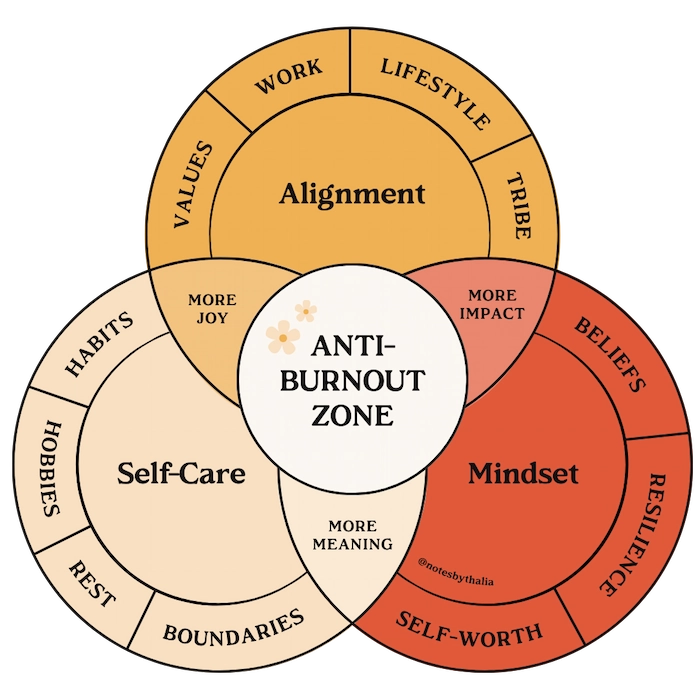
- Alignment: When your values, work, lifestyle, and tribe all vibe with each other, you become magnetic. Life feels lighter. You stop forcing yourself into a box that doesn’t fit and start attracting opportunities that feel effortless
- Mindset: When you learn to question the beliefs you’ve been telling yourself about success, worth, and failure, you stop living on autopilot and start making empowered choices from a place of self-trust, not doubt
- Self-care: This is what holds it all together. It’s not a reward for working hard. It’s the foundation that keeps you grounded, energised, and able to show up fully for your work and yourself
These three pillars work together to get you unstuck, in flow, and thriving in every area of your life (including your job). Alignment helps you find clarity on what you truly want. Mindset helps you believe in it. Self-care helps you sustain it.
I call it The Anti-Burnout Framework™, and you can apply it to your own life with my book Stay & Slay™
You’ll learn the truth about what’s causing your burnout and the framework to fix it from the inside out so you can finally feel energised, fulfilled, and in control again.
And because I’m not here to waste your time, it comes with a 50-page workbook so you can implement every strategy and actually see results IRL
I cannot wait for you to get your hands on it because I honestly think it will change things for you
You’ve got this.
Thalia xx
P.S. If staying really isn’t an option for you and you’re ready to make your next move, I can help you map out your exit strategy so you can walk away with confidence and clarity. Click here to find out more.






Laura
Career suicide is real. I had to quit my job to become a full time unpaid carer and now I can finally get back to applying for new jobs I find I’m still suffering from the consequences. Really don’t recommend 🙂