Whether we like to admit it or not, most of us love to please others.
I feel like it comes down to seeking a sense of validation, like saying yes somehow makes us feel needed or useful. Like we have a purpose.
This was how it was for me anyway.
For the majority of my twenties, I didn’t know how to say no. Not at work. Not with friends. Not even to myself. If someone asked me for help, I’d say yes. If I was invited to something, I’d say yes. If there was something that needed doing, I’d find a way to squeeze it in, even if I was already stretched to my limit.
And the truth is, I didn’t even realise I was doing it.
It just felt easier to say yes than to deal with the awkwardness or guilt of saying no and risk disappointing anyone.
But what I didn’t see at the time is how much it was costing me—my time, my energy, and any real space to just pause and breathe.
Eventually, I started to feel burnt out and resentful. (To the point where I’d get irritated at other people for saying no to me, simply because I couldn’t give myself the same permission.)
I felt like I was constantly being pulled in different directions, saying yes to everything but slowly losing sight of myself in the process.
That’s when I realised—saying yes all the time wasn’t the problem. Not being able to say no was.
So if you’re in that space right now, where you keep saying yes even when your gut is screaming no, this post is for you.
Let’s talk about what’s really going on and how you can start choosing yourself.
P.S. If you’re new here, hey! I’m Thalia. I help burnt-out girlies like you build a life that’s aligned, magnetic, and unapologetically yours. Every week(ish), I share content on burnout recovery, self-development, finding joy, and career growth. Subscribe here so you never miss a debrief.
Signs you’re a people pleaser
This is going to hurt a little, but I think it’s way better to be aware than to stay stuck on autopilot.
Because when you’re aware, you can actually start to do something about it instead of wondering why you always feel so drained or annoyed or low-key resentful. So here it goes…
Being a “yes girl” can look like:
- Saying yes just to avoid awkwardness
- Feeling bad or guilty for saying no
- Worrying that someone will be annoyed at you if you don’t agree to something
- Taking things on even when you’re already overwhelmed
- Feeling responsible for how other people feel
- Replaying conversations in your head, wondering if you upset someone
- Saying sorry out of habit, even when it’s not your fault
If this feels like you, I want you to know—you’re not alone. So many women fall into this pattern and stay there for years without even realising it. It doesn’t mean you’re weak, naive, or doing life wrong.
It just means that somewhere along the way, you learnt that keeping everyone else happy mattered more than honouring your own needs.
But just because this is how things have been doesn’t mean it’s how they have to stay.
How to stop saying ‘yes’ all the time
PSA: You don’t have to keep abandoning yourself to keep the peace. You don’t have to keep saying yes just to avoid conflict or guilt.
And no, this isn’t about becoming someone who never helps or shows up for others. That’s not the point.
It’s about learning to support the people you care about without constantly putting yourself last. It’s about making decisions that actually honour your time, energy, and capacity so that you’re not just surviving, you’re living in a way that feels good for you, too.
Below is how you can start to shift things. These are changes that might seem small, but over time, they’ll help you build the kind of self-trust that makes saying no feel less scary.
I encourage you to save this post so you can come back to it whenever you need to.
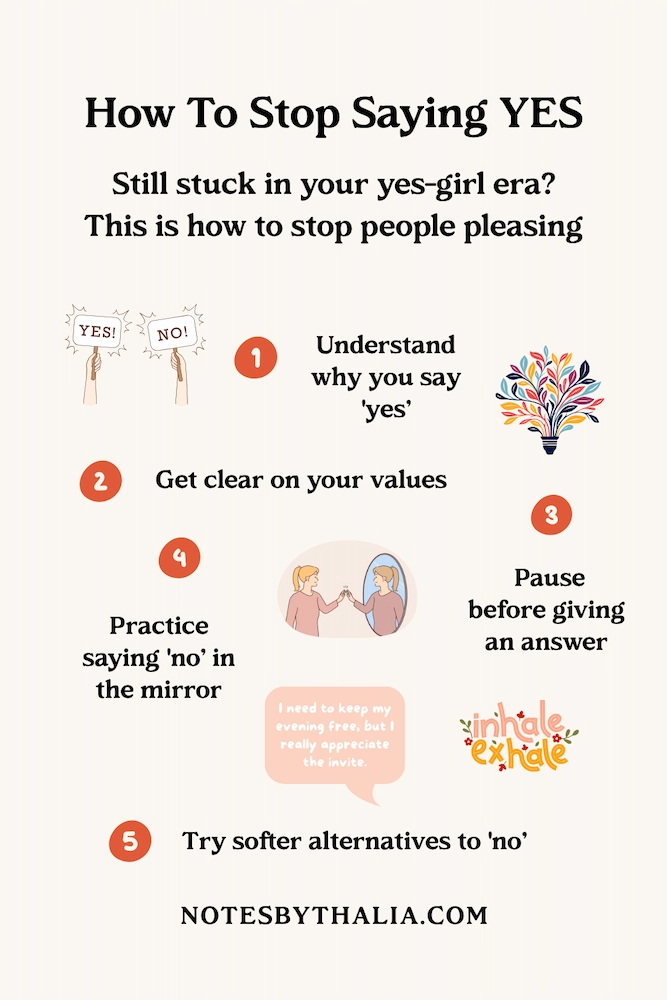
1 | Understand why you say ‘yes’
Before you can start saying no, you need to first figure out why you say yes.
Do you genuinely want to help people, or are you saying yes because you feel like you should? Is it because you don’t want to disappoint people or because you’re scared they will be upset with you?
People pleasing often doesn’t come from kindness. It comes from fear. Fear of conflict. Fear of letting someone down. Fear of not being liked.
Yes, that’s right. Even though you think you’re being kind when you say yes, it’s really just a form of self-sabotage.
So rather than judging yourself for it, get curious. What’s really driving that ‘yes’?
Dive into these journal prompts to find out:
- When was the last time I said yes, even though I didn’t want to? What was going through my head in that moment?
- What am I afraid will happen if I start saying no more often? Whose reaction am I most worried about and why?
- Do I tie my self-worth to being helpful, reliable, or easy to get along with? Where do I think that belief came from?
- What emotions come up for me when I disappoint someone? What am I making that mean about me?
- If I could press pause and say what I really wanted in the moment, what would that sound like? What would I be choosing instead?
2 | Get clear on your values
Without a doubt, I will always find a way to relate any topic back to core values. Because let’s be real, living in alignment with your values is the only way you are going to feel completely at peace with yourself.
And when you’re not sure what you care about or what you’re working towards, it’s so easy to say yes to everything.
Because everything feels equally important.
But when you do know what your values and priorities are, you’ll start to notice when something doesn’t feel aligned.
Let’s say one of your core values is connection. You deeply value time with people who make you feel seen, heard, and safe. That’s something you want to prioritise more. So when a friend invites you to a small dinner with a few close people you haven’t seen in ages (even though you’re tired from work), you say yes. Because deep down, you know that kind of connection fills up your cup. It’s aligned.
But then, someone else asks if you want to join a huge group for Friday night drinks with a bunch of people you barely know. A few months ago, you might’ve said yes out of habit just to be included. But now? You know that saying yes would leave you feeling drained, not energised.
That’s the difference.
When you’re clear on your values, your decisions become less about what other people want from you and more about what actually works for you.
Action steps
- Reflect on the times when you felt genuinely happy and fulfilled
- Identify what values were present in those moments
- Write down a list of 10-15 values that deeply resonate with you
- Narrow it down to your top five core values
- Compare these values to how you’re currently spending your time and energy—how can you bridge the gap?
3 | Pause before giving an answer
We live in a world where everything’s instant—DMs, emails, Slack, calendar invites. Someone asks you a question, and suddenly it feels like you have to reply ‘yes’ right away.
But here’s your permission slip: you don’t.
You’re allowed to pause and ask yourself: Do I actually want to do this? Do I have the capacity?
Sometimes that breathing space is all you need to realise something’s not aligned. And the more you practise slowing down, the easier it becomes to spot the difference between a genuine yes and a yes that’s coming from guilt or pressure.
Remember, you don’t need to be available every second of the day or say ‘yes’ to be a good employee.
Just because someone says “Got a sec?” doesn’t mean you actually do.
Try saying:
- “Let me get back to you.”
- “Can I check my schedule first?”
- “I need a bit of time to think.”
- “I’ll need to check a few things.”
- “Can I sleep on it?”
4 | Practice saying ‘no’ in the mirror
This one might sound silly, but trust me, it works.
If you’ve spent years people pleasing, then saying no won’t come naturally. At first, it’ll feel weird. You might ramble. You might apologise. You might feel the urge to soften the blow so much that you end up saying yes anyway.
That’s why it helps to practise.
Say it out loud when no one’s around. Look at yourself in the mirror. Get used to the sound of your own voice saying no.
The more you practise, the more confident you’ll feel when it really counts.
Action steps:
- Choose one or two “no” sentences that feel natural to you, like “No, I can’t take that on right now” or “That doesn’t work for me.”
- Practice saying them out loud, once a day, for a week
- Record yourself on voice notes and listen back—notice your tone, pace, and how it feels
- Pay attention to how your body reacts when you say no (tense shoulders? holding breath?)
- Keep going until it starts to feel less awkward and more empowering
5 | Try softer alternatives to ‘no’
I get it, you’re done saying yes, but sometimes, a straight-up “no” can feel too blunt. And that’s okay, especially when you’re still learning to hold your boundaries without the guilt.
The good news? You don’t always need to use the word no to say it.
Here are some softer phrases to protect your time without sounding harsh or abrupt:
- I don’t have the capacity for this right now. Could we revisit it later?
- I’d love to support, but I wouldn’t be able to give it the attention it deserves.
- I’ve got too much on my plate right now, I’d rather not commit to anything extra.
- That doesn’t quite align with what I have space for right now.
- I need to keep my evening free, but I really appreciate the invite.
- I won’t be able to make that work, but I hope it goes well.
- That sounds lovely, but I’m feeling a bit maxed out and need some downtime.
Final thoughts
Look, saying no at work isn’t always going to be easy. Especially if you’ve spent your life putting others first. It will feel uncomfortable at first. You might second-guess yourself. You might feel guilty.
But every time you choose yourself, you’re rewriting your story.
You’re saying: “I matter. My needs matter. My energy matters.”
And guess what?
You don’t owe anyone 24/7 access to you. You don’t have to explain why you need rest, space, or silence. You’re allowed to choose you, without guilt or apology.
People pleasing might have felt like the safer option, but it’s not the sustainable one. So, whether it’s your boss, your best friend, or that overactive voice in your head, it’s time to draw the line.
Boundaries aren’t a luxury. They’re non-negotiable. And they’re the difference between staying stuck in a job that’s draining the life out of you vs. slaying in it.
So don’t skip this step.
You’ve got this.
Thalia xx