I see you. You’re doing all the “right” things.
You work out every day, go to therapy, and religiously listen to daily affirmations.
You’ve taken a vacation, vented to your friends (more times than you can count), and even tried meditation because someone on TikTok said it would help.
So why do you still feel stuck, exhausted and overwhelmed?
I hate to break it to you, but most of the advice out there doesn’t actually fix burnout. It just helps you cope with it. And trust me, there’s a big difference between coping and healing.
Let’s break it down…
P.S. If you’re new here, hey! I’m Thalia. I help burnt-out girlies in their 30s unf*ck their life through 1:1 coaching and self-paced tools. Every week(ish), I share content on burnout recovery, self-development, finding joy, and career growth. Subscribe here so you never miss a debrief.
Prefer to watch and listen? I’ve got you!
Hit play on my latest YouTube video where I break down why popular burnout advice usually fails, plus what to do instead if you actually want to recover.
1 | A new job
A fresh start sounds good in theory. New boss. New office. New responsibilities. But if you’re not clear on what actually led you to burnout, it will just follow you to your next role. Yup, different desk, same disconnection.
A new job is really just a prettier version of the same problem, and it won’t take long for you to start experiencing the same negative thought patterns or “stuck-ness.”
The thing is… burnout isn’t always about a toxic workplace or never-ending workload.
Sometimes it’s about something deeper. Like a lack of boundaries, people-pleasing, and feeling out of sync with the work you’re doing and your values.
Sure, you might be thinking: “If I just find a job that pays more / lets me WFH / isn’t as intense, I’ll be fine.”
But if you don’t know what alignment actually looks like for you in your career, then you’ll just end up in the same position somewhere else.
So before you quit your job, ask yourself if the job really is the problem, or if it’s you.
What to do instead:
- Get clear on your values: What do you need to feel fulfilled, not just function?
- Spot your bad habits: Are you overworking, avoiding conflict, or saying yes too much?
- Check for red flags in your current role: Is it the job that’s draining you or the way you’re doing it?
- Build your ‘hell no’ list: Sometimes knowing what you don’t want in a job is the fastest way to figure out what you do want
- Talk to a coach: Map out your next move with someone who’s been there
2 | Taking a vacation
Just like a cup of tea in a British Soap, a vacation also seems like it’ll cure all.
A week in the sun, cocktails on the beach, well-deserved lie-ins, and no Slack notifications… sounds like the dream, right?
Sure, a vacation gives you the relief you need. But it’s only temporary.
Once you’re back in the office, you’ll just be stuck staring at the same draining AF inbox, dealing with the same stressful work environment, and within a week? You’re right back where you started.
That’s because taking a vacation is a bit like slapping a plaster on a wound.
It might protect you for a while, but it doesn’t actually help you heal on the inside.
I’m 100% all for taking as many vacations as your company will let you. Because rest is important. But real change only comes from shifting how you work, not just taking time off.
What to do instead:
- Make rest a habit, not a reward: Make self-care part of your daily life, not just something you do at the weekends
- Respect your own boundaries:
- Focus on wellness habits you actually need: Don’t drink a green juice or push through another HIIT workout just for the sake of it
- Build a shutdown routine: Something that tells your body “we’re done for the day,” not just logging off and doom-scrolling
- Speak up with confidence and ask for what you need: These email templates help you communicate boundaries and ask for support without sounding awkward or apologetic
3 | Talking to HR or venting to friends
It makes sense. You’re struggling, so you reach out to HR, your manager, maybe your work bestie, or a group chat full of tired corporate girlies who totally get it.
But let’s be honest, HR is there to protect the company, not you.
Sure, they might listen, nod, maybe offer advice or even give you some well-being resources, but it rarely leads to real change. That’s because it’s not their job to help you navigate burnout; it’s to keep the company running smoothly.
Yes, you can totally chat to your work bestie too, maybe even a senior colleague, but they’re probably just burnt out as you are. They’ll 100% validate your stress, but they can’t help you out of it.
And your friends? They love you, but they’re not trained to help you untangle career misalignment or guide you through burnout recovery.
They’ll offer advice based on their experiences, not what’s actually best for you.
What to do instead:
- Talk to someone neutral: A coach or mentor can offer clarity without judgment
- Journal it out: Writing helps you process what you’re feeling and figure out what’s actually not working and what kind of support you really need right now
- Be selective with who you talk to: Not everyone needs to weigh in. Choose one or two people who you trust and can hold space without making it about them
- Stop collecting advice, start trusting yourself: Other people can offer perspective, but only you know what’s best
- Create your own support plan: Instead of relying on HR or your group chat, figure out what you personally need and go out there and make it happen (use this book for a step-by-step framework)
4 | Therapy
Therapy is great if you’re dealing with deeper emotional wounds, past trauma, or mental health struggles.
But if your biggest issue is hating your job, you don’t need to spend months analysing your childhood. You need a strategy to change your career from the inside out.
Because burnout recovery isn’t just about healing the past. It’s about building a future that works for you.
It’s not enough to unpack why you people-please, overwork, or tie your worth to your output. You also need to rebuild, set boundaries that you honour, design habits that support your energy, and create a lifestyle that aligns with who you want to become.
It’s not just an emotional journey—it’s a strategic one. And you need to do both.
What to do instead:
- Work out if it’s burnout or just the wrong job: Not all stress means you’re broken, sometimes the role just isn’t right
- Set boundaries at work: Ones you actually follow through on, even when it feels uncomfortable
- Do the inner work, then make a plan: Processing is great, but progress comes from action
- Use what you’re learning in therapy to make real changes at work: Insight is powerful, but it only helps if you apply it
- Find support that helps you move forward: Coaching picks up where therapy leaves off
5 | Sucking it up and working harder
You told yourself to just push through. Hustle more, work a little later, take on another project, and pretend everything’s fine—that things will eventually get better. But you’re still stuck in the same place you were six months ago.
That mindset is what landed you here in the first place. (By here, I mean desperately searching my blog for the answers on how to beat burnout.)
Do I really need to explain why hustling harder is a bad idea? You’re already running on empty. What do you think will happen when you push yourself even harder?
Burnout isn’t a badge of honour, and you don’t have to hustle yourself into the ground to prove your worth.
Start giving yourself permission to slow down. Productivity means nothing if you’re too burnt out to enjoy your life or show up for yourself in a way you’re proud of.
What to do instead:
- Rest. That’s it, that’s the tip
- Redefine what success looks like to you: What if it was about energy, joy, or fulfilment, not output?
- Prioritise just 3 things: Not everything is urgent, focus on what actually matters today
- Start pushing back on extra work and unrealistic deadlines: These email templates give you the words and mindset to set boundaries without the guilt
- Log off when the day ends: Not when you’re done with your todo list (because let’s be honest, it never ends)
Final thoughts
The reason why most burnout advice doesn’t work (and what no one tells you) is that burnout has less to do with your job and way more to do with how you’re showing up in your life.
I’m talking about the pressure to be perfect, the need to prove yourself, and the habit of saying yes when your body is screaming no. That shit runs deep.
And it doesn’t magically disappear with time off, a better work environment, or resources from HR.
The good news? You can beat burnout without quitting your job or becoming THAT friend who’s constantly venting about her boss.
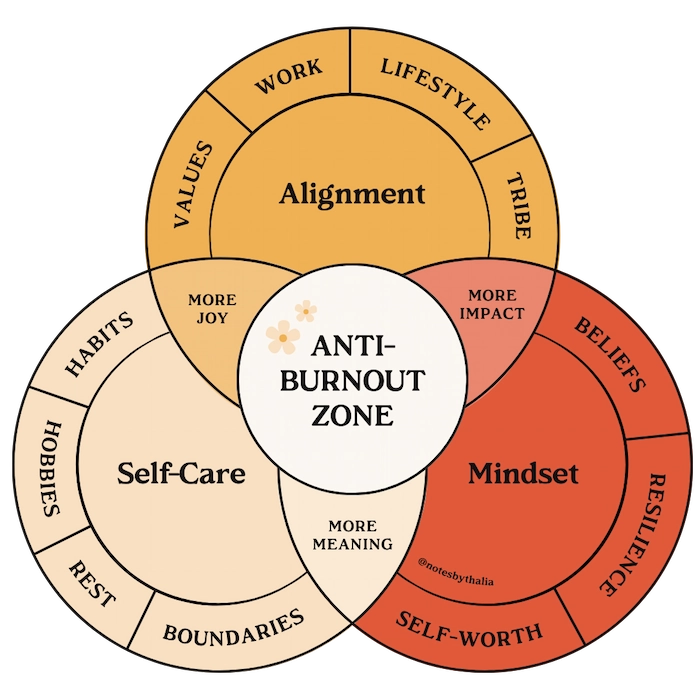
What you need is a mindset overhaul, radical self-care, and the courage to prioritise what truly matters to you.
That’s exactly what I teach you inside Stay & Slay™.
It’s your no-BS guide to breaking the burnout cycle and actually SLAYING in (and out of) the office.
Inside, I’ll walk you through my Anti-Burnout Framework™ and show you how to:
- Understand what’s really burning you out (hint: it’s not just the workload)
- Set boundaries that stick without the guilt
- Rewire the perfectionism and people-pleasing keeping you stuck
- Build habits that actually support your energy (not just your productivity)
- Feel even more confident asking for what you need
Get your copy now and take the first step toward showing up for yourself instead of just pushing through another exhausting AF week.
You’ve got this.
Thalia xx