I’ve always journaled in some way.
As a teen, journaling meant pouring my heart into a “Dear Diary” entry—mostly venting about family, boys, and school. You get the picture.
During my early twenties, I turned to scrapbooking: photos, magazine cut-outs, and moody quotes. Nothing too serious. It was definitely more aesthetic than emotional.
But during my burnout era? Journaling became something else entirely.
It wasn’t cute or curated. It was messy. Honest. Raw.
It stopped being about documenting life and started being about healing from it.
There wasn’t a single moment or breaking point that pushed me to journal. It just… happened one day.
I was lost, burnt TF out, and desperate to feel something again. So I wrote. No prompts. No plan. Just whatever needed to come out that day.
And that simple act of putting pen to paper became the most unexpected tool in my burnout recovery journey.
Let me show you how…
P.S. If you’re new here, hey! I’m Thalia. I help 30-something girlies beat burnout and unf*ck their life through 1:1 coaching and self-paced tools. Every week(ish), I share content on burnout recovery, self-development, finding joy, and career growth. Subscribe here so you never miss a debrief.
Benefits of journaling for burnout
When you’re burnt out, it’s normal for your mind to be all over the place.
You’re tired, overwhelmed, and can’t think straight. So you end up overthinking, second-guessing every decision, and doubting yourself.
Trying to make sense of your life on a good day is hard. But trying to make sense of your life during burnout recovery is basically impossible.
This is where journaling comes in, because it helps you get out of your own head.
Writing things down gives your mind a break. It slows your thoughts so you can actually hear yourself think and start making sense of what’s going on beneath the surface.
Here’s why it works:
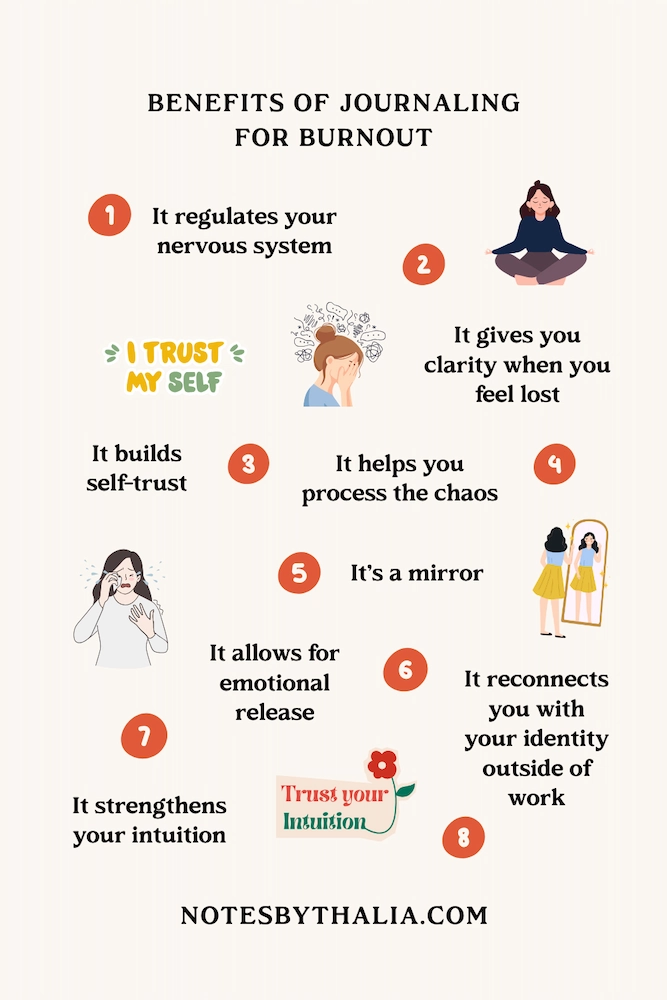
- It regulates your nervous system. When you write things down, especially by hand, you naturally slow your breathing, soften your heart rate, and come out of fight-or-flight mode. It’s basically a mini reset for your mind, body, and soul.
- It helps you process the chaos. Journaling helps you declutter your thoughts, process emotions, and stop going around in circles.
- It’s a mirror. You start to notice patterns—how often you say “I should…” or how many times your boss shows up when you’re venting. It helps you connect the dots between your thoughts and your burnout triggers.
- It allows for emotional release. When you’ve been holding everything together for so long, finally letting it out, without judgment, is relief.
- It builds self-trust. Even just opening your journal daily tells your brain: I’ve got me.
- It gives you clarity when you feel lost. Instead of spiralling or overthinking, journaling helps you see your situation more clearly. You can zoom out, get perspective, and start to untangle what’s really going on.
- It strengthens your intuition. When you give yourself space to reflect, you start to hear the quiet voice underneath the noise—the one that already knows what’s right for you. Journaling helps you tune in and trust it.
- It reconnects you with your identity outside of work. If your job has become your whole identity, journaling can help you remember who you are beyond your career. Your passions, your values, your voice, etc. All of it lives there, waiting to be rediscovered.
The journal that got me through burnout
My burnout recovery journey didn’t start with pages of deep reflection or life-changing truths.
Honestly, that would’ve been too overwhelming, especially when I was already feeling scatty and exhausted.
So I kept things simple.
I started with The Five Minute Journal.
It gave me structure when I had none. Just a few straight-forward, no-BS prompts, like:
- What am I grateful for today?
- What would make today great?
- What did I learn?
No pressure. No performance. Just five quiet minutes to check in with myself.
And surprisingly, those five minutes became the one thing that kept me going when everything else felt like it was falling apart.
Some days I felt nothing, but I still showed up.
Some days I wanted to scream into a pillow, but I still showed up.
And little by little, I started to feel like me again.
P.S. This is the exact journal I use and always recommend to my clients. It’s simple, low-effort, and surprisingly powerful. Plus, you get 10% off when you use the code NBT10
5 Ways journaling helped me navigate burnout
If you’re feeling lost, empty or stuck in your own head, these are the exact ways journaling became my go-to burnout recovery tool and helped me slowly find my way back to myself.
Nothing fancy. Just small, consistent moments that made a big difference over time.
Take this as your sign to give it a go—you never know what might shift once you start putting pen to paper.
I encourage you to save this post so you can come back to it whenever you need to.
1 | It gave me the space to just be
When you’re burnt out, it can feel like you have to perform 24/7.
At work, you’ve got to hit deadlines, smile on Zoom, and push through. At home, you’re holding it together so nobody asks, “Are you okay?” because let’s be real—you don’t even know the answer.
Journaling became the one place where I didn’t need to pretend I was fine.
No filter. No expectations. Just me. It was like the first deep breath after holding it in for months.
Writing gave me space to exist without needing to explain or justify anything. It was a judgment-free zone where I could collapse into the truth of how I was feeling and still feel whole.
The Five Minute Journal helped me ease into this. On days when I couldn’t write a full page, those few prompts reminded me that I could just be, without needing to fix anything.
Next steps:
- Block 5 minutes each morning to journal with no agenda
- Use one prompt: “How do I really feel right now?”
- Let it be messy. Don’t edit. Don’t judge.
2 | It made me feel safe in my own head
When I was deep in burnout, my mind wouldn’t shut up. It was loud, messy, and overwhelming.
My thoughts were all over the place. I couldn’t tell what was real and what was just my anxiety talking. I didn’t trust myself because it felt like every thought I had made me freak out.
But journaling helped calm the noise. It gave me space to slow things down and look at what I was thinking without freaking out. That alone made a big difference in my burnout recovery journey.
Over time, I realised that just because a thought popped into my head didn’t mean it was true. I didn’t have to believe every shitty thing my brain was telling me. I could step back, see it for what it was, and decide if it actually deserved my energy.
Next steps:
- Journal at the same time every day to create a safe ritual
- Write one “scary” thought and then respond to it like a friend would
- End with: “What do I need to hear right now?”
3 | It helped me figure out what was actually draining me
Burnout isn’t always caused by one big thing. Sometimes it’s a build-up of small, daily triggers. The passive-aggressive emails. The meetings that could have been emails. The way your shoulders tense every time your boss’s name lights up your phone.
I didn’t realise how much all of it was getting to me until I started writing it down.
Journaling helped me see what was really draining me.
The same things kept showing up, and once I noticed the pattern, I could start changing it. This looked like setting better boundaries and cutting out the stuff that was slowly burning me out.
The Five Minute Journal made this easier. Even just asking what would make my day great helped me spot what was making it feel shit.
Next steps:
- At the end of each day, ask yourself, “What drained me today?”
- Write down something that gave you energy
- Look for patterns and set one small boundary this week
4 | It helped me shift my mindset
When you’re burnt out, it’s easy to focus on everything that’s going wrong.
I was stuck in a cycle of feeling like nothing was working and wondering what the point even was. But journaling helped me break through the cycle.
It didn’t magically fix everything, but it did give me a chance to zoom out and look at things differently.
The Five Minute Journal made this way easier. It gave me prompts that were simple but powerful, like “What are you grateful for today?” or “What would make today great?”
At first, it felt kind of awkward to focus on myself. But the more I did it, the more it started to change how I saw my life.
I stopped only focusing on what was draining me and started noticing what was actually supporting me. That positive shift helped me feel way more in control of my day, my energy, and my mood.
Next steps:
- Try writing 3 things you’re grateful for each morning
- Write one small thing you’re looking forward to today
- End with: “What’s one thing that’s working right now?”
5 | It helped me rediscover who I actually am
Burnout made me feel like I had no identity outside of work.
I didn’t know what I liked anymore. I didn’t know what made me feel alive. Everything just felt… meh.
Journaling gave me space to start figuring that out. Bit by bit, I started writing about what I cared about, what lit me up, what I missed, and what I didn’t want in my life anymore.
It helped me reconnect with my values, my passions, my actual personality—not just the version of me I showed up as to the office or in bars.
The more I wrote, the more I remembered the things I used to love, and the person I was before burnout took over. That’s when I started to feel like me again.
Not “work me,” not “burnt-out me”—just me.
Next steps:
- Write a list of things you loved doing before work became your whole life
- Journal about what feels most like you right now and what doesn’t
- Ask: “Who am I when no one’s watching?”

The exact journal prompts I used to recover from burnout
By now, you’ll know I love a good journaling session!
It’s what I turn to the most whenever I need to stop self-sabotaging and actually get clear on what the hell’s going on in my head.
But I also know how overwhelming a blank page can be.
So if you’re not sure what to write, start here. These prompts are what I turned to when I had no other choice. They’re simple, low-pressure, and designed to help you get out of your own head and into a better place, one page at a time.
You don’t have to do them all. Pick one, or three and save the rest for later. Keep it simple. Keep it honest. Just get real with yourself.
- What do I need to get off my chest right now?
- What’s been feeling heavy lately?
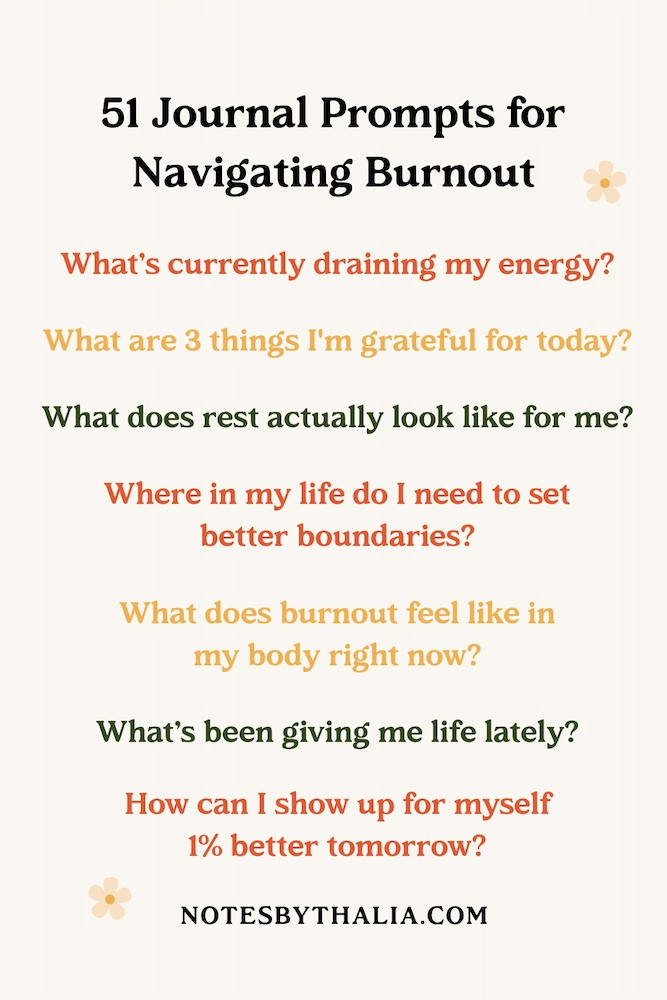
- What’s currently draining my energy?
- What’s been giving me life lately?
- What does burnout feel like in my body right now?
- What does rest actually look like for me?
- What are 3 things I’m grateful for today?
- What 3 things would make today great?
- What am I most proud of about myself today?
- What do I wish someone would say to me right now?
- Where in my life do I need to set better boundaries?
- What’s one thing I know deep down but keep ignoring?
- What were my top 3 highlights from the day?
- What do I need more of? Less of?
- How can I show up for myself 1% better tomorrow?
Want to take this work deeper?
Sometimes you need more than just a journal prompt to get unstuck and actually feel better. Because let’s face it, burnout doesn’t go away just because you write about it once.
You need a smarter, more sustainable strategy—one that actually helps you recover from burnout, not just cope with it.
Stay & Slay™ is your no-BS guide to breaking the burnout cycle, reclaiming your energy, and thriving in and out of the office.
It walks you through my 3-Part Anti-Burnout Framework (alignment, mindset, self-care), and shows you how to:
- Understand what’s really burning you out (hint: it’s not just the workload)
- Set boundaries that stick without the guilt
- Build a lifestyle that supports your energy, not drains it
- Ditch the beliefs keeping you stuck
- Create habits that support your energy (not just your productivity)
- Reconnect with who you are outside of work
- Design a life that feels ridiculously good

Final thoughts
Burnout doesn’t mean you’ve failed.
It just means you’ve been doing way too much, for way too long, with way too little support.
Maybe you’ve mentally checked out. Maybe you’re low-key carrying the weight of the world on your shoulders while still pretending everything’s fine.
If that’s you, I see you.
Because I’ve been there, too. Back when I was working in fashion, I looked like I had it all together on the outside, but on the inside, I was running on empty. I had no energy, no joy, and no clue who I really was anymore.
What helped me start piecing myself back together—and what I still turn to when I feel stuck—is journaling. It certainly wasn’t aesthetic, but it did give me the space to get real with myself. To vent. To feel. To slow down and hear my own voice again.
Journaling didn’t “fix” my burnout. But it was a lifeline.
It gave me five minutes a day to check in with myself and rebuild the trust that burnout had taken away. And now it’s one of the first tools I recommend to every woman I work with.
Because when you’re burnt out, you don’t need more noise.
You need a safe space to reconnect with yourself, one page at a time.
You’ve got this.
Thalia xx