
If it feels like everyone and their dog is changing career right now or quitting their job, you’re not imagining it.
There’s a collective realisation among us 30-something girlies that we did everything “right” for very little in return. Go to Uni, get a good job, be the agreeable employee, don’t say no, work hard, and get noticed. Like if we were useful enough, we’d finally have a purpose.
But now we’re broke, burnt out, disillusioned, and wondering why we even listened to hustle culture in the first place.
It’s not that we don’t want to work anymore, Kim. We just don’t want to feel miserable in our jobs anymore. There’s a big difference.
We’ve romanticised the grind for way too long, saying yes to everything, overdelivering to prove ourselves, taking on more work than we can handle, and getting barely any sleep because we don’t know how to slow down.
We’re exhausted and craving softness. A life that allows us to make space, breathe, and enjoy it.
But hey, we still gotta eat right?!
We’re not exactly the type to drop everything either, go completely off-grid and live on a remote farm with 8 kids and a vegetable garden. (Although that set-up does sound pretty damn dreamy right now.)
What we actually want is something in between. And a tad more realistic.
A career that fits the life you want, not a life that fits around a career you hate. And changing careers in your 30s, done properly, is how you get that without burning down everything you’ve already built.
P.S. If you’re new here, hey! I’m Thalia. I help burnt-out girlies in their 30s unf*ck their life through 1:1 coaching and self-paced tools. Every week(ish) I share content on burnout recovery, career growth, and navigating life in your thirties. Subscribe here so you never miss a debrief.
Signs you need a career change
As an ex-fashion girlie turned burnout coach, I know a thing or two about changing careers in your 30s.
I quit my job as a model agent when I was 27 thanks to six years of burnout. I had no clue what I wanted to do next, so I took a long sabbatical to travel and after a few months ended up teaching English in Peru.
Once I got back home, I somehow co-founded a digital marketing agency with my now husband. His idea, not mine, alas it wasn’t for me so I quit that too.
My next venture was blogging and growing this blog to 100,000 readers per month while also collaborating with other wellness brands. Yes, I fully entered my content creation era in 2020.
Now, I’m a Certified Health Coach.
What can I say, I’ve clearly got an eclectic taste when it comes to work. But since doing a complete 180°, it’s become clear that my career change story isn’t unique.
For most of the corporate girlies I work with, something shifts around 27 or 28.
What once felt exciting like the late nights, office gossip, and working under pressure, starts to feel exhausting. You start wondering if the stress and the burnout are actually worth it, and if you’re even building a career that feels fulfilling.
More signs you’re overdue a career change are:
- Outgrowing your workload
- Wanting bigger, more exciting opportunities
- No room for growth in your current role
- Being promised a raise or promotion more than once, and still waiting
- Your skills not being used or challenged
- Coasting on autopilot, bored out of your mind
- Not being able to picture yourself still doing this in a year
- Your work not fitting who you’re becoming
How to change career in your 30s
The aim of the game isn’t to swap one career for a carbon copy.
It’s to find something that fits who you are now, not who you were when you applied for your current role at 22. And if you don’t know what that is yet, don’t freak out, because it’s 100% normal to not have the answers yet.
That’s exactly why I put together this step-by-step guide for you. Because it’s what I wish I had when I was desperately trying to figure things out and thinking that the problem was me.
It’s also the exact framework I use with my 1:1 clients so they can stop second-guessing and figure out what’s next.
P.S. I encourage you to save this post (like now!!) so you can come back to it whenever you need to.
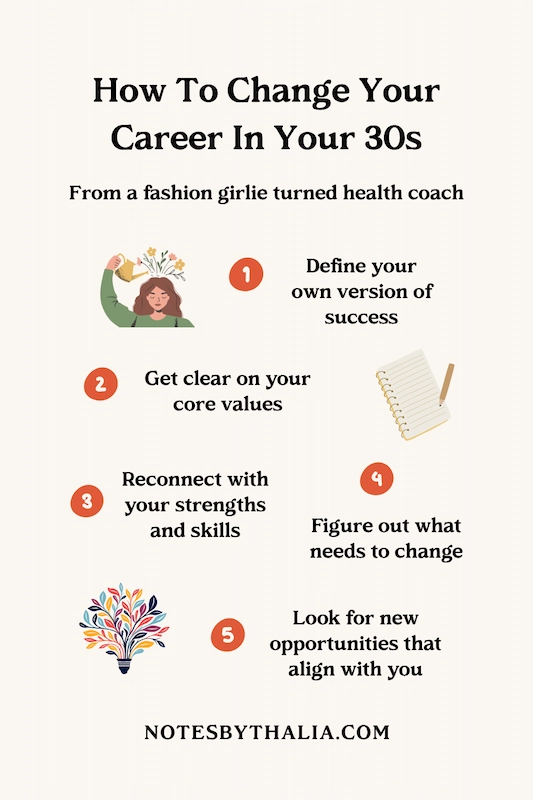
1 | Define your own version of success
From a very young age, we’re taught that money and appearance dictate how valuable we are.
We make money so we can spend it on expensive clothes, designer handbags, and other material possessions just so we can impress others. We chase societal norms so we can look like we’ve got our shit together, but no matter how much we do accomplish, it never feels good enough.
This is what keeps us stuck in corporate careers that no longer make sense for us.
So ask yourself, “What does success really look like for me?”
Because it might not be a 100k salary a year and a 2-bedroom high-rise apartment in the city. If it is, then great — you do you. But if it’s not, then that’s okay too.
Success is no longer one-size-fits-all. It is unique to you.
For me, success is more of a feeling — it’s happiness, it’s joy, it’s having the freedom to think for myself and go about my day without anyone telling me what I can and cannot do.
Yes, it’s scary AF to admit what you really want in life, but without that self-awareness, it’s so easy to get stuck in a career that’s built entirely around other people’s expectations.
And then after 5 or 10 years, when you hit 40-ish, you’ll probably have the same realisation that climbing the corporate ladder is still not what you want anymore.
Action steps:
- Reflect: When was the last time you felt successful? What contributed to those feelings?
- Find the pattern: List other moments that made you feel truly accomplished
- Pinpoint what lights you up: Identify what motivates you and gets you excited to wake up
- Get to know your energy givers: Map out what brings you joy, meaning, and fulfilment
- Visualise it: Picture your ideal future self — how are they successful?
2 | Get clear on what you stand for
This isn’t about landing any old job that sounds impressive or comes with a shiny salary and perks you don’t even care about.
It’s about finding a career that feels good, one that aligns with what you deeply care about. Because if the work you’re doing doesn’t reflect your values, it will always feel like a grind. And well…. hello, burnout.
Yes, I know, I bring everything back to values but they are so damn important because they are your foundation.
Core values are the things that matter most to you. They guide your decisions, shape your priorities, and help you figure out what kind of life and career you truly want.
For example, if you’re driven by creativity, doing repetitive admin work all day is going to suck the life out of you. You need space to experiment, make things, and think outside the box.
Or if you’re driven by leadership, you need a job that lets you get visible, speak up, and run with your ideas.
When your work vibes with your values, you become magnetic. You stop forcing yourself into a role that doesn’t fit and start attracting opportunities that feel effortless.
If you haven’t done this exercise with me yet, I 100% suggest doing it now and following along with this step-by-step breakdown.
Action steps:
- Reflect: Think about all the times when you felt truly alive, happy and energised
- Identify the values that were present: Was it creativity, connection, freedom, helping others, etc?
- Add to your list: Continue to write down 10-15 values that deeply resonate with you
- Narrow it down to just 5 core values: These will become your guiding principles for making decisions
- Bridge the gap: Use this workbook to help you apply your values IRL
3 | Reconnect with your strengths and skills
When you spend years doing the same tasks every day, it’s easy to lose sight of what you’re actually good at. I’m talking about our strengths, skills, and the stuff that makes you, you.
You get so comfortable with what you know that even thinking about doing something different feels overwhelming. So you stay in roles that don’t challenge you anymore, because at least they’re familiar.
Hence why you currently feel stuck.
This is where the concept of Ikigai comes in. It’s about finding the sweet spot between four things:
- What you love: your passion and mission
- What you’re good at: your skills and expertise
- What the world needs: your purpose and impact
- What you can be paid for: your profession and vocation
When all four of these things overlap, work stops feeling like a grind and starts feeling like something you actually want to get out of bed for.
This was the exact method I used when I came home after 1.5 years of travelling and still felt lost. And it eventually led me here, writing weekly blog posts to over a million girlies all over the world.
Action Steps:
- Brain dump: List out everything you’re passionate about and that brings you joy
- Give yourself credit: Identify your natural strengths and skills
- Find your sweet spot: Find the overlap between what you love, what you’re good at, and what the world needs
- Explore your options: Look into roles or projects that align with that sweet spot
- Take small steps: Start making small shifts toward work that fulfils you rather than drains you
4 | Bridge the current gaps
Now it’s time to compare all of this with your current career.
Go back through what you wrote in the steps above and audit whether any of this is showing up in your job right now.
For most people, the answer is a hard no. But that gap between where you are now and where you want to be, is exactly what you need to get clear on before you start looking for something new.
So grab a notebook and a pen (obvs), and journal on the prompts below.
You don’t need to have the perfect answers. You just need to start noticing the gap, because that’s what’s going to guide what you look for next.
Journal prompts:
- Where does your current career not match your version of success?
- Which of your values are getting completely ignored in your career right now, and why?
- If your career was fully aligned with your values, how would it look different?
- How does your career support your strengths and skills? Where are they not being used fully?
- What is your Ikigai telling you?
5 | Look for new opportunities that align with you
If you’ve followed this framework step-by-step, you’ll now know:
- What success looks like for you
- Your values
- What drives you out of bed in the morning
- How to bridge the gaps
But we’re not just going to stop here. You’re now going to look for opportunities that align with this version of you.
Start broad. Look at industries, roles, or even job titles that sound interesting, even if you’ve got zero experience in them. You’re not committing to anything yet, you’re just snooping around to see what’s out there. I also suggest following people on LinkedIn with active profiles who are doing the kind of work you’re curious about. If they post regularly, you can get a better idea on what their day-to-day looks like.
And talk to people. Not ChatGPT but actual girlies who are already doing the job you think you might want. Ask them about the unglamorous stuff like what’s annoying about their career, or what they wish they’d known before they started.
And don’t rule out your current industry either. It might be worth looking at your current role and reshaping it instead of ditching it altogether.
Action steps:
- Get curious: Explore roles and industries that align with your values and strengths
- Follow the breadcrumbs: Find people on LinkedIn doing work that interests you and see what their career looks like
- Talk to real people: Reach out for a quick chat with someone in a role you’re curious about
- Reframe your industry: Look at different roles within your current field
- Make a shortlist: Narrow it down to two or three directions worth exploring further
The TL;DR version
I like to call this the TL;DR version because let’s be honest, you probably skipped straight to this bit. So here are the key takeaways from this post:
Signs it’s time to change career:
- You’ve outgrown your role and there’s nowhere left to grow
- You’re bored, coasting, and barely present at work
- You’ve been promised more money and responsibility but it never came
- You can’t picture yourself doing this in a year
- Your work doesn’t reflect who you are anymore
What to do next:
- Define your own version of success
- Get clear on what you stand for (aka your core values)
- Reconnect with your strengths and skills
- Bridge the gap between your current career and what you want
- Look for new opportunities that align with this version of you
Things to avoid:
- Comparing your career to everyone else’s
- Chasing a job because it sounds impressive or popular (aka content creator)
- Naked quitting or jumping ship before you’ve figured out what’s next
- Pretending things will get better
- Settling for “good enough” because change feels scarier than staying stuck
Final thoughts
For so long, ambition meant one thing: climb the ladder, become the girl boss, and build an empire before you turn 40. That was the dream we were sold.
Now, we’re quietly walking away because we don’t want to be a slave to hustle culture anymore. Been there, done that, got the t-shirt. But in doing so, we feel more lost than ever.
We’re scared to try something new in case we lose ourselves to work again the way we did before. And that fear makes sense. Our entire identity has been built on output, on being useful and productive, and it’s terrifying to walk away from the only version of success we’ve ever known.
But ambition doesn’t have to mean go big or go home.
It can simply mean building a career that’s aligned with who you are.
Real ambition isn’t about achieving the next big shiny thing at all. It’s getting honest about what success actually looks like to you, stripped of everyone else’s expectations, and unapologetically going after exactly that.
Because chasing something you don’t truly want is the fastest way to burn out.
And we’re not doing that anymore.
You’ve got this.
Thalia xx