I’ll be the first to admit it, the whole journaling thing has been done to death.
Open Instagram on any given day, and I guarantee, without fail, you’ll see someone scribbling in a tan leather notebook with her matcha latte perfectly in frame, captioning it “morning pages” like she’s about to crack the meaning of life.
It’s giving aesthetic. It’s not giving useful.
But before you write journaling off completely, hear me out because this shit works.
Research on expressive writing has linked regular journaling to less stress, better sleep, quicker decision-making and a quieter brain at 2 am.
Which makes me, a very anti-woo-woo girlie, very happy.
So the question isn’t really should you journal (which is a solid yes!!). It’s how you actually start journaling in a way that helps you, rather than just looking good on the ‘gram.
Here’s how to do it properly.
P.S. If you’re new here, hey! I’m Thalia. I help burnt-out girlies like you build a life that’s aligned, magnetic, and unapologetically yours. Every week(ish), I share content on burnout recovery, self-development, finding joy, and career growth. Subscribe here so you never miss a debrief.
The real perks of journaling
I’ve been journaling for 5+ years now.
Which I guess is long enough to know what works, what doesn’t, and which trends are absolute nonsense.
It’s hands down one of the most useful things I’ve ever added to my wellness routine.
More than any meditation app (sorry, Activations™) or more than any self-help book or productivity planner. Basically, more than anything else I’ve tried during my anti-burnout era.
From the outside, I get why journaling gets a bad rep. It can be hard to take seriously when most of what you see online is diary entries and surface-level gratitude lists.
But that’s not what it actually is.
At its core, journaling is getting what’s in your head out of your head and onto a page. And there’s a bunch of research backing up how powerful that simple act can be.
But honestly, the real proof for me is in how different my life looks after five years of doing it consistently.
And that’s why I keep going back to it, day after day, because journaling allows me to:
- Check in with myself honestly
- Get clarity when my head’s a mess
- Overthink way less
- Spot patterns before they turn into problems
- Catch my own BS in real time
- React less when I’m triggered
- Trust myself more
- Actually know what I want

How to start journaling
In theory, journaling is one of the easiest things you can do for self-development.
I mean, all you need is a notebook, a pen, and 5-10 minutes of your time.
But in reality, most people quit after four days because they have no idea what they’re supposed to be writing about, and it starts to feel tedious. Like, how many different ways can you say you’re grateful for your family and health?
Done properly, journaling takes a bit more intention than just practising gratitude, writing about your feelings, or venting on a page.
But once you’ve got the basics down, it becomes second nature, and you’ll start to notice a difference pretty quickly.
P.S. I encourage you to save this post (like now!!) so you can come back to it whenever you need to.
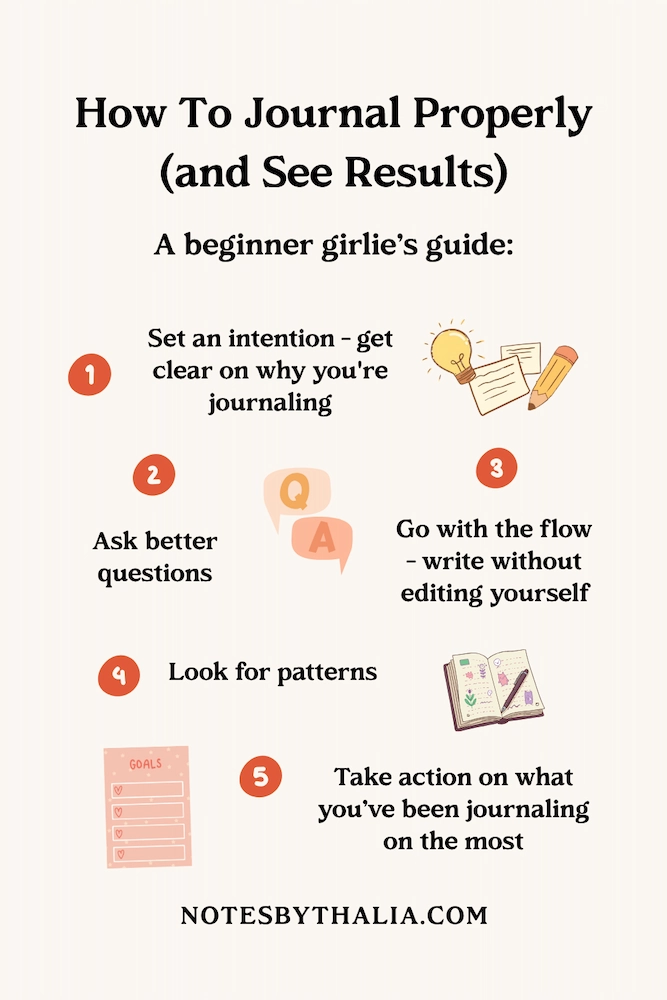
1 | Get clear on why you’re journaling
Before you even open your notebook, you need to get clear on what you actually want from this practice.
Because journaling without an intention is just writing for the sake of it, and that gets boring real quick.
For some girlies, it’s about processing a specific situation that’s been replaying in their head. For other girlies, it’s getting unstuck on a decision they’ve been flip-flopping on for months.
And sometimes it’s about reconnecting with yourself after years of being on autopilot, doing everything for everyone else and forgetting what you even want anymore.
When I started journaling consistently, my why was clarity.
I was burnt out, felt totally lost, and was trying to figure out what TF I wanted to do with my life.
Naming that intention upfront made my entries feel useful, instead of like I was venting into the void.
Once you know your why, the writing has somewhere to go. You stop defaulting to surface-level dumps about how busy your week was, and start using the page for something meaningful.
Action Steps:
- Reflect: What do you want journaling to actually help you with right now?
- Get specific: Saying you want to feel better isn’t enough — keep narrowing down why
- Pick one thing to focus on: Don’t try to fix everything in one go. Choose the one thing that’s been on your mind the most lately and start there
- Write down your why on page one: That way, you’ll see it every time you journal and won’t lose sight of what you’re working on
- Revisit it monthly: Your why will shift as you grow, and that’s a good thing
2 | Ask better questions
Generic journal prompts will always give you generic answers.
If you’ve been journaling about how your week was or what you’re grateful for and feel like it’s not really doing anything for you, this is probably why. None of those questions are actually pushing you to look at something new.
The three questions I come back to over and over are:
- What’s working in my life right now?
- What’s draining me that I keep ignoring?
- What would I do if no one’s opinion mattered?
These hit harder than your standard gratitude list because they force you to be honest with yourself, not grateful for the sake of it.
And the answers might surprise you.
When I first asked myself what I’d do if no one’s opinion mattered, I realised about half the decisions I’d made in my twenties had nothing to do with what I wanted. They were based on what my parents, friends, and colleagues would think.
Naming that was uncomfortable AF, but it was also the start of me building a life on my terms.
Action Steps:
- Start with one question: Don’t try to answer all three in one go. Choose the one that feels most relevant right now
- Write the first thing that comes up: Don’t pause to filter or edit yourself
- Be specific: Names, situations, exact moments, etc — vague answers won’t change anything
- Notice the resistance: If a question makes you uncomfortable, dig deeper. That’s usually where the good stuff is
- Come back to it: One sitting isn’t always enough, so keep returning to the same question over the space of a week
3 | Be radically honest with yourself
The whole point of journaling is that no one is reading it apart from you.
It doesn’t need to sound clever or even make sense, for that matter. Let it be messy. Let it be contradictory. Let it be radically honest. Let it be the version of you that you’d never want anyone else to meet.
That’s where the real insight lives.
The tidy, articulate entries won’t tell you much, but the raw, unfiltered, slightly embarrassing ones are where you’ll actually learn something about yourself.
Action Steps:
- Don’t overthink it: Get it down before your inner critic has a chance to step in
- Let it be messy: Bad grammar, dramatic AF complaints, half-sentences — none of it matters
- Skip the caveats: You’re not being oversensitive, if you feel it, it’s worth writing down
- Use loose paper if it helps: Journal on something you can throw away if that helps you be honest
- Reread an entry a week later: You’ll often spot something useful in the mess
4 | Look for patterns
One journal entry on its own won’t tell you much.
But when you journal consistently for a few weeks, the patterns start showing up.
Like maybe you always feel better after the days you’ve been outside. Or the same fear keeps popping up over and over.
For me, the biggest perk of journaling has been spotting the patterns I’d been ignoring for months, sometimes even years.
Like the things I kept saying yes to, even though they drained me, the friendships that only ever felt one-sided, and the version of success I’d been chasing that wasn’t even mine to begin with.
Looking for patterns is the work that actually changes things.
Action Steps:
- Read back over past entries: Once a week or so, sit down with a cup of tea and reread
- Highlight what repeats: Names, feelings, situations, specific words, etc — anything that keeps showing up
- Track your energy: Notice which situations leave you feeling lighter and which ones drain you
- Look for what you’re avoiding: The most important thing is often the one you keep dancing around
- Write a monthly summary: Pull together everything you’ve noticed and see what story it’s telling
5 | Take action
Journaling on its own won’t change anything.
Sure, it’ll help you see what’s going on, but if you don’t act on what comes up, you’ll just end up writing about the same problem over and over and feeling stuck in the same place a year from now.
So once you’ve got the insights, you need to actually do something with them.
This doesn’t have to be huge.
Just pick one thing from your journal entries each week and take action on it. Maybe it’s having the awkward conversation about burnout with your boss you’ve been avoiding. Or blocking out an evening for yourself instead of saying yes to plans you don’t want to go to.
Small actions, repeated consistently, are what change your life. Journaling is just the tool that shows you which actions to take.
Action Steps:
- Pick one insight per week: Find the thing that keeps coming up
- Turn it into something doable: Take action
- Do it within 48 hours: Otherwise, it’ll get lost in the noise of everyday life
- Journal about how it went: This closes the loop and makes the practice feel useful
- Rinse and repeat: One small action a week, compounded over a year, is wild
How to know if it’s working
Journaling isn’t a magic fix. You’re not going to one day do your “morning pages” and suddenly have your whole life figured out.
It takes time. And the shifts can be so subtle that you might not even notice them at first.
There probably won’t be a big breakthrough moment where everything just clicks.
It’s more of a slow burn, a quiet yearning where life just starts feeling a tad lighter, your head a bit quieter, and your decisions a lot less stressful to make.
Some signs the journaling is working:
- You feel a bit lighter after writing
- You can sit with uncomfortable feelings instead of distracting yourself
- You start spotting patterns you didn’t see before
- You’re not lying awake at night overthinking everything you said that day
- You stop second-guessing every little decision you make
- You start making changes IRL based on what comes up on the page
If in a few weeks, none of this is happening, it’s worth getting honest with yourself. Are you actually journaling, or are you writing surface-level stuff and calling it done?
Because the work only goes as deep as you’re willing to take it.
Final thoughts
If there’s one thing I’ve learnt from journaling over the past 5 years, it’s that the real value isn’t in the journaling itself.
It’s in the relationship you build with yourself by doing it.
You start to actually get to know yourself — what you want, what you don’t, what triggers you, what fills you up, etc. And once you know yourself that well, you stop looking to other people to tell you how to live.
You stop asking the group chat if you should leave your job.
You stop comparing your timeline to the girl from uni who’s already on baby number two.
You stop second-guessing every move because the answer is usually already there, you just haven’t given yourself the space to hear it.
That’s the bit no one tells you about journaling. It’s not really about the writing. It’s about the version of you that slowly comes back to herself, one page at a time.
So grab a notebook, use the framework above (especially those three prompts), and give yourself just five minutes tomorrow to brain dump and see what comes out.
You’ve got this.
Thalia xx